Mastering Love Rescue Closes Down After Four Years
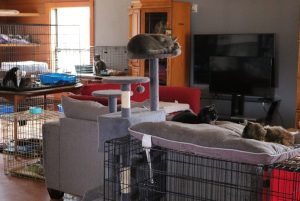
Photo by Lydia Berglar – After four years of saving cats and kittens, Mastering Love Rescue is closing down.
By LYDIA BERGLAR
News Editor
Near the beginning of this year, the Sentinel shared an update on Mastering Love Rescue (MLR) (see the Jan. 29 issue). Four months later, we are sad to report that the rescue is shutting down. Debbie Mansberger poured her time, energy, heart, and finances into the rescue, but it is no longer feasible to continue MLR.
As Mansberger explained in the January article, she and her husband turned their cabin on Sand Mountain into a sanctuary for cats and kittens. The goal was that MLR, as a nonprofit, would cover the cabin’s rent, but instead, the money ended up coming out of the Mansbergers’ pockets.
The Mansbergers persevered through the financial strain, but the bank foreclosed on the home this spring. Mansberger explained, “We’re losing our home, the rescue, and our entire retirement.”
During this emotionally challenging time, Mansberger is working tirelessly to find homes for the remaining animals at MLR. At the time of foreclosure, she had over 90 cats and kittens, so she’s been working with partners to find homes for all of them.
MLR never euthanized animals, almost never turned down a cat, didn’t charge adoption fees, kept cats for as long as they needed a home, and occasionally took in other animals. Mansberger recognizes that some people will say it was unwise to sacrifice so much to save these cats, but she is thankful that she was able to rescue so many cats and find many a forever home through adoption.
Mansberger is also thankful for the people who supported MLR for the last four years. MLR found homes for over 100 animals in that time, but we will never be able to count how many unwanted litters were prevented thanks to Mansberger’s work to take cats off the streets and spay and neuter them.
Mansberger shared the sad news about the end of the rescue on MLR’s Facebook page on May 27. Later that week, she shared the story of one cat in particular. In her words, Coal is the most affectionate and friendly cat that ever lived. Mansberger bottle fed Coal and his sister, Teenie, and kept them for two years. Many people wanted to adopt Coal, but the siblings were a packaged deal.
Mansberger wrote, “I wouldn’t separate them. And I’ve always said, if you make it to us, Time is on your side. There would never be euthanasia to make space. Never!”
The pair lived at the rescue until, in the final days of MLR, a family adopted both cats. Mansberger wrote, “It’s made me so very relieved and happy. I loved them both very much. Saying goodbye was bittersweet. This is what Mastering Love is. This is why I’ve done what I’ve done for the last four years. Two kittens tossed away in a box, left to die, two years later, have a real Home. That’s why I do this. And today, my Heart is full.”
Mansberger, like so many other animal welfare advocates, cites the importance of spaying and neutering animals if you don’t plan to take care of unwanted litters.
This is a story, first and foremost, about how big an animal lover’s heart can be and the impact grassroots, citizen-driven efforts can make, but it also ties to other topics: the ongoing discussion about our local animal control ordinances, the Trenton-Dade Animal Center (TDAC) project, volunteer/nonprofit work vs. government work, and the inability to do it all (i.e. save every animal).
There’s also one issue that is worth considering when thinking about government overreach. The State of Georgia requires animal rescuers to apply and pay for a shelter license through the Georgia Department of Agriculture. MLR did not have this license.
Given Mansberger’s story of how she almost accidentally became a rescuer, (see the Dec. 15, 2021, Sentinel), it makes sense that a state license wasn’t in the picture. She didn’t create a business plan and research state laws about how to start a shelter; she simply saw a need in the community and started meeting that need, slowly but surely, until MLR grew into what it was.
Per Rule 40-13-13-.02 in the Rules and Regulations of the State of Georgia, MLR would have had to pay $400 to the state each year to have an animal shelter license simply for the sake of having the license. This is an additional $400 that would have had to come out of the Mansbergers’ pockets or have been donated by supporters.
It’s worth asking, what benefit would MLR or any other rescue gain by having this license? Would the state help rescuers in their work? What does the state do with that revenue from license fees?
When reading through the Rules and Regulations, the reasoning behind this license requirement appears to be concern for animal welfare, but the cats at MLR were better off under Mansberger’s care than getting hit by cars, abandoned by people, or getting sick.
The Sentinel asked Monda Wooten (TDAC committee member, Dade County Pet Project founder) about this state requirement. She said, “That’s one of those things that’s not pushed around here because there’s nowhere else for [the animals] to go.” She reported that the Georgia Department of Agriculture has told her that this law is not typically enforced unless neglect or abuse is involved.
When Mansberger announced that MLR was closing, many voiced support and were saddened by the news. MLR’s legacy remains, however, in the form of the rescued cats, the families who found their pet through the rescue, and the countless unwanted litters that were prevented.