The Roads That Led Her Home: One Dade County Woman’s Reflections on Her Past
By John P. Boan
News Editor
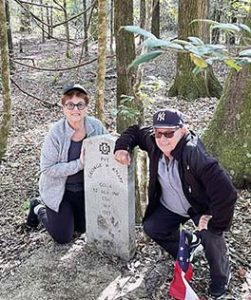
Photo courtesy of Pat Johnston – Pat Johnston with her cousin at her great-great-grandfather’s grave in Alabama. Johnston recently wrote a book chronicling four generations of her family’s history.
Lifetimes before Pat Johnston chose a home at the base of Lookout Mountain, others were making decisions that would lead her there.
They crossed oceans. They farmed. They fell in love and started families. One left the family farm in Washington County for Mobile, where he began with the railroad. Another went to war halfway around the world, witnessed the horror of what men were capable of doing to one another, and returned to Mobile Ala., where he became a minister.
None of them knew Johnston, nor could they rightly imagine her or the world she inhabits.
Yet at age 77, after 12 years spent researching her family’s genealogical history, Johnston said she only now fully appreciates how much of her own story was written by those who lived and died before she was even born.
That realization became a book, “Four Fathers: From Roots to Reckoning,” which Johnston self-published earlier this year and is available on Amazon.
Before it was a book, though, it existed as most genealogical research does: as a mound of documents, a list of names, handwritten census records, snippets of deeds, a laundry list of facts without the throughline of narrative.
As she began to build in her head the story she wanted to tell, Johnston saw that she had to decide first what to leave out. A family’s history branches in a million different directions, and she couldn’t tell every story.
So, she began with George Washington Knapp, her great-great grandfather.
His story would take her from England across the Atlantic Ocean to America, into the pine country of Washington County, Ala.
The Knapps were not wealthy plantation owners. Johnston describes them as poor farmers, people who worked the dirt. George Washington Knapp and his son, David Franklin Knapp, served together in an Alabama Confederate infantry unit during the Civil War. One was in his 50s, the other 19. Both survived, and both returned to Washington County.
And the family continued. History, Johnston discovered, did not simply happen around her family, so much as it kept reaching into it.
Her grandfather, Frank Knapp, wanted something other than farming. The railroad came through, and with it came a possibility that had not existed before. He moved his young family to Mobile and became an accountant and wrote poetry. He lived there until he died.
Johnston never really knew him. She remembers seeing him only once, and her father didn’t talk about him often.
Yet Frank became the ancestor with whom she felt the closest.
He was gentler than the fighting men who preceded him. He loved words. He respected the world from which he came without believing he had to remain inside it.
Johnston recognized something of herself in that.
She has lived for years at the foot of Lookout Mountain. She chose the place without knowing that during the Civil War her own great-great-grandparents had traveled across that same landscape, moving from Chickamauga and Chattanooga toward Atlanta.
Only after the research did she learn that the mountain she had been looking at was part of their story too.
But not all her discoveries were pleasant.
Johnston learned that an ancestor farther back in the family had owned slaves, only sold after his death to settle outstanding debts.
She does not believe learning where a person came from requires defending everything found there. Her own worldview differs in important ways from those of some of the people whose lives made hers possible.
The task, as she sees it, is more complicated. Instead of making peace with the past, she said her efforts are aimed at understanding the people who came before her in the context of their times while deciding for herself what deserves to continue.
Some things she recognizes immediately.
Resilience.
Hardheadedness.
Determination.
Loyalty.
Other things can be left behind. And perhaps that is the distinction between ancestry and inheritance. Ancestry is fixed, but inheritance, on the other hand, is something each generation must reckon with individually.
Over the years, her research eventually became more than names connected by lines on a family tree. Johnston and a cousin traveled to the places where those names became people. They found graves. They visited Washington County. They sat on porches and listened to stories. She went into archives and read old records, including the military file of an ancestor once labeled a deserter who later, when denied his pension, fought the designation and won.
Through this process, she said, the dead, gradually, become less abstract.
Every generation arrives in a world already under construction, she said.
There are roads beneath our tires that somebody decided to build. Towns that were once forests where somebody once decided to stop and create their future. Talents that seem to vanish for generations and then unexpectedly reappear.
George Washington Knapp could not have known that generations later a descendant would sit at the foot of Lookout Mountain and try to understand him and the world he navigated so long ago. Frank could not have known that the poems he typed would one day be published in a book written by his granddaughter. And Johnston did not know, when she chose to make Dade County home, that she was returning to ground her family had walked across 160 years ago.
She learned that, over the course of the last 12 years, by looking backward, she discovered that the distance between the living and the dead is not always as great as it appears.”