NASA HUNCH And Greenpower Racing Reach Milestones In Dade County Schools
By LYDIA BERGLAR
News Editor
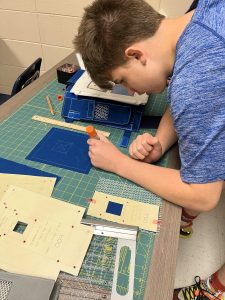
Photo courtesy of Dade County Schools – Thomas Wade works on a NASA HUNCH project for the Soft Goods pathway at Dade Middle School.
Since NASA HUNCH’s early days in Dade County Schools in 2018, the program has reached many milestones, and this is the first school year that HUNCH programs are offered at every grade level, starting in kindergarten. Also, Greenpower USA supplements HUNCH, offering students another STEM (science, technology, engineering, and mathematics) project.
Shenea Hill (director of career and technology innovation) was instrumental in getting NASA HUNCH started in Dade. She came from Huntsville City Schools to Dade Middle School (DMS) as the engineering teacher. NASA HUNCH and Greenpower USA are a major part of the Huntsville schools, and while there, Hill made connections that would later benefit Dade.
Although she had only taught at the high school and college levels before coming to DMS, Hill was blown away by the skill of Dade’s students. With Huntsville being a city, Hill explained, “the majority of my kids didn’t know the difference between a flathead and a Phillips screwdriver. I had a $10 million dollar lab where we did carbon fiber layup, but I couldn’t advance them to that because I was having to start at such a low level.”
Dade was a stark contrast. “When I got here and had sixth and seventh graders telling me about tearing a carburetor apart at their grandpa’s garage, I was so impressed with the knowledge they had.”
This is why she felt confident that NASA HUNCH would thrive at Dade. At that time, it was a high school program, but Hill wanted to bring it to DMS, so she reached out to her HUNCH contacts who told her to go for it.
To start the program, Dade first needed to get a specific Stratasys 3D printer. The superintendent at the time (Dr. Jan Harris) worked to get this printer, and Hill spoke with her contacts at Stratasys. “They laughed at me at first. I have a really good relationship with them, and I said, ‘I’m fixin to put this in a middle school and have sixth, seventh, and eighth graders use it.’”
The DMS students didn’t let Hill down, and now, Dade can proudly look back on multiple HUNCH milestones. For example, in 2022, Dade County Schools became the first NASA HUNCH Center of Excellence.
Also, Dade Elementary School (DES) created NASA HUNCH Academy, bringing the curriculum down to the elementary level. It started with fourth and fifth grade and expanded all the way down to kindergarten this school year. If you look at the NASA HUNCH Academy logo, you’ll recognize the familiar outline of Georgia in honor of Dade’s role in developing the program.
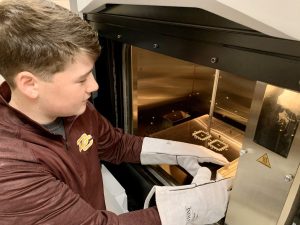
Photo courtesy of Dade County Schools – Trip Hill removes a completed piece from the 3D printer. Every NASA HUNCH 3D printed piece that is sent into space is printed at Dade Middle School.
One reason Hill was eager for the program to be offered to lower grades was to reach girls. She explained that once girls enter middle school, they’re less inclined to pursue STEM activities. Hill found that before the middle school pressure of being “cool” takes over, girls are more likely to jump into STEM.
Before reaching the elementary level, NASA HUNCH first was implemented at Dade County High School (DCHS). Hill explained that they couldn’t offer students this great opportunity in middle school only to leave them hanging once they moved to the high school. Also, some of the HUNCH pathways correlate to the CTAE (Career, Technical, and Agricultural Education) pathways, making HUNCH a natural addition to DCHS.
Hill said, “The goal is for the kids to see the projects they work on go into space by the time they’re seniors. It takes five or six years for a project to go through testing. I thought how cool is would be to have fourth and fifth graders start thinking about a project, then we can develop it throughout middle school, and they could really master it in high school.’”
Like NASA, Hill would love to see more students going into STEM careers. She found that of the HUNCH students she had in sixth grade in 2018 who graduated from DCHS in 2024, ten plan to go into engineering. She said, “I asked them if NASA HUNCH had an impact on their plans. They said it did because they didn’t know they could do engineering until they participated in those projects.”
Ninth grader Trip Hill said, “I have been a part of NASA HUNCH since the sixth grade. It is the reason why I’ve decided to become an engineer. I also like Greenpower because I like to work on cars.”
Hill is particularly proud of the DMS students in the HUNCH Soft Goods pathway. She wanted to offer a pathway to students in the GNETS (Georgia Network for Educational and Therapeutic Support) classes. “I wanted to give them something that made them feel accomplished and gave them some ownership. We didn’t know how it would work, but it’s done great. They love it.”
Thomas Wade, a sixth grade Soft Goods student, said, “The NASA HUNCH program makes me feel like I have the opportunity to help the NASA people with my space sewing project.”
Carson Whitt added, “The NASA HUNCH program is cool and means a lot to me and it makes me feel cool that we get to sew with the industrial sewing machines. I never thought I would get to do this!”
Corey Crow said, “The NASA HUNCH program makes me feel happy because I know how to sew. It makes me feel like I am helping astronauts in space.”
There are many other examples of HUNCH’s success in Dade, such as DCHS piloting the Biomedical Science pathway in 2021 that is now nationwide. A Software and AI pathway and Cybersecurity pathway are also being incorporated at DCHS this year.
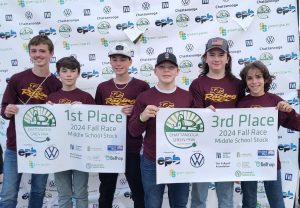
Photo courtesy of Dade County Schools – Two Dade Middle School Greenpower USA teams placed during this November’s competition. Pictured here from left: Tyrone Blevins, Mason Smith, Warren Allen, Mason Deakins, Damian Kirby, and Anthony Nunez.
After HUNCH took off in Dade, Hill turned next to Greenpower USA. Building a Greenpower race car provides students with a hands-on project that they can test, adjust, and put into action by racing the car. The program came to Dade in 2020.
Hill said, “For me, I need to do to be able to understand, and I have a lot of kids that are the same way. The Greenpower car gives them that. It’s just a great added project for the kids to think about aerodynamics. Without the car, they don’t have a real-world problem to work on; we just give them scenarios in NASA HUNCH. With Greenpower, they can put their theory to test on their own and modify the car.”
Greenpower again showed Hill the difference between Dade and Huntsville students. “In Huntsville, riding around on four wheelers isn’t as common as it is here. I really struggled with trying to get them to stay on the track, but here, these kids are five and six years old driving a tractor, and they ride four wheelers. We get to build on that common knowledge they already have.”
The cars can go up to 35 miles per hour, depending on the track and gear ratio. Hill explained, “All tracks have different elevations, so the students have to take that into account when they’re doing the gear ratio for the cars.”
Mike Beeler leads Greenpower at DCHS, and Bill Shelton leads it at DMS. In November, the DMS Greenpower team placed first and third while the DCHS team placed second at their respective competitions. Hill said, “They’d been working on nose cones, decals, steering wheels, and making small modifications to lighten up the car.”
Two eighth grade engineering students shared why they enjoy Greenpower. Anthony Nunez said, “I like the team building and engineering practice we get from the Greenpower class. I also enjoy the challenges we face on the track and in the pit.”
Damian Kirby added, “In Greenpower, you get to take chances, and there’s so many opportunities to challenge yourself and your team.”
Once they learn about 3D printing (also known as additive manufacturing) from Hill, students are able to work on the cars because 3D printed parts are used in Greenpower. Hill explained that teaching students how to use the printer is primarily about teaching them how to design in SolidWorks (a computer-aided design program). While some students excel in engineering, others are better at the technology side. Together, students design, create in SolidWorks, and export designs to the printer.
DMS also has an exciting responsibility: The school is the designated 3D print center for NASA HUNCH. Hill said, “If it goes from NASA HUNCH into space, it goes through us first. We work with all schools across the United States and Puerto Rico. The final designs come to us and we 3D print them.”
These opportunities help students prepare for careers in STEM, and they get to play a part in NASA’s big picture work. Eighth grade engineering student Aaron Hayes said, “NASA HUNCH has given us a cool opportunity to design lunar legs for a rocket that could go to the moon if we work hard enough. It’s exciting to think that if our project is chosen, this could be something remembered for years to come.”
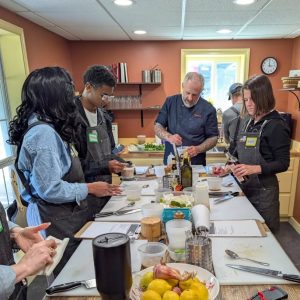
Twelfth grader Heidi Maldonado reflected on the Culinary pathway. “Knowing that our work as a team could be tested by astronauts and influence how they eat in space is a unique achievement alone, but this challenge has also allowed me to take pride in my own work and my team’s abilities to contribute to something much larger than ourselves, pushing the boundaries of what is possible in food, space, and science.”