Forester Farms And Apiary Expands Rising Fawn Business, Classes, CSA
By LYDIA BERGLAR
News Editor
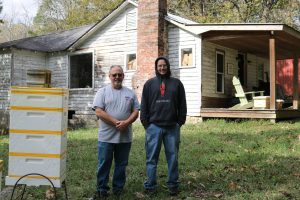
Photo by Lydia Berglar – Derick Forester (left) and Lee Hudson stand in front of the Honey House where Forester Farms and Apiary reopened store operations this August. Next to Forester is the new HiveIQ that helps bees better survive winters.
Forester Farms and Apiary has been booming over in Rossville for several years, but now the farm is expanding its offerings and bringing new life to the Rising Fawn location called the “Honey House.” (See the March 24, 2021, Sentinel for the story about the Rossville store opening and the history of the Honey House.)
Derick Forester is a third-generation beekeeper, but his family also farmed the Rising Fawn land for many years. When Lee Hudson joined the team, the business was able to think big. They are now offering more classes, starting a CSA (community supported agriculture) program, and have reopened the Rising Fawn store. The overall focus of the business is homegrown, homemade, natural food and products.
The store reopened this August, although Forester’s original plan when opening the Rossville location was to keep both stores running. However, due to his limited time, Rising Fawn remained the apiary while customers had to go to Rossville to buy beekeeping supplies.
When Hudson bought a home in Rising Fawn, he and Forester became friends. Forester recalled, “I was telling him how this is where I started the store and had wanted to keep it open. He said, ‘I’d like to reopen it.’ I told him I want to do some of the things I’ve not been able to do, like offer more classes, and he said he could do that too.”
With Hudson on board, the pair got the Rising Fawn store ready for customers, Hudson coordinated improvements to the website (www.foresterfarmsandapiary.com), and they added classes.
The store sells bees, beekeeping supplies, honey, and soap, but it will also sell canned jellies and jams, teas, and spices. The business is working on getting licensed to make and sell baked goods. Hudson said, “We’re focusing on sourdough and all-natural goods.”
When Forester first looked into opening the Rossville location, customers from the Chattanooga area were having to drive down to Rising Fawn, but for the last three years, customers from Lookout Mountain and Alabama have been driving all the way to Rossville. Hudson and Forester hope that the reopened location will be more convenient for these customers.
Forester founded the Tri-State Beekeepers Association and currently serves as vice president. Through this club, he teaches beekeeping classes. He sees a demand for learning opportunities, which is why he had the goal of adding classes. Coming on board as the teacher, Hudson made these classes a reality.
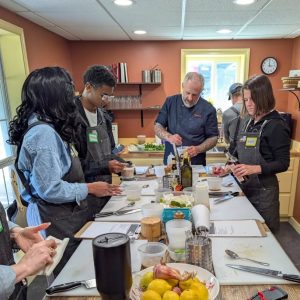
The classes go beyond beekeeping and honey to other homemade goods and practices. The October Rising Fawn classes are: Make Your Own Lotion, Crochet Round Loom Hat Making, Quilt Making, Assembling and Repair Beekeeping Hives and Equipment, Cooking with Honey, and Butter Churning.
Hudson said, “We’re trying to incorporate a lot of survival type classes. More people are growing their own food and raising their own animals, so we’re trying to show people how to do that.” For example, the farm raises chickens and will be leading a chicken cleaning class in November. Hudson, a holistic health practitioner, will also be creating videos about diets that address particular health conditions.
Soon, the same classes will be offered at both locations, except for honey extraction: Because the hives are in Rising Fawn, the honey extraction classes will be at that location.
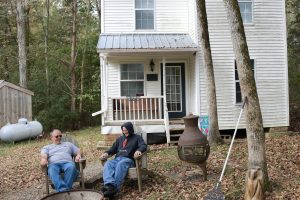
Photo by Lydia Berglar – Along with beekeeping, homesteading classes, and a CSA, Forester Farms added an Airbnb rental to the overall business. “The Bee Hive” is pictured here.
The business also offers honey extraction service for beekeepers who don’t want to invest in the equipment necessary, and Forester completes hive inspections (with a recorded video option for beekeepers who are away from the hive when he completes the inspection).
The CSA will begin this spring. (CSAs are ways for customers to enjoy farm fresh products while directly supporting local farmers.) Most CSAs end when winter begins, but with an in-ground greenhouse, Forester Farms will be able to offer fruits and vegetables year-round.
One other part of the Rising Fawn location is a small Airbnb rental, “The Bee Hive.” Forester said, “Everybody thinks it’s an old house which makes me feel good because that’s the feel I was hoping to accomplish. It was actually built in 2006.” Some guests come to see the bees and visit the farm, but others simply come because it’s a nice location away from the city.
The Sentinel asked Forester about concerns for bee health, and he recalled how much easier it was for hives to thrive in the 1960s and 70s. In these decades, when his father and uncle were teaching him about beekeeping, the Varroa Destructor (a parasitic mite) had not yet come to America from Asia. (It arrived in 1987.) The less-devastating hive beetles also didn’t come until the 1990s, and the use of pesticides has increased since Forester first learned the craft.
He said, “Beekeeping is not as easy as it was back then, but it’s manageable if people are trained in it. Some give up too easy. Some put bees in a box and hope they make it, but I don’t suggest doing that. That’s why I’m in it, to help people with their bees.”
He explained that there are many treatment options, and he opts for organic methods. “Some are chemical based which I don’t prefer, but sometimes you have to do things to bring the mites down to a level that’s manageable.”
Forester and Hudson teased a new organic treatment that they’re excited about, but they couldn’t say much about it yet.
They are, however, happy to talk about a new hive they’ve been selling: HiveIQ. Forester said, “It’s six times more insulated than wood. They’re supposed to keep bees healthier and survive the winters a lot better, and when it’s hot, these boxes keep them cooler.” The colder the weather, the more honey the bees need to eat to survive the winter, so these hives can increase honey harvests.
According to the United States Department of Agriculture (USDA), bees pollinate roughly 75 percent of our fruit, nut, and vegetable plants. As Forester said, “If they’re not here, we’re not here.”