
Citizens Weigh In On Million Dollar Elections Building Project
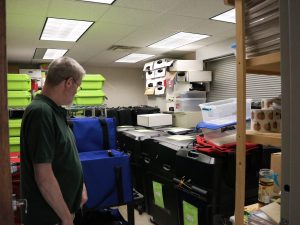
Photo by Lydia Berglar – This is how Dade’s voting machines are currently stored.
By LYDIA BERGLAR
News Editor
After the Aug. 7 Dade County Board of Commissioners meeting revealed that the planned elections building will cost around $3 million, citizens swiftly made their opinions known, and it became clear that the public desires evidence proving the need for such a building.
The Sentinel is waiting for responses from the county commissioners, county executive, and state, and we will keep you updated once further information becomes available.
As of this week’s press time: Don Townsend (county executive) had seen the Sentinel’s list of questions and planned to answer them soon. Melissa Bradford (Lookout Mountain commissioner) and Bob Woods (South Dade commissioner) acknowledged the Sentinel’s inquiry, but they had not yet answered the questions. The Sentinel has not heard anything from Phillip Hartline (Sand Mountain commissioner) or Bill Pullen (North Dade Commissioner).
The three reasons the county has historically cited needing the building are more office space, more storage space, and preventing elected employees who work in the county’s administrative building from coming in contact with voters when they are on the ballot.
One example of the third point was when Townsend ran for county executive. He was already the county clerk and CFO, so he reported to the office daily while people were voting. As a candidate, he was not allowed to speak with voters who were waiting to vote.
The same was true for Angie Galloway (tax commissioner) and Alex Case in recent elections. Case ran for city mayor, an elected position, but his full-time job as EMA director required him to be in the administrative building while voting was ongoing.
This is why the county has talked about moving the Trenton and early voting precinct away from the administrative building. However, it seems that a much simpler and cheaper solution would be for anyone on a given ballot to simply stay clear of the north-facing entrance to the building and the commission room except for the one time he or she goes in to cast a vote.
The Sentinel requested documents detailing the state’s requirements for elections offices/buildings and election machine storage from the Georgia Secretary of State’s office.
The Sentinel also submitted an open records request to the county for documents detailing the state requirements that indicate the need for an elections building and the building plans and total square footage.
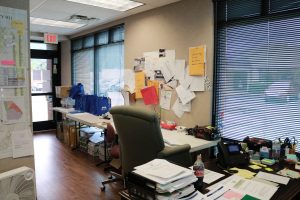
Photo by Lydia Berglar – When work like recounts must take place in this current elections office, it can get crowded.
Of the state requirements portion, the records custodian reported that the county employee from whom that information could be obtained was out of the office all of last week for training. The records custodian planned to get that information to the Sentinel as soon as possible this week.
The Sentinel’s cursory review of the Official Code of Georgia Title 21, Chapter 2 did not reveal specific requirements indicating that a new building need be constructed.
O.C.G.A 21-2-267 indicates that each county’s elections office is in charge of deciding how best to store the equipment: “The superintendent, unless otherwise provided by law, may make such arrangements as he or she deems proper for the storage of election equipment in the various precincts of the county or municipality at such times of the year that it will not be used for election purposes and may fix reasonable compensation therefor.”
O.C.G.A. 21-2-300 and 327-328 go in depth about the process elections offices must follow when using the equipment, but there is not a clear correlation to the proposed new building.
The Sentinel contacted State Rep. Mike Cameron and State Senator Colton Moore. While Cameron admitted that he was not familiar with the ins and outs of the issue and therefore did not have an opinion to offer, Moore addressed the state regulations: “Enlighten me about these regulations. Those county officials always blame the state. Elections happen at churches and community buildings all over Georgia. I’m tired of getting blamed for their wasteful spending.”
It seems that Moore was not familiar with the other proposed plans for the building connected to office space and storage space.
As for the building plans obtained through the open records request, parts of it are not related to voting and elections at all but rather basic necessities that come with every building such as a mechanical room, a utilities room, a janitor’s closet, men’s and women’s restrooms, corridors, and entryways. The other rooms are labeled lobby, voting, voting equipment, multi-purpose, storage, supplies, office, registration, ballot count/server, and work.
Due to the small, blurry print on the digitized plans, the Sentinel could not determine the exact square footage of the plans, but there appears to be at least 6,200 square feet on each level for a 12,400 square foot total. The response from the records custodian did not list the total square footage.
The county plans to use Special Purpose Local Option Sales Tax (SPLOST) to build the building. However, we know from recent history and common sense that each additional building the county owns drives up the annual operating budget.
Buildings require janitorial services and maintenance. For just one example, see the Sentinel’s county meeting article from Feb. 12 which covers HVAC costs in the courts facility. Also, see the June 18, 2024, county budget article for information about how new buildings require more staff which in turn drives up budget costs through ever-increasing salaries and insurance costs.
Additionally, government properties aren’t on the tax rolls, meaning each new lot not only drives up budgets but also takes away what would otherwise offer some property tax revenue.
Now for the citizen input from those who oppose the project in part, in whole, or at least have many questions about the high price tag.
Sandra Chitwood submitted a concise and articulate letter to the editor, so see page seven for her complete thoughts. She cited other projects that citizens would like to see their tax dollars going toward first (such as an animal facility) and other county properties that could have been used to address elections office needs.
A few other citizens who shared similar views include Monica Andrews, Taylor Shirley, Carla Hicks, Jennifer Wojcik, and Connie Daniel.
Felicia Christopher and Jeanette Cox understood that state requirements play a part in the issue, but they felt that other affordable avenues to address the needs have been overlooked.
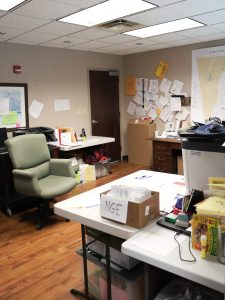
Photo by Lydia Berglar – This is the office of the only full-time elections employee.
Cox said, “If it is determined by statute that a certain size building is necessary due to storage of machinery etc., this $3 million price tag is still outrageous. No building of that magnitude can be justified. There must be external oversight if such a project moves forward. Whether it’s accurate or not, it gives the appearance of underhanded dealings.”
Susie Talbott said succinctly, “It’s baffling to me that the only solution our county commissioners can come up with on the election storage issue is a multi-million dollar one.”
Austin Henegar wrote, “Spending over $2.9 million on a new elections building when the original estimate was around $300,000 is a huge leap in cost with little explanation. The proposed site would also take up valuable city land that could be used by local businesses to grow jobs and generate tax revenue, rather than more government buildings. There are already other pieces of county-owned land that would be more than sufficient for building or repurposing without sacrificing prime business property. County leaders should focus on making smart, cost-effective decisions that prioritize true community needs over expensive ‘wants’ that can wait.”
Jennifer Galyean reported that she had contacted her commissioner via email to voice her opinion. She told the Sentinel, “Taxpayers will be forced to absorb the high cost, and for what? So they can use a building a couple times a year for the primaries? Don Townsend said the voters need transparency. We need more than that. We need a commission that listens to what we want and don’t want.”
Andrea Holt wrote, “I have lived all over the country and voted in schools, libraries, and VFW halls. Voting in Dade County has been the quickest and easiest anywhere I have lived. We do not have a problem that needs three million dollars thrown at it. We can protect voting machines without building monuments to bureaucracy.”
Jon Shadrick was curious about how the number of county employees compares with the number of currently available office space. He said, “In the real world, if I was to present a new office building to my boss, I’d have to justify it with ‘we have this many employees versus this many offices.’ I’ve not seen these numbers come out of Dade County.”
He agrees that election equipment must be securely stored, but he would like to see data from the county to support the need for a new building. Shadrick asked, “Who is going to benefit the most from this building? Is it the voters, or is it the people we’re voting for?”
One of the citizens who voiced support for the project was Tom McMahan. He wrote, “The current office is way too small, and the security of the election machines is nowhere near what it should be due to a lack of space. The SPLOST money is already in place; no additional tax hike is needed for either the elections building or the proposed animal shelter.”
Of the cost, McMahan said, “Six companies independently priced the building very close to one another. For those who are claiming the price is too high, what are you basing that on? Lower costs of similar government buildings recently constructed? Where? If not that, what part of the county specifications aren’t necessary and can be eliminated to reduce the cost? I haven’t seen anyone complaining address either of those questions, so how can they claim the price is ‘too high?’”
Similarly, Ann Brown believes more office space and secure storage is needed. “I don’t know if they need a $3 million building; and I don’t know how much space they need, but they do need more space,” she said.
Brown has helped with absentee vote counts, ballot reviews, and election audits, so she’s seen how tight the current space can get due to requirements for counts to be viewed by each party.
She was also concerned about voter privacy during counts. “Say we’re standing there counting votes and someone comes in wanting to register to vote. That’s exactly where they’ve got to come register to vote, so no, it’s not private.”
Brown had thought through other buildings that could be used as the Trenton precinct to address the current-officials-and-employees-who-are-on-the-ballot issue. Because of the many weeks of early voting, she felt that loading and unloading the machines each day is unreasonable.
For example, if the county were to rent the legion hall for early voting, the machines would still have to be loaded up at the end of the day to be secured in the current storage. The other precincts don’t have this issue because they only host voting for one day per election.
Brown cited growth in the county which will eventually lead to the need for more machines. “I just think it’s a good idea for the simple fact that more people are moving into Dade County. Build it now because in the next 3.5 years, the prices are going to do nothing but go up.”
Chase Wooten was also in favor, saying, “Storage is primarily the reason why. As for the cost estimated to be three million dollars, that might be explained here: Costs related to the project should include construction, materials, equipment, supplies, and more, not just for the building itself. It’s needed more than people think.”
A few citizens who see the need for some sort of solution but, like Brown, aren’t sure that it should be a $3 million solution include Shannan Dumke, Cliff Auman, and Robby Ryan.
Dumke has been a poll worker in recent years, so she’s dealt with the limited space. “There is so little space for the equipment we use, and the put up and take down and moving it into and out of storage is a lot.” Keep in mind that the machines must undergo regular testing which means they are not only taken out during active voting but also during each round of testing.
Dumke continued, “It affects the employees that work for that department the most and the poll workers. They have such a tiny office as well. But I don’t know that the inconvenience is worth $3 million. I think maybe they should buy something that is already built and do a modest remodel. Truly, they need to think outside the box sometimes and not just build.”
Auman said, “If the State of Georgia requires a separate elections building, then we must renovate or build something. What that creation entails doesn’t necessarily have to be millions of dollars. Could this building be built outside of the city limits on potentially less expensive property, allowing the county to sell the current slotted property? Does the building have to be as large as proposed, or could the elections facility have a smaller finished area and then a storage area that is more shop/warehouse-like to store the equipment? I think this thing has morphed beyond what is probably actually needed. In my opinion, it doesn’t show true conservatism to build something this expensive.”
Ryan sees the need for secure storage space, a room for ballot counts/recounts perhaps with a glass divider for observation, and a separate voting precinct. “I would like to provide something, now what that something is, I don’t know. I don’t think it needs to be $3.4 million. Out of all the property the county owns, why put it there? If the government takes up all the centralized property, what other options does that leave for other businesses to come into the community?”
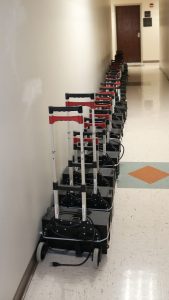
Photo by Lydia Berglar – Currently, batteries line a hallway in the administrative building.
He suggested the east side of the courts facility building, behind Citizen’s Bank and Trust, as a potential location that the county already owns. The Sentinel has observed, and Ryan agreed, that the courts facility parking lot is large and very often empty. It’s most crowded during court days, but even on those days, it does not appear to be full. The county also has a parking lot at the south end of the administrative building that is typically about half full.
Lowanna Vaughan (elections supervisor) was out of town at training last week, but the Sentinel was able to speak with Tracy Street, one of the five members of the Dade County Board of Elections, who was at the office on Aug. 12. Street was very helpful and showed the Sentinel around the entire office and the machine storage space.
When asked how many employees are typically in the office, Street explained that it’s sometimes just one and sometimes two. “Lowanna’s the only full-time employee. The rest of us come in to cover and help fill in gaps as needed.” He explained that The office gets busier leading up to an election, but typically, only Vaughan and one of the board members are there at a time.
This means that there would be days, perhaps many days, during which the elections supervisor would be the only person inside the proposed new building.
Street addressed the need for more space. One project that requires space is preparing the tubs of materials that are delivered to each precinct. Currently, the elections office uses the commission meeting room to lay everything out and pack up the tubs. However, Street said that they must run back and forth to the office at times, like when the phone rings. “It’s just become very hard to quickly do some things. It’s all so cluttered.”
If ringing phones are the only issue, it seems a better solution than a $3 million building could be found. However, the Sentinel can attest that the office is cluttered all the time. The Sentinel stops by several times throughout the year when working on election-related articles, and boxes and papers piled high are a consistent presence.
When asked how much more space is needed, Street didn’t have a square footage number in mind nor an estimate, but he agreed that simply expanding the current office would help. “If we had that portico area,” he said, pointing to the portico leading into the commission meeting room, “it would save us a lot of wear and tear on this area.”
The Sentinel asked if expanding the office northward (getting rid of the sidewalk that is currently there) would help. Street said, “That would be awesome.”
Street could not point to specific state requirements that indicate that a new building is needed, but he said the election code book may have some information. He added, “As far as a specific list, there’s not really one on the secretary of state’s website.”
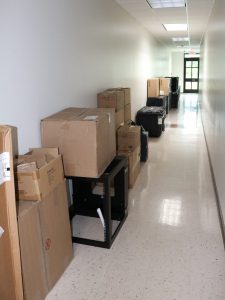
Photo by Lydia Berglar – More elections storage fills another hallway in the administrative building.
He reported that the state encouraged the U.S. Department of Homeland Security to evaluate each county’s election machine storage system. Here in Dade, “The Department of Homeland Security came and evaluated our area, and they suggested an alarm be placed on the door.”
The Sentinel asked if Homeland Security was satisfied with our system once the additional alarm was added. Street said the department was satisfied. The Sentinel can attest to the security measures currently in place: Street couldn’t simply grab a key to show the Sentinel the storage closet. He had to get approval from Vaughan or another board member in order to not set off the alarm.
Before reaching the secure storage room, Street showed the Sentinel rows of voting machine batteries and the tubs that go out to each precinct lining the hallway. There was still ample room to walk through the hallways, but it’s understandable that the county doesn’t want to leave the batteries out in the hallway.
While the secure storage room that houses the voting machines was indeed mostly full, it is right next to a large, open hallway-type area. It appears that expanding the closet would provide storage space for the batteries at least and possibly the tubs.
It also appears as though another closet was right next door to the voting machine closet. Is it possible that whatever is in that closet could be moved to another location inside the building to create additional space for future voting machines, should they ever be needed?
Street explained that moving the machines in and out of the doorway is tricky. Perhaps a sliding door would fix that issue.
He added that a loading dock would make sending the machines out to the precincts much easier, so the Sentinel has asked the county executive and county commissioners if it’s feasible to add a loading dock in place of the external staircase at the west side of the building.
It also seems that if more storage space is needed—whether for election materials or to clear out the closet by the current elections closet—the county could add on outside of the Department of Family and Children Services or the Dade County Health Department.
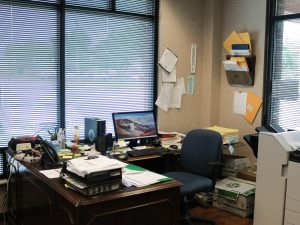
Photo by Lydia Berglar – Board of Elections members fill in as needed, using this desk as their work space.
About a week after the commission meeting, the county began sharing a series of press releases about elections and the proposed building (available on the county’s Facebook page and website). The second press release talked about the limited space and included photos from elections-related work.
The photos offer a glimpse into the amount of required work, and viewers can imagine how monumental the task of moving all the machines is, but even in the photos of machine testing (which requires all of the equipment be brought out and tested), there appears to be room to walk between tables.
It’s worth asking how the commission room would be used if it wasn’t used for testing. Should the elections building come to fruition, the county commission room will have one less purpose to fulfill. Similarly, the current elections office will be empty until the county decides how to use it.
The third press release explained how none of the other county-owned buildings or properties meet the state’s requirements. However, could the millions of dollars for the new building go instead toward renovating or expanding one of the existing buildings?
In this press release, the county at last shared some state requirements. An elections facility must:
- “Securely store all voting equipment and supplies, with climate control and fire safety measures.
- “Provide adequate space for Logic and Accuracy testing of all voting machines before each election.
- “Allow training for all poll workers prior to each election in compliance with state guidelines.
- “Meet ADA accessibility standards for both the public and election workers.
- “Have proper electrical capacity, network infrastructure, and loading access for equipment delivery and pickup.”
However, it seems that while the current system in the administrative building could use some expansion and adjustments, it does already meet these requirements.
The fourth press release addressed the price tag. It read, “Some citizens have compared these proposals to figures discussed years ago under a prior administration. At that time, no formal design or bid process had taken place, and the figures were based on rough discussion rather than vendor proposals. Those earlier numbers also reflected outdated market conditions, different design considerations, and pre-inflation construction costs.”
However, the estimates citizens have referred to are from the Feb. 1, 2024, county commission meeting—a year and a half ago, not many years ago. (See the Feb. 7, 2024, Sentinel).
It is clear now that the estimate from Ted Rumley (former county executive) was poorly formed, but Hartline’s estimate was based on research. One question that arises when considering this brief history: What expansions to the scope of the project caused the cost to increase so greatly?
On Aug. 16, Townsend announced that the county will be holding virtual town halls. All questions will be pre-vetted and must be emailed to info@dadecounty-ga.gov or sent via Facebook messenger. As of press time, the county has not given dates when the town halls will air.
Check out next week’s Sentinel for hopefully more details about state requirements and answers from the county executive and county commissioners about alternatives to building a new building.



The only pressing need I have heard from my fellow Dade County residents has been for an animal shelter. It is utterly shocking that a million dollar election building is even being considered.
Has there been any discussion on the probability of paper ballets in the future, and if the building needs would be the same as proposed?
No, there has not been any discussion in open meetings about returning to paper ballots.