Sheriff’s Office K-9 Found Dead After Being Left In Car For Extended Time
By LYDIA BERGLAR
News Editor
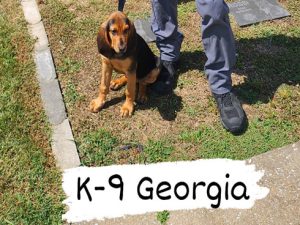
Photo courtesy of Dade County Sheriff’s Office – This photograph shows K-9 Georgia not long after she joined the Dade County Sheriff’s Office.
On the evening of July 13, the Dade County Sheriff’s Office (DCSO) lost K-9 Georgia who died from heat stroke when her handler left her in the patrol car for an extended period of time. The handler was then promptly fired.
After the department had time to complete most of the investigation, it published a statement on the morning of July 15. The statement explained that the heat index was around 100 to 102 degrees on July 13, and Georgia’s handler was inside the sheriff’s office when she died inside the vehicle’s kennel.
DCSO wrote, “The sheriff’s office immediately launched an investigation into the incident. What we found was that the air conditioner compressor on the patrol unit malfunctioned while K-9 Georgia’s handler was inside the sheriff’s office, requiring total replacement of the compressor. The patrol vehicle was also equipped with a heat alarm that was not functioning. Those previous two factors, coupled with K-9 Georgia being left unattended for what we considered to be an unacceptable amount of time, contributed to her passing.”
The Sentinel asked Chad Payne (DCSO public information officer) how long the handler left Georgia in the vehicle and, in general, how much time is considered unacceptable. Because the decision about prosecuting is currently in the district attorney’s hands, he could not share the exact amount of time involved in this case or the handler’s name. However, Payne said that 30 minutes or even an hour is not considered unacceptable or abnormal.
The sheriff’s office has released that the handler said he was working on reports while in the office.
While on duty, it is normal for K-9s to remain in patrol cars for extended periods of time. Sometimes the handler is in the vehicle, whether driving or parked. Other times, the handler is working a case or stopping for food, at which times the vehicle remains running with the A/C on.
Payne explained that rather than bringing a dog into a restaurant or other space where its reactions and other people’s reactions are uncertain, officers will leave them in the running vehicle while they eat. Handlers might also be responding to calls where a dog is not needed or could make the situation worse, so the K-9s remain in the vehicle.
Payne said that in extreme heat situations, a dog can die within ten to 15 minutes. “The thing that negates the issue are heat alarms,” he explained.
The sheriff’s office and the handler knew that this particular vehicle’s heat alarm was not working, and Payne said this handler should have known to pay extra attention to his partner because of this.
However, the A/C was functioning at the time the officer left his vehicle; it malfunctioned sometime while he was inside the office. Payne said, “Reports will tell you that malfunctions of those two things, A/C and heat alarms, are the leading cause of K-9 deaths.”
As for how the department will make sure this doesn’t happen again, the post read, “Going forward, any K-9 vehicle we have will be taken out of service if ANY of the essential K-9 equipment isn’t in 100 percent working order. We are also going to overhaul our K-9 handler policy, and K-9’s WILL NOT be left in vehicles for extended periods of time during summer.”
Payne explained that “extended periods of time” isn’t a set in stone number because of the nature of the job. For example, when responding to a situation where a K-9 is not needed, handlers can’t leave the scene to check on their partners every 15 or 30 minutes. Instead, handlers are expected to use their best judgement, and they’re supposed to be able to rest assured that heat alarms will work in case of an A/C malfunction.
The Sentinel asked why the policy mentions summer instead of all seasons. Payne said that they will be revisiting the policy and will look at that wording, but the risk of heat stroke is generally isolated to hot summer months.
The statement continued, “At the direction of Sheriff Cross, K-9 Georgia’s handler is no longer an employee of Dade County Sheriff’s Office, and this entire incident will be turned over to the Dade County District Attorney’s Office to determine if prosecution is warranted in this particular case. We will be 100 percent transparent about this incident! After we get a decision from the Dade County District Attorney’s Office about prosecution, we will know what additional details we can (or cannot) release.”
Georgia was the first bloodhound the department ever had, and her primary responsibility was to track lost persons and fleeing suspects. She began her K-9 training in fall 2024.
DCSO shared, “Our hearts are aching at the loss of K-9 Georgia. Many of you know that she was donated to us by a local family, at no cost to the sheriff’s office. She was an amazing bloodhound who was sweet, goofy, and had all the potential to be the ‘best of the best.’ She will be deeply missed by everyone at our office, and by anyone who had the pleasure to meet her.”