Recycling Challenges Continue At County And National Levels Alike
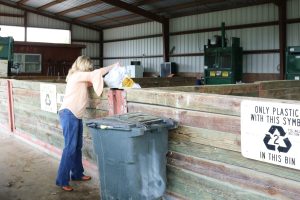
Photo by Lydia Berglar – While the Sentinel has heard from citizens who care about properly recycling (like the woman pictured here), the county employees often deal with improperly sorted or contaminated materials dropped off at the center.
By LYDIA BERGLAR
News Editor
“America’s become a throwaway nation.” This is a phrase that Billy Massengale (Dade County director of public works) uses often when talking about the problems in the local and national recycling systems.
The Sentinel has covered these problems before (most recently in the March 15, August 9, and August 16, 2023, issues). Sadly, little has improved in the last two years, and it’s a national and international problem.
Here in Dade County, having a recycling program cost taxpayers about $100,000 each of the last two years. Massengale gave a rough estimate that Dade’s recycling program hasn’t been profitable in about four to six years.
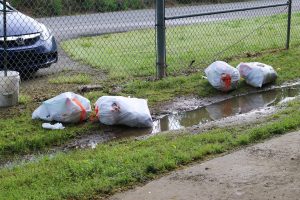
Photo by Lydia Berglar – Trash dumped over the side of the recycling center’s fence is a common Monday morning sight for Dade’s recycling center employees.
He said, “When I was growing up, you didn’t run and grab a paper towel. You had a dish rag hanging there or a towel. You didn’t run and get plates and plastic cups and throw them in the garbage. You washed dishes.”
In the March 2023 article, the Sentinel reported that the county put $92,580 toward recycling in fiscal year 2022 (FY22). A profit of $26,957 from selling recyclables brought the net loss to $65,623.
The county’s system doesn’t have a way to separate the recycling portion of the transfer station’s budget from the trash side, so this time around, Rebecca Jones (CFO) pulled estimates. The estimate for FY22 ($91,812) was close to the numbers that Massengale and Melissa Bradford (Lookout Mountain commissioner) worked to pull together in 2023. This makes the net loss $64,855.
In FY23, the estimated recycling cost was $120,631 with a profit of $14,505 for a net loss of $106,126. The county had originally budgeted for $34,000 in revenue from recycling.
The budgeted revenue for FY24 still left a deficit, but just a $4,000 instead of a $20,000 deficit. The estimated recycling cost was $115,230 and the revenue was $16,134, leaving a net loss of $99,096. The county had budgeted for $20,000 in revenue.
In summary:
- FY22 net loss: $64,855
- FY23 net loss: $106,126
- FY24 net loss: $99,096
While recyclable materials used to bring in revenue, garbage never has. The county pays about half a million dollars each year to take our trash to the landfill. The FY25 budget has $515,000 allocated for landfill fees). Keep in mind that although the recycling program is costing the county, dumping the materials in the garbage will still cost money.
The only way to cut back on this expense is to produce less waste, which would take initiative from individuals and businesses. As Massengale said, “Garbage ain’t cheap.”
Two concerned citizens who recycle and want others to know how to properly recycle reached out to the Sentinel earlier this spring. After learning that contaminated recyclable materials are thrown in with the garbage, Polly Ryan realized that the general public might not know the rules of recycling. She said, “I want to do it right. I don’t want it to go into the garbage.”
Laura Durel has the same concerns. She also wanted to know why the county doesn’t recycle paper, glass, or plastics with numbers higher than one and two.
The answer comes down to cost. Paper used to bring in revenue, but Massengale said, “The market’s just gone.” It got to the point where the recycling center was only able to sell newsprint, so the center gave up on paper altogether.
Plastics are a similar story. While there is still a market, it’s far from profitable. Massengale said, “It costs so much more to recycle than it does to make it new. If you’ve got a business, do you want to spend $100,000 to make your product, or do you want to spend $50,000?”
Some recycling centers do accept higher number plastics, but the most widely recycled are ones and twos. Again, it comes down to the market and finding places that will accept these plastics at a rate that makes sense for municipalities.
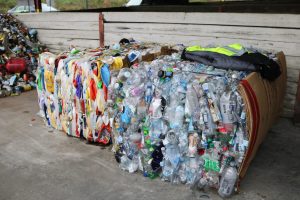
Photo by Lydia Berglar – Like many recycling centers, Dade County only accepts #1 and #2 plastics, pictured here in bales ready to be transported (#2 on the left and #1 on the right).
Massengale noted the efforts to develop biodegradable plastics. While these materials could be a step forward in the recycling/waste disposal world, kinks with biodegradable plastics are still being worked out. Many interesting articles explaining the pros and cons of these materials (from cost to infrastructure deficiencies to environmental concerns) are available online.
As for metals, Dade County accepts aluminum and tin. Aluminum is the one material where Dade breaks even. Massengale reported that it’s the only recyclable material that currently makes any money (about seven cents per pound at the moment).
When the Sentinel visited the recycling center to talk with Massengale, a few aluminum cans were mixed in with the pile of tin cans due to improper sorting by citizens. However, Massengale said, “If you pay someone to look through all of this, the county loses even more money.”
The center takes these metals to A and K Metals on Sand Mountain. The other materials are sent to WestRock Recycling in Chattanooga. The county used to sell to the highest bidder, but other competitors have closed down. As Massengale said, “When there’s only one buyer, you’re at their mercy.”
The county also accepts large batteries—car and lawn mower batteries. When the Sentinel visited, someone had set some AAAs and other small batteries by the bin in the hopes that they would be recycled. However, the materials in alkaline batteries are expensive to recycle but not worth much, so these were destined for the landfill.
It’s been years since Dade County recycled glass. Massengale explained, “Back around 2006 or 2007, we had a container out front where people threw glass in, but we could not sell the glass. We donated it to Orange Grove recycling center, but it got to the point where they wanted to charge us for us to give them the glass.”
The good news is that glass breaks down into sand in a landfill. Massengale said, “There’s no leaching, no etching, and it don’t contaminate anything.”
Dade County’s recycling center has about $100,000 worth of machinery, per Massengale’s estimate, and maintaining the machines costs money. The center is accustomed to running even when a machine is broken, but with a new machine recently purchased, all have been running well lately.
Other expenses in the facility’s budget include electricity, fuel to transport the materials, and employee wages.
When the Sentinel worked on the March 2023 article about recycling, citizens had dumped plastic materials into the aluminum section, but thankfully, Massengale reported that sorting has improved since then. He believes this is due to word spreading about the importance of proper sorting and efforts to keep the facility clean. He said, “If it looks like a dump, everybody’s going to treat it like a dump, but if the guys here do a good job of keeping it clean and caught up, people do a better job about putting things where they’re supposed to go.”
Discouragingly, when the Sentinel visited the recycling center on a Monday morning, someone had dumped bags of trash over the fence, leaving it for recycling workers to take care of instead of waiting until the transfer station was open. The Sentinel asked about the bags, and Massengale said, “This is the kind of thing we see when we come in on Monday morning.”
Also in March 2023, the center was often having containers dropped off that hadn’t been properly cleaned, but Massengale has seen improvement here too. Rinsing recyclable materials is important because “if a clear bottle comes in with something yellow in it, I’m not going to ask the employees to pour that yellow out to try to get a hundredth of a penny, not knowing what that yellow is. It might not be Mountain Dew.”
Massengale also said that people sometimes use plastic containers to collect used needles and throw the container in the recycling. If the recycling center throws this container into the baler (the machine that compresses the recyclables), it ruins that entire bale. WestRock and other recycling companies run a magnet over the bales, and if it detects the needles, the entire batch is considered contaminated.
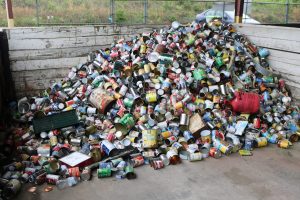
Photo by Lydia Berglar – Two years ago, the Sentinel took a photo of the aluminum can pile which showed that plastics had been tossed in with the cans. This year, the recycling center is pleased to report a decrease in improper sorting.
Similarly, oil and grease can cause a batch to be rejected. Massengale said that if WestRock repeatedly has to reject batches from Dade due to these issues, the company will stop accepting Dade’s materials. So far though, Dade has a good working relationship with WestRock.
Massengale mentioned reports that a significant percentage of materials transported by municipal recycling centers are thrown into landfills instead of being recycled. The articles that he’s read explain that just having recycling programs makes people feel better about themselves—whether the materials are actually recycled or not. There are many sources out there about this topic, but one helpful piece is NPR’s 2020 article, “How Big Oil Misled The Public Into Believing Plastic Would Be Recycled.”
The two things citizens should do if they want to make it more likely that materials will actually be recycled are: properly sort materials and rinse containers.
As the commissioner over the transfer station, Bradford has been working to bring glass recycling back to Dade. She heard about Overlooked Materials in Chattanooga last year and reached out about the possibility of recycling Dade’s glass through the company.
As of the June 5 county commission meeting, some final steps still needed to be completed before the program will be up and running at the recycling center, so stay tuned for details about how to recycle glass in Dade.
Morgan Holl founded Overlooked Materials in an effort to create a feasible glass recycling business model. The lack of population density in rural counties like Dade is part of why glass recycling is difficult. Holl explained, “Glass is not valuable enough for us to absorb a two-hour round trip cost.”
He said that one ton of glass is worth about $10-$20. Holl works to save money by eliminating unnecessary travel. He will only collect in Dade when he can get a full truckload to help ease the gas expense.
The company accepts mixed glass, so we won’t need to sort bottles by color. People also won’t need to remove labels or plastic rings or rinse glass—just make sure containers are empty, and the company’s machines will do the rest. However, Holl does ask that if the glass held something like peanut butter, do rinse it out.
Overlooked Materials pulverizes the glass into sand and gravel which is then used for things like countertops, concrete, asphalt, mulch, and sandboxes. As Bradford told her fellow commissioners at the May 1 county commission meeting, “The magnitude of what this glass turns into is what really makes you want to take glass to recycle.”