NASA HUNCH, Special Education, and Pre-K Updates At BOE Meeting
By LYDIA BERGLAR
News Editor
The April 28 meeting of the Dade County Board of Education focused on reports from the NASA HUNCH program and special programs department (which includes special education and pre-K).
First, Josh Ingle (superintendent) noted that the annual report for calendar year 2024 is hot off the press. (The annual reports run a year behind because they’re put together after the audit of the previous fiscal year.)
The 2024 annual report is dedicated to Carolyn Bradford, honoring her service on the school board, work in the juvenile court system, and her community service in the forms of foster parent, foreign exchange student host, Girl Scout troop leader, and Sunday School and worship teacher.
Ingle read, “Her greatest passion in life is supporting efforts to improve the future of our children and advocate for their overall well-being.”
Ingle also recapped the Dade County High School (DCHS) career fair on April 16 which 39 businesses attended. He said that last year and this year, sophomores seem to have been more engaged when talking with potential employers than juniors or seniors.
Next, Shenea Hill (director of career and technology innovation) gave an update on the NASA HUNCH program. (For a more in-depth overview, check out the Dec. 11, 2024, Sentinel.)
Hill told the story of Kirsten Breedlove who designed a logo patch for the program’s center of excellence award when she was in eighth grade. Now in tenth grade, Breedlove got to print the patch with the 3D printer. Dade County was the first NASA HUNCH Center of Excellence, so we’re the model that other schools look to as an example.
Hill reported that the Dade Middle School (DMS) engineering students 3D printed parts for ARISS-USA (amateur radio on the international space station). The parts went into orbit in March. The students spend a lot of time working on mockups, but when it comes to the certified parts that make it to the space station, the process is more serious and tedious.
NASA HUNCH stirs kids’ excitement about STEM fields, helping them see how math and science can be used in the real world and how creativity is also a part of STEM. By collaborating with Greenpower Racing and CTAE (Career, Technical, and Agriculture Education), the program builds students’ understanding of how these fields play out in the real world.
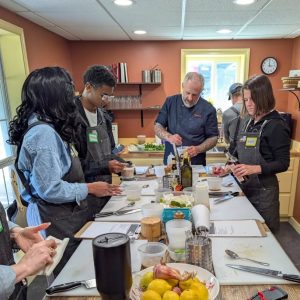
Hill highlighted the culinary competition which Patrice Whitt’s Family Consumer Science students participate in. They must create a dish that aligns with astronauts’ needs and requirements for outer space. This year, the DCHS team lost to the national winner by just two tenths of a point.
Dade is starting a new biomedical HUNCH pathway by studying wearable technology in collaboration with DCHS athletes. This new pathway could also collaborate with culinary classes (to work on sports nutrition) and computer science classes (to work on software coding). The pathway is still in the early stages but holds lots of possibilities.
In the heat of this summer, DCHS football players will wear Titan GPS vests which can track many data points, like workload, speed, and impact level (and possibility of concussions).
As Hill explained, “We’re already using wearable tech in space, so we just aligned it with biomedical so we can start watching physical health and see how we can read this data to create better pathways when astronauts do come home for rehabilitation…This is one of those new projects that we’re pitching, and we’re going to see where it goes.”
When Dade HUNCH students met NASA astronaut Victor Glover a few years ago, Glover offered to take something up to space in his pack to test it for the students. Hill explained why this is significant: “Ounces cost thousands and thousands of dollars, and in their personal packs, they’re only allotted a certain amount of weight, but he said he would take something up in his pack, test it, and bring back the data. Those opportunities that our students have are unbelievable.”
Susan Reyes (director of special programs/pre-K) followed Hill, noting that Dade’s GNETS (Georgia Network for Educational and Therapeutic Support) and functional classrooms are also involved in HUNCH. Jayne Griffin (At-Large representative) as if this is unusual, and Hill answered that we were the first to try incorporating NASA HUNCH into GNETS.
Reyes then highlighted special education and pre-K in particular, but also falling under special programs are Section 504 (students who qualify for accommodations like extended testing time), hospital/homebound instruction, and GaMTSS (Georgia Multi-Tiered Systems of Support) advanced tiers. She explained personnel, funding (some of which comes from federal and state grants), and community partnerships for these programs.
Special education in Dade County currently serves 300 students (14.2 percent of the student population). Juniors and seniors at DCHS can participate in a vocational program through which they learn hard and soft work skills in local jobs.
Ninety-seven students are currently enrolled in pre-K, split between one class at Davis Elementary School and four classes at Dade Elementary School. Griffin asked if there’s a difference between pre-K and kindergarten enrollment, to which Chris Davis (director of academics/testing) and Reyes noted that there are about 40 more students in kindergarten than in pre-K.
Griffin asked Reyes: If she could have a wish granted for anything to support special programs, what would it be? Reyes said there are no dire needs, thanks to the support of the community and the board and superintendent, but she plans to return with a bid for an accessible outdoor sensory playground at DES.
Before moving on to action items, Ingle reminded the school board that SPLOST VII (Special Purpose Local Option Sales Tax) will be a referendum on the November ballot.
The board approved the policy update related to school nutrition that Jennifer Bowden (director of school nutrition) presented last month.
The board also approved purchasing a floor buffer for Davis for $12,999.69, chose the $407,800 bid from Integrated Builds to repair walls and slabs at DMS and DCHS (see the Feb. 5 Sentinel), and approved the purchase of an LED scoreboard screen for DCHS from Booster Digital Displays for $39,999 (see the April 2 Sentinel).
Lastly, the board approved a five-year renewal of the contract with Softdocs, an internal software used for human resources and finance. This year’s cost is $17,022.78.
The personnel report is as follows:
- Hire: FY26 Certified Personnel, Courtney Street, Jennifer Lynch, Erica Cooper, Morgan Johnson, Doris Fugate, Rhonda Bradford
- Resignations: Caroline Hurst, Kalah Newsome (end of FY25), Alaina Stevens, Rebecka Chambers, Jamie Nelson (end of FY25), Autumn Holden, Dustin White (end of FY25)