Community Partners Gather For Dade County Community Forest Site Visit
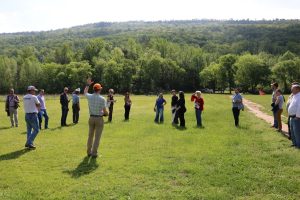
Photo by Lydia Berglar – Noel Durant points out the property layout and boundaries of the community forest parcel to representatives from a variety of public and private groups.
By LYDIA BERGLAR
News Editor
Trust for Public Land hosted a site visit at what could become the Dade County Community Forest on the morning of April 23. All present were excited about the project, and they hope to continue hearing from a broad representation of the community. The group gathered at Lookout Mountain Flight Park’s training hills (which are on the property).
To catch up on the beginning of this project, refer to last fall’s Sept. 11, Sept. 25, and Oct. 9 issues of the Sentinel.
The following groups were represented: Trust for Public Land (TPL), Dade County commission office, Alliance for Dade, State Rep. Mike Cameron (District 1), Lookout Mountain Flight Park (LMFP), the Lyndhurst Foundation, Thrive Regional Partnership, MKSK planning studio, Georgia-Alabama Land Trust (GALT), Cloudland Canyon State Park (CCSP), Dade County Schools, and community volunteers.
Speaking on behalf of TPL, Noel Durant (area director for northwest Georgia) explained that the community forest model is a compelling approach to preserving land for the benefit of the public. This model started in New England where some communities not only protect the land and use it for recreation, but they also selectively harvest timber and tap for maple syrup. Through these methods, the land brings revenue to a community while offering its residents an outdoor space and protecting the flora, fauna, and earth itself from development or erosion.
Durant said, “It’s a really compelling mix of a local government and local residents choosing their own destiny for protected land. All the benefits that property provides go right back into the community.”
Of timber management, he explained that in the southeast, the typical profit-focused method is to clear cut the hardwoods, plant pine, and harvest it on a 27-year cycle. However, “If you’re not wed to turning a 27-year profit, it opens up opportunities to think about very long-term timber management that might generate returns that are sustainable. We’d be talking generations, so 75, 80, 100 years. But that’s up to Dade County if that’s something the county wants to see.”
For example, the county could selectively harvest and sell white oak stave logs which Durant said “generate a lot of return for very few number of trees that are cut.” This revenue would return to the county’s general fund.
Durant gave an example of one community forest where a wind event blew down many trees that the community salvaged and sold for a net of about $2 million. This revenue paid for the restoration of the town’s historic courthouse.
Citing our region as one of the fastest growing in the country, Durant said, “Often, communities’ ability to protect land is being outpaced by developers who can pay more and do things faster than we can. We don’t know how much more federal land protection will be happening in the next little bit, so if communities want to see land protection happen, it’s going to often fall on local governments and nonprofit partners to make that happen.”
As Phillip Hartline (District Two commissioner) has explained before, he chose to champion this project because it does not solely fall on the government and taxpayers. Thanks to grants, it’s a great deal for the county. In addition to the $50,000 the county already put toward due diligence work, the county would only need to pay another $500,000 toward the roughly $1.62 million total.
Hartline also sees protecting roads, waterways, and property from landslides as part of the county’s responsibility. The recreational use and protection of natural beauty are added but still important benefits.
He said, “When Noel came to me with this, I thought it was a great idea. I’ve lived here my whole life, and when I was younger, I could go from my house plumb to the Tennessee River. You don’t have that anymore, and I think we need to preserve land for our children. If you go north, you see all the cabins being built on the side of the mountain. My daddy said the side of the mountain is good for one thing, and that’s to hold the world together.”
In particular, he would like to see a public space for kids to hunt. “I have land, so I don’t have to have this for my kids, but I would like all kids to have a place to go to hunt without their parents having to pay.”
Hartline has heard opinions from those opposed to the project, but he’s found that once naysayers learn about the complete plan, they view the project more favorably. He understands that some are not opposed to the project itself, but they mistrust the county. “The biggest thing for the county and the citizens is that this goes through without a hitch, and they see it work. For the naysayers, it’s probably not about the land itself; it’s the commission. I’m being honest; I’m on the board.”
He referenced the Sells Lane property and citizens’ frustrations with that fiasco and said, “That’s why TPL is here. My stipulation was that if we do this and I go after it, I want to move it along. Once we close on it, I want to see us working on it; I don’t want to see it sit here for years. That’s pointless for everybody.”
The property is separated from the Dade County Sports Complex by two tracts, and Hartline reported that he knows one of the two property owners. “If we can convince them to give us an easement, you could park there and walk to Cloudland Canyon and never see a house or anything. You’d be in the woods, on the side of the mountain, all the way to Cloudland Canyon.”
As for LMFP, the flight park has a vested interest in this land because of its training hills. With permission from previous owners and now from GALT, the flight park has made use of the hills on the property for over 40 years. Jen Richards (general manager) explained that without the hills, the flight park couldn’t train hang gliding and paragliding pilots, and the park has taken care of the road that leads into the property for years.
Representing both the Riverview Foundation and the Lyndhurst Foundation, Bruz Clark explained reasons for supporting this project: “We are as interested in developing great cities as we are in protecting great natural areas, and we see the two as being balanced…We work where we’re welcome, we work where it’s appropriate, and we work where it’s affordable.”
Thrive Regional Partnership’s representative, John Bilderback, explained that one of Thrive’s concerns is the impact of severe weather on towns. “When you’ve got a town that’s nestled right up against the mountain and a creek or river or highway going by, a lot of these towns are dealing with a lot of flooding. One of the things we can do to keep it from getting worse is just don’t touch [the land]. But how do small towns come up with the funds necessary to buy these large tracts of land? That’s where TPL and GALT and all of these other land trusts that understand all the ins and outs of this very complicated work come into play.”
Speaking on behalf of GALT, Mike Heneghan (conservation programs director) said that collaborations are important to GALT. Of all of the many organizations in the area that support natural resources, he said, “Our goal is not to get the credit but just to get the goal accomplished, which is protecting land to benefit the most people.”
Heneghan lives in Cartersville which is quickly being developed. He said, “About 100 yards from my house, there’s a nine-acre field that has resident coyotes, we watch a red-tailed hawk hunting voles there all the time, and right now, it’s in the middle of being converted into a 72 unit housing complex.”
The crowd let out a collective groan when hearing this anecdote, and Heneghan continued, “People need jobs, and people need housing, but we need to make sure we’re not sacrificing the unique things about our area that makes people want to come here in the first place.”
Emily Camargo (TPL land protection project manager) gave an update on the timeline and next steps. The property has been appraised, and TPL is currently having it surveyed. If the funding avenues work out as planned, TPL and Dade County hope to close the land acquisition in late spring 2026 at the earliest.
The funding sources are:
- Dade County’s $500,000 commitment
- Land and Water Conservation Fund, a National Park Service program that is administered by each state. We have been pre-approved for this $500,000 grant, but TPL is still working through the second phase of that grant.
- Community Forest Program by the U.S. Forest Service. TPL is waiting to hear back about this grant.
- Once the funding for Dade to purchase the property is lined up, TPL will apply for development funds from the Appalachian Regional Commission to complete work on the site and create recreational opportunities.
Durant noted that the group at this tour brought diversity of expertise to the table, but he asked the group to think about what segments of the community might be missing from the conversation and who should be brought in.
“It’s important that if there are folks who are skeptical or even openly antagonistic to the community forest to bring them in and have an open dialogue about why this is important and hear why they’re skeptical because it should inform how we think about forest management.”
The Sentinel asked what could be the biggest barriers to acquiring the land and, once acquired, to turning the land into something accessible.
To the former, Durant answered, “If we failed to meet the criteria for a funding source. If there happened to be some gigantic, buried toxic waste dump on this property and we did our environmental survey and found that the county would be accepting crazy liability because of something like that, it would be very hard for the county to acquire or for the National Park Service to approve.”
To the latter, Hartline answered, “For the county, it would be if something happened to the economy. As of now, the money is coming from SPLOST. If the economy stays like it is and our SPLOST stays where it’s at, I don’t see a problem.”
Hartline’s goal is that almost immediately upon closing on the property, it would be open to the public with limited infrastructure. Work would begin quickly to add parking and trails, especially on the flat portion, and over time, more would be added. It would be a slower process to add trails up the side of the mountain.
Throughout the morning, multiple people noted the importance of encouraging kids to get outside and appreciate nature. As John Smith (director of facilities and transportation for Dade County Schools) said, “When I was a kid, all weekend and all summer long, I was outside. I didn’t even go in the house until late at night when my mom called me for supper. Today, it’s the exact opposite. All the kids want to do is sit inside on their devices. They don’t want to get outside. The school system is hoping to find ways to create and encourage an interest in the outdoors.”
The Sentinel noted that, since we already have CCSP and many other outdoor attractions in the region, isn’t it up to parents (as well as kids) to want to take advantage of what we have? Also, how would the groups present overcome or change the culture of technology addiction?
Hartline answered, “Who has the kids most of the time during the day? The schools. Start there.”
Smith agreed, saying, “If the kids get excited, the parents are going to follow suit. That’s the key; we’ve got to get them here.”
Sandy White (Alliance for Dade president and CEO) said that even though some locals might never have stepped foot in CCSP, this new property would draw attention. “They take Cloudland Canyon for granted, but this being a new avenue for recreation will spark some interest just because it’s new.”
Also, for people who don’t live on Lookout Mountain, the community forest would be closer, making it easier for some to access.
Carey Anderson (communications director for the county) added, “It’s not just the kids we want outside. We also have a very robust senior population in Dade County. One of the things we all know about land use is that it enhances quality of life for all people.”