Cross-County Joint Meetings Return After Five-Year Hiatus
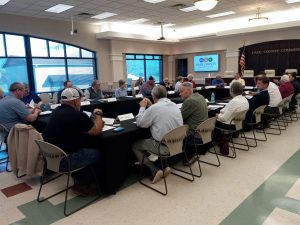
Photo by Lydia Berglar – Representatives from boards across the county convened last week and will meet again in September.
By LYDIA BERGLAR
News Editor
On March 27, Dade County welcomed the return of cross-county joint meetings that bring together the main boards in the county. The last time such a meeting was held was 2019. Another will be held this year on Sept. 25. Don Townsend (county executive) indicated that the plan is to continue to have these meetings in years to come.
The entities present last week were: Dade County Board of Commissioners, City of Trenton Board of Commissioners, Dade County Board of Education, Industrial Development Authority, Alliance for Dade, and Dade County Water and Sewer Authority.
Not all members of every board were present, but each had at least one representative present. Three citizens (aside from the media) attended.
Nearly every topic in the meeting has been reported on at various board meetings and covered in the Sentinel. No votes were taken, nor were new items of business addressed. Rather, all boards were brought up to speed on current key projects throughout the county.
During the county commission report, Townsend noted that the elections building and animal control facility are the county’s current major projects. When talking about the elections building site, he brought up a farmers market, saying, “A lot of people see the gravel lot. That’s more of a future site of a farmers market, we’re hoping.”
However, a farmers market has not been discussed at any of the commission’s regular monthly meetings, nor has it been voted on. Instead, it came as a surprise to some commissioners when former county executive Ted Rumley first mentioned it on the May 23, 2024, KWN News Now segment. Refer to the June 26, 2024, issue of the Sentinel for more about the confusion surrounding this topic.
Of the animal control facility, Bob Woods (District Three county commissioner) reiterated that the county and city decided to move forward with constructing the shell of the building (the plumbing, floor, outer walls, and roof). As grants and donations are secured, the interior will be completed.
Woods explained that the grants and donations are intended to lessen the burden on Dade taxpayers. He said, “From my foxhole, the citizens are in favor of [the facility], but a millisecond later, they ask, ‘How much is it going to cost me?’” He reported that donations are beginning to come in, and citizens in favor of the facility are glad to see progress.
Melissa Bradford (District Four county commissioner) added that in the meantime, the county and city will firm up the ordinances/law enforcement aspect of animal control, finalize the intergovernmental agreement, and gather input from a part-time director. (However, at the March monthly commission meeting, Woods reported that they plan to hire a full-time director, so it’s unclear exactly which director Bradford was referring to.)
Townsend also reported that Kathy Ragon, the new part-time grant writer, has been busy working on 17 grants at the moment. Townsend noted that the other government entities in the county are welcome to ask for assistance with grants they are working on.
He added, “Some of you know, you can become grant poor: You can get a lot of grants, but if you don’t necessarily need the grant and you have [to have] those matching dollars, then where do those matching dollars come from?” To avoid this problem, the county is identifying grants that will meet a need here in Dade and for which any necessary matching amount can be met.
During the city’s report, Alex Case (mayor) also discussed the animal control facility, noting the adjustments in the city’s budget to make room for a director/manager.
He then discussed sewer infrastructure needs and progress in depth, saying that this is the biggest issue the city is working on. The American Rescue Plan Act (ARPA) funds helped improve the city’s ability to handle solids, but the overall system needs more improvements.
Case said, “The plant has got a lot of room to grow, but processing sewer is different now with our industrial development areas.” He explained that the flow (i.e. volume) isn’t the problem; the level of contamination/dirtiness is. Heavily contaminated sewage takes more time and money to clean.
He reiterated that the clay pipes from the 1960s continue to cause many leaks, and the city is preparing to work toward a Georgia Environmental Finance Authority (GEFA) grant. This is a loan, but after a number of years, some of the principal may be forgiven.
During the school system’s report, Josh Ingle (superintendent) reported that the schools are trying to market to new, young families, noting that the schools have physical room to grow, but increased enrollment would likely require increased staffing. Enrollment has never returned to the numbers from pre-2011 tornadoes.
Ingle noted that this November, the schools will be advocating for another Education Special Purpose Local Option Sales Tax (E-SPLOST). Townsend later noted that he is in favor of this tax because he remembers when the school system did not have E-SPLOST and facilities had leaking roofs and other issues.
Ingle also touched on the poorest performing schools list from the Governor’s Office of Student Achievement (GOSA). (See the Feb. 12 Sentinel.) He said, “Mr. Cooper and his team are taking that serious, and they’re going to do everything they can to get off the list because we know there’s great things happening at Dade County High School.”
Jayne Griffin (At-Large school board representative) also cited “bright spots” at the high school and in the schools in general, while also noting that we do have an issue with attendance. (See the Jan. 1 Sentinel.)
Monda Wooten (city street commissioner) asked how Dade might be impacted by the dismantling of the U.S. Department of Education. Ingle gave the same answer that he gave at last week’s school board meeting. (See the accompanying article in this paper).
He added that current reports indicate that existing funding will continue but will shift to different departments. Ingle said, “Perhaps, it may be block grants where the funding goes to the state, the state sends it out to local districts, and the states are responsible for monitoring. If that’s the case, then there would be less red tape.” (This all aligns with communications from the Trump administration. For one source, see The White House’s March 20 fact sheet on improving education.)
Moving on, three groups fall under the economic development umbrella (of which Evan Stone is the director): The IDA, Alliance, and Downtown Development Authority (DDA). Stone began this section by saying that on the retail side, he’s seen a recent uptick in interest in Dade, and one company is hoping to relocate from Chattanooga to Dade because it is less expensive to operate in Dade.
Like Ingle, Stone said the county has never fully recovered from losing 174 homes in the 2011 tornadoes. “We’ve never recouped homes and places for folks to live. We can look at the census and say there’s a lot more people and a lot more traffic, but [Ingle’s] statistics at the school really tell the tale.”
Indeed, Dade’s population decreased by 382 people from the 2010 to 2020 U.S. Census, but there may be other contributing factors to the decline in student enrollment, such as the national declining birthrate, retired folks moving to the area instead of young families, families opting to send their children to private schools or to homeschool instead of enrolling in Dade’s public schools, and the increase in vacation rentals and lineman housing rather than long-term residential options. The “65+5” tax exemption could potentially be a factor, making it more affordable for senior citizens to own property than for young families. (See the Feb. 21, 2024, issue of the Sentinel for more on the population topic.)
Regardless, the IDA hopes to obtain workforce housing grants to help fund affordable homes that could attract young families, thereby creating a workforce and a student body.
Griffin asked what price is considered affordable when considering the wages that industries being recruited pay. Stone did not give a number specific to Dade, but he cited the $290,000 cap set by the governor’s office—to qualify for the state affordable housing grants, the homes cannot sell for more than $290,000.
At a seven percent interest rate with three percent down, a $290,000 house payment would be about $1,870 monthly. Using the 30 percent rule (i.e. budgeting 30 percent of your gross monthly income for housing) and round numbers, a family would have to earn about $75,000 a year to afford this home.
Stone later reported that while Vanguard started out with average pay of $10/hour, the average is now $18/hour. Two adults working 40-hour weeks at this rate (not including overtime pay) would just barely be able to afford a $290,000 home. However, keep in mind that per the state grant requirements, some homes might be below this amount. Also, because some wages in the industrial park are much higher than $18/hour and overtime pay is a factor, the situation is more optimistic.
Tying into this topic, Case added that the city has “taken a beating” over the D.R. Horton issue and the Woodford at Glenview development. He said the biggest barrier to residential growth is sewer infrastructure, and, “We’re getting beat up a little bit, but we need [housing] because people need it.”
James Cantrell (IDA chair) reiterated that the authority is selective about which industries they chose to partner with. Griffin asked what constitutes a perfect fit for Dade when recruiting industries. Stone said the IDA considers the total investment: money invested in the community, number of jobs created, types of jobs, and average wage. Stone said, “Just because they pay $50,000 a year and maybe a $50 million investment, is it the right fit for Dade County?”
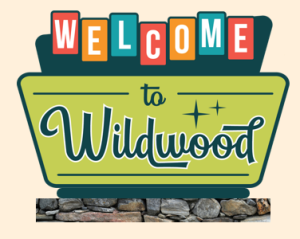

Photos courtesy of Alliance for Dade – These are some samples of the signs that the University of Georgia designed for the Alliance for Dade. A variety of signs will be installed throughout the county.
Next, the Alliance’s report focused on the wayfinding signage project. (See the Dec. 27, 2023, Sentinel). Sandy White (Alliance president and CEO) showed the color palette and mockup examples created by a design team at the University of Georgia.
Sets of signs include: when entering the county on major roads, when entering voting precinct communities on major roads, when entering smaller communities (like Slygo), signs at attractions and community centers, a kiosk and “selfie station” on the Trenton square, and several others.
White said, “The colorful, cohesive signage will not only enhance the navigation, but it will also provide a unique, visible identity…Ultimately, the project will foster a strong sense of place and create a welcoming atmosphere for all who live here and visit.”
Quickly touching on the DDA, Case said, “We’re hoping we can help the mom and pops and the one or two employee businesses with tax credits and other things that come up, like grants for improvements of businesses.”
During the water company’s report, Elizabeth Zeller (general manager) reported that they’re working to secure funding through Senator Raphael Warnock’s office to run a new water line up Lookout Mountain and replace some asbestos containing pipes. (See the Sept. 4, 2024, Sentinel).
Allen Townsend (District One water authority representative) also noted the lead pipe inventory project (as covered several times in the Sentinel in recent years) and the fairly new contract with American Tank Maintenance.
Stone asked about line size requirements, and Zeller explained that to provide adequate fire protection, six-inch lines are now required. This has changed over the years; at one point, the requirement was only four inches.
County Executive Townsend concluded, “The one group that can shut the school board down, the city down, economic development down, the county down—it’s water. Water makes all the difference…That’s the importance of this meeting, for us to come together and build relationships and work these things out.”
Overall, the meeting was a good example of how so many parts of the community are interconnected. The water company must be aware of fire protection needs; city sewer infrastructure must be considered in decisions about residential, industrial, and agricultural growth; schools are impacted by residential growth; tourism can bring in tax revenue and income; county and city ordinances can help or hurt just about everything; and the list goes on.