Unknowns Abound About Animal Control Facility, Budget, And Enforcement After Joint Meeting
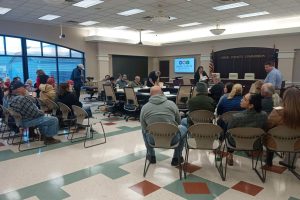
Photo by Lydia Berglar – It was standing room only last week at the joint county and city meeting to discuss the proposed animal control facility.
By LYDIA BERGLAR
News Editor
Two years and two months after the previous joint meeting about the proposed animal control facility, our local governing bodies reconvened on Feb. 18 to address two agenda items:
- “Discuss the location and construction of an Animal Control Facility”
- “Discuss Intergovernmental Agreement for the purpose of the maintenance and operation of the Joint Animal Control Facility”
Last time, the Dade County Board of Commissioners and City of Trenton Board of Commissioners met on Dec. 28, 2022, and concluded by agreeing that a subcommittee should be formed with two representatives from each commission. (See the Jan. 4, 2023, issue of the Sentinel.) However, nothing was ever heard from or about that subcommittee.
This time, the boards again formed a subcommittee.
Last time, they agreed to break ground within 90 days (even though no floor plan had been approved or budget set). The only progress with construction of the facility since that time was the pouring of the pad. This time, no timeline was set.
It’s unclear why the boards needed to approve the location of the facility at this month’s meeting because the location had been decided on several years ago, and the groundwork and pad have already been completed. It’s unclear why that work would’ve happened if the site wasn’t already approved.
The site is behind the Dade County Transfer Station off Sunset Drive.
In the time since the 2022 meeting, the city has drafted floor plans after researching other counties’ animal facilities. They drew heavily from Cherokee County’s building and whittled it down. The city approved these plans at the May 13, 2024, city meeting, but the county has not yet voted on these plans.
These plans have not been made public (the Sentinel put in a request to see them), but the board members had the plans in front of them during the Feb. 18 meeting.
The meeting drew a crowd. About 70 citizens came and went (not including media members, law enforcement, board members, or county employees working the meeting).
The only absent board member was Lucretia Houts (Trenton fire and utility commissioner). Tommy Bradford (Dade County Sheriff’s Office chief deputy) and Steve Beaudoin (Trenton Police Department police chief) were also at the table to offer the law enforcement perspective.
Bob Woods (District Three county commissioner) kicked off the meeting with a presentation of his thoughts and feedback he’s heard from citizens. Common citizen thoughts include:
- If we don’t get what we voted for, why should we vote?
- What’s taking so long?
- An animal facility is needed.
- Not all pet owners are irresponsible and/or not everyone wants or owns animals, so not all taxpayers should be footing the bill.
Woods is in favor of moving slowly in order to come up with thorough financial and operational plans and execute the project correctly.
Monda Wooten (Trenton street commissioner) thanked the many citizens who showed up, saying, “This is a community problem, and it deserves a community response.”
She said the animal control facility isn’t primarily for/because of pet owners “because they take care of theirs,” but rather because of strays, abandoned animals, and those that pose a threat to public safety.
Wooten acknowledged the burden the facility will place on taxpayers, but she said there will be revenue streams at the facility through spay/neuter and rabies vaccination clinics, adoption fees, and fines from ordinance enforcement. At no point in the meeting were numbers presented of how much revenue these sources will bring in or what the fees for non-compliance with ordinances will be.
Of the need for animal control, Wooten said, “Sometimes people have to be made to understand and educated.”
Melissa Bradford (District Four county commissioner) explained that she believes the first step is enforcing ordinances and adding a county animal control officer. She’s reviewed the city and county ordinances and called them “not bad,” but they simply haven’t been enforced, partly because the county doesn’t have an animal control officer.
Bradford stressed that this will be a control facility rather than a shelter. The facility’s primary focus will be public safety and addressing nuisance animals. She sees the other side of animal care (rescue, shelter, adoption, sanctuary) as coming from volunteer groups and individuals who have a heart for animals rather than from the government.
Phillip Hartline (District Two county commissioner) was the only board member who presented numbers. He said, “I do know we need an animal control facility, but I’m going to shed some light on numbers.”
He explained that the county has $375,000 set aside in Special Purpose Local Option Sales Tax (SPLOST) funds and asked the city how much it has set aside. Alex Case (Trenton mayor) answered that about $61,000 from the city’s 2015 SPLOST is earmarked for the project and an unknown amount will come from the current SPLOST.
Hartline then offered his quick estimate for construction: At $150 per square foot, the proposed building would cost $750,000. “I ran preliminary numbers—not getting to the inside of the building, just the [structure], plumbing, electrical, concrete—we’re at $302,000 with no general contractor money in that at all.”
He continued, “I’m not going to say, as far as being a commissioner of this county, that I’m willing to go ahead and purchase a building to get us started when we don’t have enough money to complete it, or we’re going to have to scale this building back.”
He also read other counties’ animal control facility operating budgets from a document the board members had in front of them. (This document was not attached to the online agenda.) Long County had a $150,000 budget, and Rabun County had $349,000. Hartline’s question, “What do you think it is going to cost to run it for us?” was not answered in the meeting.
He also asked how the costs will be split between city and county. Case listed three options: flat rate per resident, fee by intake of animals from county and city (i.e. pay by animal), or a combination of both.
Hartline noted that adding a county animal control vehicle and officer is another cost. He said the officer (a DCSO deputy) would cost around $81,000 (including insurance, gear, uniform, etc.)
Dr. William Pullen Jr. (District One county commissioner) asked if a spay/neuter area is included in the floor plans. Case and Wooten said it is included in the medical area of the building.
Pullen noted that he heard that Walker County’s animal control budget has been between $600,000 and $900,000 in recent years. (For budget year 2025, Walker allocated $970,050 for its animal services department.) Board members noted that Walker has a larger population than Dade.
Pullen asked what the plan is for how long animals would be isolated and held at the facility. Case answered that it would depend on intake evaluations, what diseases the animals have, openings at rescue operations, etc.
Wooten explained that she believes community partners, volunteers, and grassroots rescuers will cover the rescue, shelter, adoption, and sanctuary side of things once the building is built. She said, “This whole room is full of people that have resources, relationships they’ve built over the years…We have so many resources. We’re already doing a lot of the work out there, and we’re passionate about it.”
She explained that she is in favor of starting the building even without all of the money needed in hand, because to apply for many applicable grants, you must have some form of animal facility.
Woods, however, said the boards must first figure out how to “handle issues before this Taj Mahal gets built.”
Bradford added that farm animals and large animals must be taken into account when planning the building.
Wooten got heated when Hartline asked again about the budget question. Hartline asked, “What does that cost us?” Wooten brought up the Dade County Community Forest that Hartline brought to the commission last year and said he couldn’t discourage her.
Hartline said he’d be willing to give the $375,000 and allot $100,000 annually for operations if the city would run the entire project, but he said that they would come back wanting more money, concluding with, “I’m not going to pull the trigger then aim the gun. What’s it going to cost? That’s all I’m asking.”
Wooten said, “I don’t expect you to pull the trigger. I don’t expect you to be for about anything that comes up around here, because you never are.”
After all commissioners had a chance to voice their opinions, Don Townsend (county executive) turned to the agenda items, starting with the location. He asked if all were agreed upon the location behind the transfer station. (Again, work has already started at this location, and it’s been the reported location for several years.) Both boards approved the location.
Townsend then turned to construction, noting that there may be grants available for construction of a facility. Citizen Jimmy Stewart was nodding in agreement, so Woods called on him to offer input. Stewart said there is plenty of money out there, if you look for it. He recommended the Humane Society of the United States (now called Humane World for Animals).
Another woman asked if an existing property could be renovated to serve as an animal facility. Townsend noted that they do already own the property behind the transfer station. The woman asked if celebrities have been contacted for donations. Townsend said that if they have foundations that offer grants/donations, the county could apply.
Hartline noted that the total known county and city SPLOST allocations, ($436,000) would cover concrete work, plumbing, and the metal building, and grants and donations could then come into play to cover everything else.
Wooten believes that once the building is started, even before it’s finished, she can get a spay/neuter clinic up and running to start bringing in some revenue. Again, nothing has been presented publicly about projected revenue or how much it would cost to have a pet spayed/neutered at the clinic.
It was unclear what the board agreed to (if anything) regarding the building and floor plans. They discussed moving forward with requesting bids, but they also discussed altering the floor plan or building in phases.
Wooten explained that she is not in favor of expanding the facility continuously in the future to house more and more animals, because “it doesn’t matter how big you build a shelter, you can fill it up.”
She wants to focus on educating the public about spay and neuter and animal care. “When we have these ordinances, and we’ve got officers that can enforce them, what happens is you start changing that mindset. Over time, people understand if a dog is going to run loose, if it gets picked up, it’s going to cost them.”
Townsend then turned to the second agenda item, the intergovernmental agreement. He recommended forming a committee that will provide updates to the county and city regularly. Woods, Bradford, Wooten, and Terry Powell (Trenton parks and animal control commissioner) volunteered, and it was decided that the mayor and county executive (Case and Townsend) would be ex officio members of the committee.
Due to the Sunshine Laws, these committee meetings will be advertised and held as public meetings.
Stewart again offered his input, saying, “Don’t reinvent the wheel. Little shelters have been done for eons in counties around us.” He said that Walker County’s facility and McKamey Animal Center started out small and expanded over the years. Case explained that the city researched and visited other facilities to think through ordinances and before developing a floor plan.
Townsend asked for law enforcement’s input. Beaudoin and Bradford said the police department and sheriff’s office have agreed to rotate weekend shifts and coordinate schedules between the city’s animal control officer and the county’s (future) animal control officer.
Another citizen asked if the percentage of pet owners in the county is known. (It’s not.) She explained that where she’s from in Maryland, pet owners must register their animals (with higher fees for those that aren’t microchipped or spayed/neutered) and provide proof of rabies vaccination. She believes a similar system would bring in hundreds of thousands of dollars. The boards explained that similar requirements are already in our ordinances, but they haven’t been enforced.
Another citizen asked how this is fair for responsible pet owners who keep their animals on their property. Wooten explained that fines would be for animals that leave their property and are picked up by animal control, not that animal control would be going from house to house to check on every animal.
The Sentinel is working on gathering further details (such as the floor plans) and information from other counties’ animal control programs and will report back in an upcoming issue.