Inside Wildwood Lifestyle Center’s Holistic Approach To Health
By LYDIA BERGLAR
News Editor
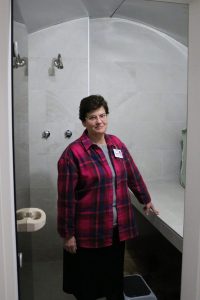
Photo by Lydia Berglar – Margarida Godinho poses in the Russian steam bath, one of Wildwood Lifestyle Center’s methods of hydrotherapy to help reduce inflammation, stress, and insomnia, and improve blood flow and immune system functions.
The Wildwood Health Institute has been a fixture in Dade County since 1942 when members of the Seventh-day Adventist Church established a rural sanitarium and medical missionary institute at the north end of the county. The institute’s 147-acre campus has a number of different departments, one of which is the Wildwood Lifestyle Center and Clinic.
In honor of the many New Year’s resolutions centered around health and weight loss (whether they made it to this month or were left behind in January), the Sentinel met with Margarida Godinho (guest services manager) to learn more about how the center promotes holistic health with a natural approach.
The center’s website reads, “We focus on reversing disease by changing lifestyle habits that caused it in the first place, instead of just prescribing medicine to keep it under control…Our medical providers are also trained in prescribing natural remedies and herbal medicine that are more affordable than conventional medicine and have less side effects. They prescribe conventional medicine only when necessary.”
Godinho gave the Sentinel a tour of the Wildwood Lifestyle Center which was established in the 1970s. She explained that new patients arrive every two weeks, with some staying for seven days, some for 11, and some for 25. Students also come to learn the center’s approach to health before going out as medical missionaries.
Students and patients come from all over the world, and when the Sentinel toured, a group from the Cayman Islands was staying at the center.
Like any doctor’s office, the center has exam rooms and laboratories where patients’ vitals are taken, and bloodwork is assessed. Each patient returns home with a prepared treatment plan.
Everything Wildwood teaches centers around the eight laws of health. Using the acronym NEW START, Godinho listed the laws: Nutrition, Exercise, Water, Sunshine, Temperance, Air, Rest, and Trust in Divine Power.
She shared her own story of how she came to Wildwood. After battling depression and obesity for years, she came to the center as a student. One line in the handbook read, “Must be willing to make the changes necessary to improve your own health.” By following the eight laws of health, Godinho lost about 90 pounds, came out of depression, lost her insomnia, and no longer suffered migraines. She described it as a complete health transformation. She was asked to stay on as an employee.
The center offers a basic Life Alignment Program which the other two programs build upon. Godinho said, “It’s geared toward individuals who have a need to relax, learn how to change their lifestyle, or individuals who don’t have medical issues but need to lose weight.”
There’s also the Mental Health Program which uses lifestyle changes and faith/spiritual care to help battle poor mental health. The guest rooms at the center feature large windows to expose patients to sunshine and fresh air, and Godinho said this is especially necessary for patients with mental health issues.
The third program is the Disease Reversal Program. While some diseases like type two diabetes (adult-onset diabetes) and high blood pressure are well known to be linked to lifestyle habits, the center also treats diseases like fibromyalgia and even cancer. Godinho said, “You name the disease, and we’ll try to address the cause, because we work from cause to effect.”
She noted that although type one diabetes can’t be cured through natural remedies, the center believes that their methods will improve a type one diabetic’s overall health.
Wildwood offers outpatient options for some treatments and one day sample programs, but those needing a full lifestyle change are best served by staying at the center so that they have accountability and can fully focus on the changes necessary to improve their health.
The eight laws of health are simple enough, and most people know we’d be better off living similarly, but healthy habits are tricky to form. As Godinho said, “The truth of the matter is, if you look at the eight laws of health, you can do it at home. The issue is that most of us don’t have the discipline to do it. It’s not as easy on your own.”
Godinho reported that even in just a week at the center, patients’ blood tests show drastic improvements. However, “I tell them, ‘It didn’t take you 11 days to get sick; it’s going to take more than 11 days to get better, and it takes more than 11 days to create a habit and break the old habit.’”
The Sentinel asked if patients stick to the changes after returning home. Godinho said most are committed enough to implement the changes, but there are also those who fall back into old patterns. Wildwood Lifestyle Center has a follow-up program and forms support groups with patients so they can stay encouraged after returning home. “It gives them time as a group to share with and encourage each other. The group setting is very important.”
The Sentinel asked how these simple lifestyle changes can fight terrible diseases like cancer, to which Godinho answered, “By giving the body the conditions it needs to fight it. The human body was formed to deal with these things. The problem is, most people’s immune systems are shot because of our diet, pollution, and stress. When they come here and we’re able to strengthen that immune system, it starts fighting the cancer. Stage one and two patients are easier, but most cases are more advanced than that. Patients try everything and then decide to try this natural route.”
She noted that some patients use only the natural treatment, while others combine it with conventional medicine. Wildwood Lifestyle Center has seen many recover, but they’ve also lost some patients, especially those at stage four.

Photo by Lydia Berglar – Seventh-day Adventist nutrition is plant-based and avoids ultra-processed foods. The Natural Food Market at the Wildwood Health Institute keeps all kinds of nuts, beans, grains, vegetables, etc. in stock for customers.
The center’s YouTube channel features livestreams of each class’s graduation where patients share testimonies. For example, Rhonda shared that she stayed at the center for 81 days, beginning with blood pressure of 148/98 (stage two hypertension) and ending with blood pressure of 111/69. She lost 48.3 pounds, and her hemoglobin A1c dropped six points. She started at 6.6, “which is actually at the level of diagnosing type two diabetes,” she said and ended pre-diabetic at 0.6.
When James found out he had 50 percent blockage of his arteries, the doctors said he’d be on medication for the rest of his life. James added, “The Lord showed me that there were issues with my spiritual heart.” After his stay at Wildwood, his blood pressure was down 30 points, and even more importantly to him, the spiritual care he received helped his heart’s state.
Linda shared that after two strokes, her neurologist told her she would die, but she said Wildwood saved her life.
David shared that he had diabetes for over a decade, along with high blood pressure, high cholesterol, regurgitation/acid reflux, high triglycerides (over 1,200), and frequent urination. During his stay at Wildwood, he was able to come off insulin, cut out 90 percent of his medications, lose 20 pounds, and leave with his diabetes in remission.
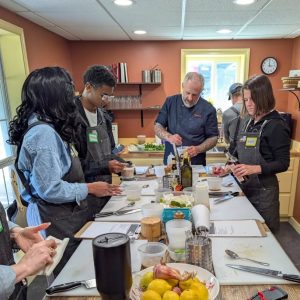
Godinho explained each of the eight laws of health as practiced at Wildwood, starting with “Nutrition.” Seventh-day Adventists don’t use any animal products, except for honey, and they don’t eat sugar, except for honey and maple syrup. The center teaches patients how to cook plant-based meals and make homemade bread.
The Sentinel asked how these dietary standards tie into the Seventh-day Adventist faith and interpretation of the Bible. Godinho noted that in the Garden of Eden, God told Adam and Eve that they could eat from all of the trees of the garden. “Talk about a diet of fruits and nuts—that’s what grows on trees. After the fall, the Lord says the herbs of the field. That introduces vegetables and plants. Still, you have to work, but now you have to work with the sweat of your brow. After the flood, the Lord allowed meat to be eaten. But he said, ‘My spirit will not contend with men forever and I will shorten his days.’ How did He do it? Through their diet.”
The center serves two primary meals a day, and some patients also have a light, early supper. Godinho said, “The idea is that as the body rests, so does the stomach. We encourage the growth hormone, which functions the most at night, to do what it needs to do, which is repair the body.”
The center also offers natural remedies classes and teaches guests how to make their own toothpaste, lotion, laundry detergent, etc. Godinho said, “We don’t push it on them, but we encourage them to be careful with all the toxins and chemicals that are present in so many things.”
Seventh-day Adventists see diet as important, but it’s not the only part of health. Godinho said, “You need to have all of the laws together. If you’re eating well but not sleeping well or not exercising, what good is that? We look at the person as a whole, attending to the emotional, spiritual, and physical needs.”
“Exercise” is a daily part of staying at Wildwood, with a combination of cardio and resistance training. Walking around the beautiful grounds is strongly encouraged. In Godinho’s words, “Your body was made for physical exercise, for movement.”
She noted that even in the Garden of Eden—before the Fall—Adam and Eve moved and worked. “Work was important for their happiness.”
The third word in NEW START is “Water,” and Godinho explained the many methods of hydrotherapy used at Wildwood. Whether through showers, baths, saunas, hot towels, liquid, steam, or ice, hydrotherapy uses the contrast between hot and cold to improve blood flow, reduce inflammation, and reduce stress.
Godinho herself takes a contrast shower every morning and evening and reported that she rarely gets sick. “The principle is very simple. You alternate back and forth, always finishing with cold water to allow the pores to close back. It helps with insomnia, it boosts the immune system, and it improves reactions to exterior allergens.”
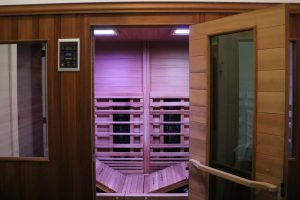
Photo by Lydia Berglar – Because some patients react better to dry heat than wet heat, Wildwood has an infrared sauna in addition to a traditional sauna as another form of hydrotherapy.
The center also induces sweating to help people detox from nicotine, caffeine, and other substances. When treating cancer, Wildwood employs “fever therapy” (i.e. pyrotherapy which was very popular in the first half of 20th century), to destroy cancer cells.
The eight laws of health stress being exposed to “Sunshine” for mental health, to get vitamin D, and to encourage the natural circadian rhythm.
“Temperance” simply means enjoying good things in moderation and avoiding bad things, which for Seventh-day Adventists means tobacco, alcohol, drugs, caffeine, and sugar, or as Godinho said, “anything that injures the body; anything that interferes with your mental faculties.”
“Air” is tied to sunshine and outdoor exercise. A daily walk could expose you to fresh air and sunshine, while also counting as some light exercise.
As for “Rest,” Wildwood encourages eight solid hours of sleep, so the center slows down after 8:30 p.m., dims the lights, and strongly discourages the use of screens. Rest is essential for recovery, and Godinho said, “It’s something that we as a society don’t respect much any more.”
“Trust in Divine Power” is the spiritual element of the eight laws. Many patients at the center are Christians, both from the Seventh-Day Adventist Church and from other denominations. The Wildwood staff pray regularly for each other and for the patients, and a chaplain is available to guests.
Mornings start with eating, walking, and then worship. Godinho said, “Worship tends to bring a lot of peace, which is one thing a sick person doesn’t have.”
She said that forgiveness is a big part of the spiritual care at Wildwood. “One thing we have to address a lot is forgiveness—accepting forgiveness and forgiving others. It’s amazing the impact it has on blood pressure. High blood pressure and unforgiveness go together.”
For Seventh-day Adventists, taking care of the physical body is an important part of following the Lord. “We strongly believe that the human body is a temple of the Holy Spirit and that the Lord talks to us through our frontal lobe, so we try to keep it in as good shape as we can. We follow the example of Jesus in using our faculties to be a blessing to others.”
Mary Fisher, a leader of the center, came to Wildwood in 1993 from Eden Valley Institute of Wellness, another lifestyle center in Colorado. With decades of experience in natural health, Fisher has seen great outcomes and benefits from this lifestyle and treatment. She said, “We deal with the psychological, spiritual, mental component of people using food and substances as a coping measure. If you don’t address all three of those things, you may see short-term health, but we’re looking for long-term health.”
When asked what the biggest obstacle is that prevents people from living this way, she answered, “Habits and pressures at home. They say it takes 21 days to establish a habit but 90 days to establish a lifestyle change.”

Photo by Lydia Berglar – Wildwood encourages patients to be aware of toxins and chemicals used in many household items. The Natural Food Market sells versions of these products that are made with fewer toxins.
The Sentinel noted that the time component of preparing healthy food and exercising might discourage some people. She said, “We do talk about how to plan for that in our program. It’s time management. It can take longer, but if you don’t take that time now, you’re going to have to take it in sickness later on. It takes a purposeful decision and viewing this as an investment.”
When the Sentinel asked about common objections and/or pushback from patients, Godinho said, “Two things that are very touchy are people’s pockets and their diet. Addressing money and food is complicated.”
Fisher said, “This lifestyle cuts across areas that people aren’t willing to give up, whether it be dietary or a sedentary life. We all have a choice—God’s given us the freedom of choice, and He’s putting that information out there whether we follow it or not. He doesn’t want to see us suffer unnecessarily.”
Fisher recalled one patient who came to the center on 25 prescription medications but left on just four, noting that investing in health through lifestyle changes saves money and time that would otherwise be spent seeing doctors and purchasing medications.
However, Seventh-day Adventists are not opposed to modern medicine. Fisher said, “If it’s founded in God’s plan, we think things can be helpful, like judicious surgeries (there can be a lot of unnecessary surgeries). We try to educate away from drugs because they’re not getting at the cause. We will use them here, but we try to treat the root cause and decrease the dependence on medications.”