County Conservationist Shares Perspective On Stewarding The Earth
By LYDIA BERGLAR
News Editor
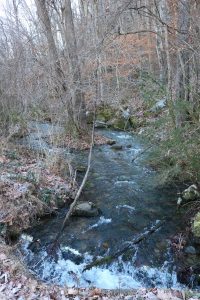
Photo by Lydia Berglar – A stream in Canyon Park Estates is one example of the natural beauty in Dade County, a beauty of which Stephen Bontekoe says, “It’s a very low bar to maintain what we have, but it’s a very high cost to get it back if we lose it.”
Regular Sentinel readers may be familiar with Stephen Bontekoe, the Dade County soil conservationist and executive director of Limestone Valley Resource Conservation and Development Council. He’s spoken with the Sentinel for articles about local waterways, USDA grants, the permeable pavement lot at Jenkins Park, septic repair grants, and much more.
Discussions about environmental concerns are too often split along party lines. The general narratives and stereotypes in the media are that Democrats/the Left/liberals care about the environment, but Republicans/the Right/conservatives disregard the earth in favor of their own interests.
Because Bontekoe is a conservative who also cares deeply about stewarding the natural world well, the Sentinel spoke with him to capture nuance in an issue that is too often misconstrued in the name of party lines.
Bontekoe’s love of the natural world started in childhood. He grew up playing in woods and creeks and enjoyed gardening as he got older. He eventually began farming full time. When the conservationist position with the county opened up (along with the joint partnership Limestone Valley role), Bontekoe applied. The job fit well with his agricultural pursuits, and it kept him close to home.
Bontekoe and his wife bought an old coal mine on Sand Mountain and worked the land for 12 years to restore it. Bontekoe said, “All these things I promote professionally we did on our farm. There was a lot of mud and scrubland when we bought it, but we turned it into pastureland. That mud is now productive grass.”
After that project, the family bought another old coal mine on Lookout Mountain and are now working to restore this land as well. The family raises cows, sheep, goats, chickens, turkeys, herbs, vegetables, and even planted a fruit orchard.
While these properties were cheap, the restoration projects cost a lot of sweat equity. Bontekoe said, “We believe in a stewardship ethic. It’s not just something I talk about; when I leave work, it’s something I go home and do.”
Of his political views, he explained, “My politics are rooted in my faith. I hold conservative beliefs, but I also believe in grace. Historically, the role of the Church has been to meet the needs within the community, and I believe it is still the role of the Church to be a good neighbor. In places where the Church has failed to do so—over centuries, this was a slow shifting—government has stepped in. It has become somewhat the role of government to continue to meet those needs.”
(Those who don’t hold Judeo-Christian values can replace “the Church” with any civic group or nonprofit for the purpose of this conversation.)
Bontekoe continued, “There are times when I feel it’s important to act out of compassion, but I believe that should be individuals meeting the needs of individuals, not necessarily the government subsidizing individuals.”
His views on environmental care are also rooted in his faith. “I believe in the Genesis mandate, meaning we were put here to steward and care for, rather than pursue manifest destiny, take, and extract. Never have we seen God say, ‘Go free and wild.’ There have always been confines and discipline. Stewardship of the natural world very much falls within the character of what we’ve seen God calling us to.”
To differentiate between an activist environmentalist and a steward of the environment, Bontekoe asked, “What are you elevating? Are you making the environment the end-all be-all? Or are you looking at it from the standpoint that we were called to do it by God? While the environment is not the end-all be-all, it is a means of glorifying God. When God gives us a task, it is for His glory, but even in difficult tasks, it is something that makes us stronger or better.”
When the natural world is healthy, human beings benefit, but Bontekoe doesn’t see this as the primary reason to care for the earth. A slippery slope of caring foremost about what we want can lead to greed and selfishness. He used examples of extracting resources from the earth, like harvesting timber. A greedy mentality can lead to acting without concern about the impact of improper harvest.
He explained, “I don’t have a problem with extraction of resources from the earth, but it needs to be done in such a way that the impacts are not detrimental to others. If the process I am benefitting from is killing people, then we need to reexamine that extraction process. We have a problem if my liberties tread on your freedoms. Therefore, we have guiding principles, morals, and laws.”
People do not live on isolated parcels. Even if you own hundreds of acres, your land connects to someone else’s land at some point. Bontekoe said, “While I own a piece of Dade County (or more realistically, I rent it from the government—if I stop paying my taxes, they’ll take it), we don’t live in isolation. Things I do on my land affect my neighbors as well as me.”
Therefore, Bontekoe considers what long-term impact his actions on his land could have on his neighbors. He recalled one instance from years ago when a neighbor negatively impacted Bontekoe’s land inadvertently.
The neighbor moved a stream on his property, but because it hadn’t been permitted, this was illegal. Bontekoe said, “What was the big deal? The neighbor couldn’t understand. He had a benefit in moving the stream so it wouldn’t impact a spot on his property. The problem was, that stream flowed onto my property and fed my pond. When he moved it, it no longer fed my pond.”
The new flow of the stream would have also ruined another neighbor’s hay lot. Bontekoe said, “Giving consideration to your neighbor is an important part of how we interact as a community and care for our surroundings.”
A big part of Bontekoe’s job is working with grants so that Dade residents can benefit from grant programs. Some people ask him why the state and federal governments take this money in the form of taxes just to give part of it back in the complicated and constricting form of grants. In the case of grants for septic system repairs, couldn’t the government take less in taxes so that homeowners would have money to fix their systems without needing the grant?
Bontekoe agrees that this would make more sense. In general, he would be in favor of less taxation and, therefore, more autonomy. However, because the system is what it is, he uses his role to serve his community. “If I can go out and manage government funds and bring them home to improve my community, that’s a good legacy. As long as this representative government does tax and does have a budget for land management, my role is to advocate to bring those dollars home.”
Once removed from a community, taxes go somewhere. People like Bontekoe work through the red tape to bring as much of that money home as possible. Bontekoe said, “There are plenty of counties that don’t have that advocacy, and their tax dollars are going elsewhere.”
When asked if caring about the environment must always be political, Bontekoe said, “The environment is a human issue, not a political issue, but politics are going to get involved anytime humans are involved. Ultimately, I think the political divisions come down to how we prioritize the environment, what our end goal is, and how we go about funding it.”
Just about everyone—Republican or Democrat—agrees that we want clean water, beautiful landscapes, and food production. These are non-partisan issues, but Bontekoe said, “We’re too tribalist about it. It’s us against them, but this isn’t debate club. We’re not here to dig in on our opposite sides; we’re here to look at what the best community impact is.”
Noting that there are a few particularly divisive issues, Bontekoe said, “We do get into issues like whether or not we should all drive electric cars and stop oil and gas. You’re not going to get me on board with that. Do I think humans have an impact on the environment around them? Yes, I do, but there are so many other layers of how to address without carte blanche, sweeping measures. We need to look at solutions, not some sort of mandated quick fix.”
Bontekoe noted that the Left has generally championed environmental concerns, but not always with effective plans. “The actions proposed have been so radical and economically unfeasible, that the Right has reacted with, ‘If you’re for it we’ll be against it.’ In reality, if you look at what’s happening on the Right, they’re not against it.”
He explained that policy makers on the Right continue to fund conservation, but they approach it from a different ideology. “They’re not coming at it from a Federalist standpoint. They come at it by empowering the people to do it out of their free choice. The conservative approach has been that each individual person on their individual land can make a bigger impact.”
Bontekoe believes that the political distinctions in environmental matters come down to opinions about how to fund and approach the work. “The conservative mindset is to empower the people to do the work, and the more liberal mindset is to tell the people what to do and make them do it. I prefer to be given options and the liberty to enact those options.”
He explained the difference between mandates and limitations. “To come in with policies that must be done, that’s a mandate. To say this is unsafe and has negative community impacts so we’ll limit it is something else. We’re not saying you can’t do this. We’re saying there’s a limit to what you can do.”
Natural limitations dictate what can be done without drastic consequences. Bontekoe used the example of trying to build a yacht club in the desert: It doesn’t work. “That’s a limit. I’ve been limited by the natural resource that isn’t there, but there are times when human limits need to be put in place because people don’t understand the natural limits around them.”
Take, for example, the clear cutting that was happening on the side of Lookout Mountain. The natural slope of the mountain imposes the limit that you cannot over-extract without causing negative consequences, but humans will not always respect this natural limit. Bontekoe said, “You can’t cut all these trees or else the slope will wash away. That’s a natural limit, but it’s one that someone could ignore.”
The limitation in the first example is obvious, but the example of deforestation requires a bit more knowledge. Therefore, “It’s when that natural limit isn’t apparent to the individual that regulations—imposed limits—are needed.”
This comes back to Bontekoe’s point about liberties and freedoms. He said, “The landowners had the right to clear cut the side of the mountain, but if they didn’t use best management practices, if they over-extracted it and didn’t have proper land cover and such—all of which costs money and cuts into profit—it could’ve caused a mudslide which would negatively impact the water supply and could impact the foundations of the houses at the top of the mountain.”
Of course, as Dade Countians, we value our freedom, and we value having control over our land. Noting the mantra, “It’s my land; I’ll do what I want,” Bontekoe said, “If you doing what you want on your land negatively impacts the community, your liberties have infringed on others’ freedoms. That’s why laws are written and why we have more government: because people cannot, or choose not, to consider the impact of their actions on others.”
The Sentinel asked Bontekoe what he would say to anyone who tends to dismiss environmental concerns simply because they don’t fall within the stereotype of his or her political party.
He answered, “Step out of the concept of politics, and ask yourself, do I care about my neighbor and my surroundings? Do I want to live in a place with clean air and clean water and beauty all around me? If you don’t, move, because this place is beautiful, but if you do want those things, it’s a very low bar to maintain what we have, but it’s a very high cost to get them back if we lose them.”
This last part is crucial when it comes to deciding how to build something, to doing environmental impact studies, to considering budgets and benefits of a project. Bontekoe said, “If you are fiscally conservative—meaning you want the least expensive solutions—every conservative should be trying to maintain what we have so we don’t have the cost of trying to regain it in the future. The lowest cost is to maintain what you have. I’m not proposing how we pay for maintenance—that’s a political question. I’m just saying that if we all do our part, there’s less cost in labor, money, cancer, sickness, lost quality of life, etc.”
He concluded, “Build it right the first time, even though it’s generally more expensive, and maintain it. That’s cheaper and easier than expensive repairs down the road.”