County Meeting Covers New Homestead Exemption And Potential D.R. Horton Development
By LYDIA BERGLAR
News Editor
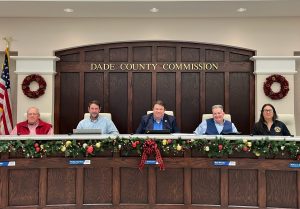
Photo courtesy of Carey Anderson –
It’s a new year and a new Dade County Board of Commissioners. From left: Bill Pullen, Phillip Hartline, Don Townsend, Bob Woods, and Melissa Bradford.
Thursday, Jan. 2, was the first Dade County Board of Commissioners meeting with Don Townsend as county executive, Bob Woods as District Three commissioner, and Doc Pullen as District One commissioner.
The board appointed Gidget Knight to the position of county clerk at the end of the meeting. There was some discussion as to whether this appointment can or should happen in executive session, but in the end, the appointment was made in the public meeting.
Townsend reported that Knight has worked for the Better Business Bureau for 33 years. All commissioners were in favor of hiring Knight. Also new to the county staff is Caleb Bradley, Townsend’s new administrative assistant.
At the end of the meeting, the board unanimously chose Woods to serve as the vice chairperson, and partway through the workshop session, Melissa Bradford (District Four commissioner) volunteered to serve as the ACCG County Legislative Coordinator.
Phillip Hartline (District Two commissioner) mentioned the new building maintenance position and asked why the role hasn’t been filled. Townsend said there hasn’t been time yet to hire someone, as he has just taken office, but Hartline noted that the position’s been accounted for in the budget since July.
Then, per Bradford’s recommendation, the board reappointed Daniel Glecier to the Dade County Water and Sewer Authority to continue representing the Lookout Mountain district.
Moving on to Special Purpose Local Option Sales Tax expenditures, the board approved a total of $127,014.17 for emergency services equipment from Stryker. Alex Case (EMA director) explained that the cardiac monitors were purchased in 2011 and are now end-of-life, with one no longer even turning on.
He also requested a stretcher and lift to be included in the purchase, along with other less expensive supplies. Stryker offered an end-of-year deal on the pricing and money back from trading in the old machines. The board approved the expense with Pullen voicing his approval of this equipment.
Hartline did not have an issue with this purchase, but he said, “What I would like to see 120 days before the end of our contract is to look at maybe some other alternatives instead of supplying Memorial all this equipment.”
Next, Elizabeth Zeller (water authority general manager) requested $127,000 in SPLOST funds to help pay for an eight-inch water line and sewer line replacement at I-24 and GA-299.
The official letter explained, “As a result of the failed pilot bore crossing on I-24, Dade County Water and Sewer Authority will go through an existing 48” casing…As a result of the installation of the sewer main, the project has exceeded its budget.”
The board approved this expenditure.
Paula Duvall (chief tax assessor) then presented information about Georgia House Bill 581, which includes the floating homestead exemption as discussed at the last two Dade County Board of Education meetings.
After attending a one-day seminar about the bill, Duvall had a better grasp of everything contained in the bill. She explained that assessment notices will now show the estimated rollback rate instead of the estimated tax amount. Then, when tax bills are sent, if governing bodies do not follow the rollback rate, it will be noted on the bill.
She covered several other minor changes that affect the tax office, but the portion of the bill that most impacts taxpayers is the tax exemption portion. The school board is opting out of the floating exemption, and the county and city must decide if they are also opting out. The opt-out process deadline is March 1.
As explained in previous articles, the new floating homestead exemption created by HB 581 is not added on top of Dade’s existing exemptions; rather, whichever is most beneficial to the property owner will automatically be applied. Duvall noted that properties that had values frozen years ago will most likely benefit more from keeping the existing exemptions.
As of now, Duvall does not know of an acreage limit, unlike Dade’s existing exemptions. Someone owning many acres could benefit significantly from the exemption.
Woods asked, “This got approved state-wide, so what gives us the authority to change our mind? Does this happen with every bill?” Duvall explained that the opt-out option was specifically included in this bill.
Reading from the slides (which are available via the county’s website), Pullen quoted, “Taxes do not disappear–they only shift: in this instance, the taxes are shifting from homestead properties to all other property types (commercial, agricultural, industrial, residential non-homestead).”
Duvall agreed, saying, “An exemption is basically a shift in who pays the amount of taxes. It’s not that the county’s not going to get a certain amount of money. They’re going to get the money they need, but a smaller group of people are putting more money in that pot.”
The slides also included the following: “Since the floating homestead exemption slows the growth in value for residential homestead properties, it will create some upward pressure on the millage rate. The effects of a floating homestead increase over time, so this will have a smaller impact in the early years and a larger impact in the later years.”
She then explained the Floating Local Option Sales Tax (FLOST). Excluding boards of education, governing bodies that do not opt out of the exemption have the option of levying FLOST, up to one cent. Townsend said FLOST would lower the millage rate.
In summary, the exemption could mean lower property taxes for some but not all. It could also mean higher sales tax for everyone if the board passes FLOST. It could also result in a higher millage rate in order to make up for the deficit caused by the exemptions. Ultimately, the county sets the millage rate at the amount needed to meet the budget.
Townsend and Bradford do not want to opt out because people voted for the exemption, but Hartline wants to opt out because he does not support the increased sales tax. Pullen’s initial inclination is to opt out.
Hartline added, “As a commissioner, I read that question the day of the election. That’s not what the question asked. It didn’t tell any of this other stuff…I think the citizens was misled. That’s why I’m not for it.”
The board reviewed the proposed fire agreement for 2025-2026. Townsend suggested that each commissioner meet with his/her district’s fire chief before the board votes on the agreement.
Woods said, “All the fire chiefs get together, and it just becomes a big phallic symbol measuring contest where not a damn thing gets accomplished, so who’s going to force and have oversight in that meeting where something can actually come out of it that’s worthwhile?…I’ve heard from numerous, well-intended, great fire leaders about the meetings and what doesn’t happen, what should happen, etc. If we’re starting off the new year with a new team, let’s work so we can support the collective fire departments that we have.”
Bradford and Hartline both suggested that commissioners meet individually with their fire chiefs before having a joint meeting with the fire chiefs and the commission. The board collectively agreed with this plan.
The board handled other annual business: approving the Tax Anticipation Note (allowing the county to take out a loan if needed to cover expenses before tax payments are received), approving the memorandum of understanding with the Family Crisis Center, and approving the agreement with the public defender’s office. Nothing in these three items changed from last year.
During Citizens Participation, Rebecca Cartwright spoke. She first noted that HB 581 will stay in effect for 50 years.
She then mentioned the 78 acres that the City of Trenton has been asked (by D.R. Horton) to annex. (See the Dec. 18, 2024, Sentinel.) She addressed the national builder’s poor reputation.
One particular example Cartwright mentioned was that D.R. Horton’s building permit was taken away in a Louisiana parish, so the company abandoned the incomplete subdivision. (WRBZ 2 covered the issue in January 2024 with the title, “Another D.R. Horton subdivision under duress after finding out their HOA may never be turned over to home owners.”)
Cartwright voiced concerns about the potential development, saying, “Having 130 homes coming all at one time, that’s a lot of traffic…Would it make us too big too soon?…Would we lose some of our funding for the schools because of that? These are questions I’m wondering.”
Bradford noted that she is unfamiliar with the issue, but that more students mean more funding. Cartwright recalled an issue in Catoosa County where growth impacted school funding.
During the commissioner’s individual reports, several returned to the D.R. Horton issue and Case (as mayor of Trenton) also spoke.
Hartline said, “You talk to one person, ‘I want to do what I want to on my property. This is my land.’ In the same sentence, that person or somebody else will say, ‘I don’t want this person doing what they can on their land.’ So, we’re up here trying to find a happy balance.”
Townsend noted that the D.R. Horton development is a city issue, but he said the county does have a need for housing. He said, “I guess my position on it is, the city does have zoning, the city does have extensive ordinances in place for code enforcement, and therefore, if the city code enforcement makes them do the right thing, no matter who the builder is, they should jump through the right hoops.”
Hartline later said that the county needs to consider how much water can be drawn from Lookout Creek, to which Case explained that the water authority and engineers are already involved to assess how much water is needed, as well as fire protection issues. With any proposed development, the water authority uses a 5,000 gallon per household per month average, so D.R. Horton’s proposed project would require 650,000 gallons per month.
Case noted that Sells Lane and Cedar Lane could not handle the increased traffic, so that would need to be addressed, but he also cited the need for more housing.
He said, “We do have some choke points. Those choke points will be the impact fee or the impact study that we will request that they would have to do…We have heard the horror stories too, but it goes back to inspections…Sometimes people cut corners, and it’s our job as inspections inside the city to make sure it’s safe.”
He said he had contacted Walker County about the D.R. Horton development near Ridgeland High School, but our neighboring county hasn’t had many issues with the company.
The city commission will be discussing the issue at its Jan. 13 regular meeting.
Pullen reported on the total 911 calls for 2024:
- EMS: 2,653
- Fire: 3,849
- Law Enforcement: 4,110
Townsend reported that Lookout Mountain Judicial Circuit court reporters are receiving a large salary increase (per chief Judge Brian House’s decision) in order to attract and retain court reporters. The current salary is $26,815. Next fiscal year, it will be $65,000. Each county contributes to the salaries based on their population, so Dade’s contribution is only 9.233 percent, meaning Dade will contribute about $24,000 (split among the four court reporters) next fiscal year.
Jennifer Blair asked to speak partway through the meeting after Citizens Participation, so near the end of the meeting, she was given the floor. She said that civic engagement ought not be discouraged. While she appreciated the officials’ responses to Cartwright, Blair feels that this discussion should have continued while Cartwright was still at the microphone before being dismissed.
Blair also believes that a citizen should be able to donate his/her five minutes to another citizen to continue a conversation. She clarified that disrespect should not be tolerated, but she asked the commission to be very careful with regard to censorship.