Georgia Emergency Management Directors Offer Mutual Support After Disasters
By LYDIA BERGLAR
News Editor
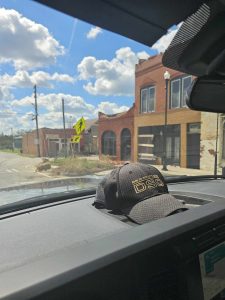
Photo courtesy of Alex Case – Alex Case photographed damaged buildings in downtown Mount Vernon during his trip to assist Montgomery County emergency management.
This past fall, Alex Case (Dade County emergency management director) had the opportunity to assist a south Georgia county in the wake of Hurricane Helene. Each year, Georgia emergency management directors sign a mutual aid agreement through which Case received support after Dade’s 2011 tornadoes and has now been able to help another county.
After natural disasters, affected counties can apply for state and federal assistance through the Georgia Emergency Management and Homeland Security Agency (GEMA). There’s a threshold of how much damage must be sustained to public roads and public buildings before state assistance kicks in, and the entire state has a large threshold before federal aid is administered.
Case spent Oct. 3-9, 2024, in Montgomery County, and he was delighted to be able to help. “This was the first time I’ve gotten to respond, aside from helping our neighboring counties,” he said. The south Georgia county experienced winds of 105 miles per hour.
Another EMA director also went to Montgomery County, and others rotated in and out of other counties that needed help.
While Montgomery County is 247 square miles compared to Dade’s 174, the county’s population is only 8,761 people compared to Dade’s 16,165. The county contains six cities, and Case spent most of his time in Mount Vernon, the county seat. Case reported that the Montgomery Sheriff’s Office is about a quarter of Dade’s, the county has a very small administrative team, and all six fire departments are entirely volunteer.
Just about every house and road in the county sustained damage. When Case arrived, they were on day seven without power. The generator in the emergency operations center (EOC) burned out from running continuously. Finally, power came back ten days after the storm.
Describing the damage, Case said countless trees were down, houses had trees through them, shingles were blown off, and sheds and carports were crumpled. South Georgia’s pecan and timber industries were heavily impacted, and he saw entire orchards blown over. “You see it on TV, but to see it in person was unbelievable.”
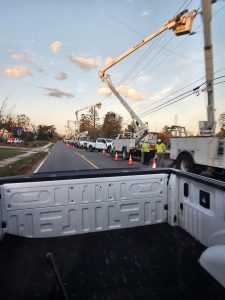
Photo courtesy of Alex Case – On his way into Montgomery County, Alex Case passed about 30 trucks in a row working to replace power lines, and he saw hundreds more throughout the county.
Case’s job was to help the EMA director with the administrative tasks. He said, “My biggest thing was to assist emergency management so they could take a break and start getting this public assistance paperwork together. We helped with the administrative work of emergency management, reporting all data back to the state, and gave them a break on Saturday and Sunday so they could go to church.”
In order to get state aid, counties must track how much damage was done. When Case arrived, Montgomery County hadn’t had a chance to start this paperwork. He was able to get this started while the other assisting EMA director organized supplies like MREs (meal ready-to-eat), ice, and tarps, and set up supply distribution points.
Case said, “Montgomery County was like home to me. It’s like here; everybody knew everybody. I met so many nice people, so many people who were appreciative. We’ll be friends from now on.”
The trip reminded him of how far Dade has come since 2011, and also how helpful three other EMA directors were in the aftermath of the tornadoes. Case recalled the first tornado on the morning of April 27, 2011, and watching Dade Elementary School’s roofs being destroyed. The second tornado did the most damage, came straight through town, and resulted in two deaths. The third tornado, which came through Rising Fawn, was less devastating.
Dade lost power, water, and internet. Fiber lines and a radio tower were damaged. Case explained, “At that time, we didn’t have redundancy loops of communication out of the county.”
He flew over the county three times after the storms, first with the National Weather Service, then with GEMA, and third with the Department of Natural Resources. Amidst the green spring foliage, the storms left a brown, dead path.
Several days after the storm, three other EMA directors came to Dade and worked with the Dade County Sheriff’s Office (DCSO) to organize volunteers and supplies. Case said, “They more or less managed every volunteer organization and point of distribution, which took a load off me. I was able to keep submitting paperwork.”
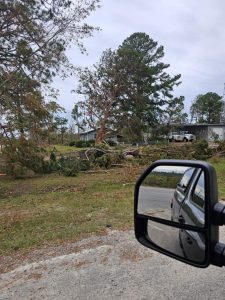
Photo courtesy of Alex Case – Large trees fell around Montgomery County’s Georgia Forestry Commission building.
Like in Montgomery this fall, the process of checking public roads and public buildings and assessing damage was similar. Teams went out to see how many homes were affected (sustained some damage), damaged (still livable but may have major damage like a tree through a room), or destroyed (home is off the foundation). Through the tax assessor’s office, counties estimate the damage in a dollar amount.
The state also needs to know how much overtime county employees (public works, sheriff’s office, 911 call center, and fire departments) work due to storms. Case explained, “FEMA (Federal Emergency Management Agency) can reimburse all this overtime caused by the storm, but you have to track all of it. That’s the paperwork we have to do.”
After 2011, Dade County added two software programs, Crisis Track and Cartegraph, to simplify all of this documentation. Overall, Case said the county is far more prepared for disasters than we were back then.
In 2011, the county administrative building and the jail had generators, but the water and sewer plants did not (which led to the water outage). Now, these plants are equipped with back-up generators.
Dade also added outdoor warning sirens and storm shelters, and communication redundancy has improved. Case is excited about a new development in this area that resulted from Hurricane Helene. “When I was down in Montgomery, if it wasn’t for Starlink, we wouldn’t have had internet. I saw what it was doing, and then Elon Musk donated 300 of them to the state of Georgia. I put in a request for two: one for our EOC and one for the sheriff’s office.”
Since his October trip, Case has checked in with his new Montgomery friends every few weeks. The county had some flooding after the hurricane, but recovery efforts continue.
Noting that he’s thankful Dade’s county commission allowed him to go, Case said, “I’m blessed that I can share what I know and what I’ve learned. Also, what I learned while I was down there could help us here if we have another major disaster. I’m blessed that the commission allows us to have the budget to get these EMA resources (like Crisis Track) and they let us go after these grants (like the storm shelter grant).”
Case is especially thankful for Dade’s emergency response team because he knew the county would be taken care of while he was gone. “I felt good going down because I know Daniel Jones, Thomas Lyons, Ansel Smith, Jerry Kyzer, and Kyle Gross were here. EMA isn’t me; it’s this team.”