DCHS Healthcare Students Start Clinicals At Erlanger
By LYDIA BERGLAR
News Editor

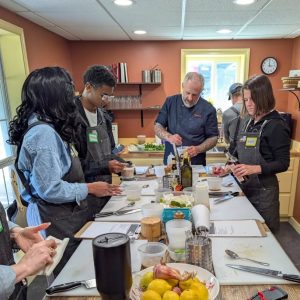
Photo courtesy of Dade County High School – Starting this year, DCHS students in the third-level healthcare class are completing clinicals at Erlanger and have an opportunity to become patient care technicians while still in high school. The students pictured here have already learned a lot at the clinicals.
Dade County High School students in the Career, Technical, and Agricultural Education (CTAE) healthcare pathway have a new opportunity this year to work with Erlanger Patient Care Technicians (PCTs).
The third-level healthcare class was formerly called “Allied Health,” but Allison Vice (DCHS Health Occupations teacher) worked to transition to the new PCT program. As she explained at the May Board of Education meeting, Allied Health included shadowing healthcare professionals, but it didn’t include hands-on experience or a path to obtain licensure.
After completing clinicals at Erlanger Hospital in the new course, students who pass the PCT certification exam will soon be employable at age 16. (Erlanger’s starting PCT wage is nearly $16 per hour.) This is one small step to address the national healthcare worker shortage.
Vice explained, “Because they’re so short-staffed, Erlanger made a new PCT job description for 16-year-olds who complete one of these programs. It’s waiting to be finalized legally. A lot of my students are working in restaurants, working school nights until midnight. If they can do a 12-hour shift on a weekend and make the same amount of money, they can focus on school throughout the week.”
This semester, the students have completed two clinicals with two more to go and potentially one optional full Saturday shift coming up. The Sentinel heard from Lilian Baker, Ayden Miles, and Jenna Hurst about their experiences thus far.
While Erlanger offered eight full days as options for clinicals, the school wanted to limit how much class time students missed, so Vice found four half-days that worked well with the school calendar. The students, however, have requested an optional full-shift day, so Vice is working on setting up a Saturday clinical.
Baker explained, “When we go, we don’t have enough time to fully see how everything runs. We’re only there for two hours. We don’t get to see them start and end rounds.”
Miles added, “We’ve already learned a lot in those two-hour clinicals, so what could we learn in a whole day?”
Before arriving at Erlanger, the students know which unit and which PCT they’re assigned to. Once they find their PCT, “We just run,” said Baker. “We jump straight into it.”
On one of the clinical days, Miles was dropped off and immediately went to help clean up a patient. She said, “We get to help clean up and move the people in the beds.”
A key outcome of the experience is that students are figuring out whether or not they’re good fits for the healthcare field and even which specific job within the field could best suit them.
Baker explained that clinicals confirmed her interest in the medical field because she’s now seen the full picture. “Beforehand, I was split between pursuing elementary education and healthcare. After going to Erlanger, I think healthcare is pretty cool. We get to see a lot that we can’t do here in class. When we go to clinicals, we get to see people actually doing all of the parts that have to be done to run the hospital and how fast-paced it can be in real time.”
Specifically, Baker is considering pediatrics. “I feel like I connect better with kids than with adults, but I can’t shadow pediatrics until I’m 18. For now, I’m seeing what I could do if I weren’t to do pediatrics, but I’m still pretty set on that route.”
Similarly, Miles feels that she is being prepared for her future career through clinicals. “It has very much confirmed what I want to do for my future. I feel more confident and excited about what I’m going into. I’ve been shadowing really great PCTs who’ve encouraged me to have a good relationship with patients. Just seeing how they talk to patients makes me want to be like that one day.”
Baker and Miles both value connections with patients, but Hurst gained some valuable insight into her strengths and weaknesses. She explained, “I’ve learned that I’m not the most compassionate person, but I was thinking I could be a nurse anesthetist. I will still be able to help people, just with not as much patient interaction.”
She’s not set on the healthcare field for sure, but she said, “Going to Erlanger has definitely made me feel more confident that this is a path I could take. The PCTs and nurses are very encouraging. They say, ‘Do you want to help? Put on some gloves and help me do this.’ It’s better learning it from them with real people than it is trying to learn it on a mannequin.”
Vice (who, in addition to teaching, is a part-time RN at Erlanger) hopes the students continue witnessing how the entire hospital team works together. “Yes, we’re learning to be PCTs, but I want them to observe and absorb everything. I told them to watch how all the roles work together. Watch when a physical therapist comes in the room, how they interact, and how what they do affects what the PCT does. You might think that being a physical therapist means you’re only helping with ambulation, but I’ve seen physical therapists help change briefs before. Everybody works together as a team. You’re taking care of the whole patient, not just your one primary role.”
Echoing the students, Vice is glad that her class is getting to work in real life situations. She said, “Ayden and Jenna got to do a chest vac and a pressure dressing on a patient who’d had open heart surgery. When I was dropping off one student, the patient was in the process of getting restrained because they were being combative. I told her, ‘You got this!’ and she had a great day. This is real life; this is what you’re going to see. I can show them how to do things in the classroom, but it’s nothing like in-person, real life.”
“As bad as it sounds, I want to see a code,” Miles said, and her fellow students agreed that they hope to witness a cardiac arrest.
Baker explained, “I want to know, if I were to end up in that situation, what do I need to do? I know there’s the team that runs in and starts CPR, but what do I need to do? I want to see what it actually looks like in the chaos.”
Miles furthered, “It’s such a high stress situation, and that’s where your skills really have to show. It’s so shocking, and I would like to experience that while I’m shadowing so maybe it wouldn’t be such a shock later on.”
Hurst agreed that she wants to experience the stress of life-or-death situations, particularly on the trauma floor. “I want to see what it’s like when they bring a trauma patient in and how they decide who does what.”
Vice reported that just about every hospital nearby offers tuition reimbursement for students who complete the program, pass the exam, and work as PCTs. Another perk is points for nursing entrance exams.
In Miles’ words, “I’m so thankful for this program because it feels like it’s opening a door for us. It’s doable now, when before, it felt like I’d never get there.”