Compensating Local Elected Leaders: How Much Do They Earn?
 By LYDIA BERGLAR
News Editor
Every so often, the question arises of how much local leaders and elected officials earn—and whether these salaries are appropriate. This year’s county budget hearings included questions from citizens on the topic, specifically about the county executive salary.
This article focuses on the county executive and commissioners of Dade County, the mayor and commissioners of the City of Trenton, and the Dade County Schools superintendent and Board of Education members. (Note that in this list, the superintendent is the only appointed rather than elected position.)
There are, of course, other important local leaders whose salaries could be addressed (including the sheriff, district attorney, school principals, Emergency Management Agency director, and many more), but for now, let’s limit the scope to the three major government boards in our county.
Starting with the City of Trenton: The mayor’s monthly salary is $1,200 (totaling $14,400 per year), and commissioners’ stipends are $600 per month ($7,200 per year).
These amounts are set through the Official Code of Georgia. O.C.G.A Sec. 36-35-4 reads, “The governing authority of each municipal corporation is authorized to fix the salary, compensation, and expenses of its municipal employees and the members of its municipal governing authority.” The code also explains that municipal governments can provide insurance and benefits.
However, any vote to increase compensation and/or benefits does not take effect until “after the taking of office of those elected at the next regular municipal election.” Actions to increase compensation and/or benefits can’t be made after candidates qualify to run in an election, and notice of intent to take action must be published in the legal organ.
Regarding schools and school boards, the majority of superintendent salaries in Georgia are negotiated between the superintendent and the board of education. Given that school boards hire superintendents, this fits with the chain of command. The total fiscal year 2025 salary for Dade County’s superintendent is $149,335.08.
Per O.C.G.A Sec. 20-2-55, school systems with no “local Act” will pay board members $50 per day of attendance at board meetings. Having no “local Act,” Dade’s school board members receive $50 per meeting they attend. If a training or a work session happens on the same day as a regular meeting, members are still paid just $50.
Not counting work sessions and trainings, BOE members could make $600 a year.
Now for the more complicated salaries: county government. The Association County Commissioners of Georgia (ACCG) publishes an annual “Computing County Official Salaries” guide, but this does not establish the base salaries. Base salaries are set locally, and the guide simply outlines how each cost-of-living adjustment (COLA), longevity bonus, and training supplement should be applied to that base salary.
The guide calls county executives “elected CEOs.”
The COLAs are the same for all commissioners and county executives, using every COLA from 2002 onward. Some years did not have COLAs. From 2002 to 2025, there are 14 COLAs ranging from one percent to three and a half percent.
A training supplement of $1,200 is added to the base salary for commissioners and county executives who earn a certificate of completion of training from the University of Georgia’s Carl Vinson Institute of Government.
The guide outlines that commissioners and county executives serving four-year terms earn a two-and-a-half percent longevity increase for each consecutive completed term. The longevity increase is capped at 11.25 percent for commissioners who have completed five terms since Jan. 1, 2005.
As for the base salary, the 2024 salary guide reads, “The base salary may have been set by local legislation or through the home rule procedures described below.” Dade’s base salaries were set through local legislation. More on that later.
Dade’s county commissioner base salary is $4,000. Once longevity, COLAs, and training supplements are taken into account, these are the 2025 salaries for the incoming board.
- Lamar Lowery (District One commissioner): $14,532.58
- Phillip Hartline (District Two commissioner): $12,900.91
- Bob Woods (District Three commissioner-elect): $12,586.25
- Melissa Bradford (District Four commissioner): $14,532.58
Currently, Ted Rumley (county executive) earns $107,908.25, but Don Townsend (county executive-elect) will earn $101,098.41 when he takes office in January 2025. He will have completed the Carl Vinson Institute training, the 2025 COLA will be applied, but he will not have any longevity.
When comparing Dade salaries to other counties, things get complicated. One reason is that some counties have both a county executive (full-time or part-time) and a full-time county manager (sometimes called “county administrator”). In Dade, however, both roles are filled by one person, referred to as the county executive. Many would argue that someone filling both roles should be compensated accordingly.
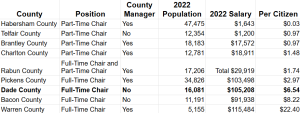
The Georgia Department of Community Affairs (DCA) publishes a Wage and Salary Report that lists county (and city) populations, government positions, and salaries. The most recent report is from 2023, using data from 2022. It does not include county managers, nor were Dade’s commissioners (aside from the chairperson/county executive) included, but the Sentinel looked up which of the counties included in this article have county managers.
The DCA report lists Dade’s population as 16,081 and Rumley’s 2022 salary as $105,208. Divided by population, that salary equals $6.54 per citizen.
The county with the next highest population to Dade was Charlton County, with 12,781 people. The part-time chairperson made $18,911, equaling $1.48 per citizen, but the county also had a county administrator.
Below that, Telfair County had 12,354 people, and the part-time chairperson made just $1,200, or $0.97 per citizen. Telfair did not have a county manager.
The first county with a population higher than Dade was Rabun County with 17,206 people. The full-time chairperson made $16,500, equaling $0.96 per citizen, but the county also had a part-time chairperson on the report who made $13,419. The combined total of the two positions was $29,9190 and $1.74 per citizen—still well below Dade’s numbers, but Rabun also had a county administrator.
Although Brantley County’s population was even higher at 18,183, Brantley only had a part-time chairperson who made $17,572 (or $0.97 per citizen). Brantley also had a county manager.
As for other interesting comparisons from the report, Pickens County’s population was more than double Dade’s at 34,826 people, but the full-time chairperson made less than Rumley at $103,498, or $2.97 per citizen. Again, Pickens had a county manager.
Confusingly, Warren County only had a population of 5,155, but the full-time chair made $115,484, equaling $22.40 per citizen. Even more baffling, the county also had a county manager.
Bacon County’s per citizen rate was also high, but the county did not have a county manager. With a population of 11,191, the full-time chairperson made $91,938, or $8.22 per citizen.
Also baffling, Habersham County had a population of 47,475, but the report only listed a part-time chairperson who made $1,643, or $0.03 per citizen. The best explanation is that Habersham also had a full-time county manager.
We could also dive into average income in these counties for further nuance, but for now, we’ll stick with population size.
The Sentinel contacted Larry Ramsey (General Counsel with ACCG), confirming that counties have a say in their base salaries and asking why population and/or average income isn’t taken into account when setting salaries.
He responded, “You’re right that state law has a process whereby boards of commissioners can set their own salaries. However, in most cases their salaries are set by the General Assembly via local act (a state law that only applies in that county). Because those can (and do) vary greatly county-by-county, the ACCG Salary Guide doesn’t dig into those local-act nuances but rather deals with the ‘general’ rules that apply to county officials’ salaries in the absence of such local acts.”
He further confirmed that Dade followed the local act route, meaning the base salaries had to be confirmed by the Georgia General Assembly.
Now for a quick summary of local history. Dade once had a sole commissioner form of government before transitioning through several other board forms and finally reaching the current form: four elected board members and an elected chairman of the board (the county executive). This took effect in 2005.
At this point, the local act was established, setting the base salary as $500 above the highest paid constitutional officer’s salary.
However, when calculating the salary for 2009, the question arose of whether or not the base salary should be reset every time the top paid constitutional officer changed. It was decided (and confirmed by the ACCG) that the base salary would not be changed each time. Therefore, the county executive’s base salary would henceforth be $500 over the salary of whoever was the top paid constitutional officer on Jan. 1, 2009.
Having served many terms as tax commissioner, Jane Moreland’s salary was set at $70,000.77 on Jan. 1, 2009. This was the top salary. Since then, the county executive’s base salary should have been $70,500.77. For some as of now unknown reason, it was instead set at $70,219.38. All of Rumley’s salaries have been calculated using $281.39 below what it should have been.
Don Townsend (CFO and county clerk) doesn’t know the reason for this discrepancy. He said neither Rumley nor auditors have questioned it. (Any errors in counties’ salary calculations should be caught during the audit process. Any excess payments would have to be paid back by the person who was overpaid.) Townsend said that the base salary will remain $70,219.38, and Rumley will not be paid the missing amount from the past 16 years.
In closing, does over $100,000 seem like quite a large salary for Dade County? Many would say yes, especially given that the average household income is $59,531 (per the U.S. Census Bureau).
Citizens could argue that base salaries should be set taking average income and/or population into account. One could argue that the leaders who represent our county shouldn’t earn too much more than the average citizen.
On the other hand, how many people would be willing to take a demanding, all-consuming, closely scrutinized job for average pay?
When it comes to compensating leaders, some would argue, “You get what you pay for.” Quality candidates with leadership experience, business acumen, strong work ethics, and mental toughness would likely be leaving good-paying jobs to take office. To attract such a candidate, how much would taxpayers be willing to pay?
However, when citizens head to the polls, they can remember the sums paid to elected officials and vote for the person they believe will best earn the salary.
If citizens are unhappy with how these salaries are set, the only way to change it is by going through the state, which means contacting Mike Cameron (Georgia House of Representatives, District 1) and/or Colton Moore (Georgia State Senate, District 53).