Dade Students Overcome Disability Stigmas And Challenges Through Best Buddies
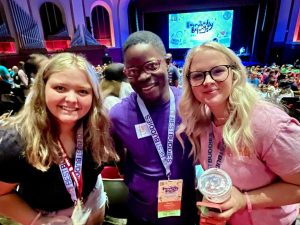
Photo courtesy of Jerzee Crabtree – Over the course of this summer’s conference, Madison Windsor (left) and Jerzee Crabtrßgraduate with an IDD who works at Georgia Tech’s cafeteria now. They loved his energy and sense of humor.
By LYDIA BERGLAR
News Editor
Dade County High School’s Best Buddies club (a chapter of the worldwide Best Buddies International organization) connects students who have intellectual and developmental disabilities (IDDs) with their peers. Now in its second full year at DCHS, the program is also expanding to Dade Middle School.
This July, two student “peer buddies” and two advisors attended the Best Buddies Leadership Conference at Indiana University where they met others from around the world who also care about IDD inclusion and awareness. The students were Jerzee Crabtree and Madison Windsor, accompanied by club advisors Kendra Belcher (special education teacher) and Deidre Stewart (parent mentor for Dade County Schools).
Crabtree and Windsor joined Best Buddies last year. Windsor said, “I didn’t know about it until Jerzee and Miss Karen [Johnson, special education parapro] told me about it. I thought it sounded like something I wanted to do.”
Crabtree said, “When I was younger, I helped with some of the special needs three-year-old and four-year-old classes. I enjoyed being around them. Then in middle school, I became best friends with a girl who has autism. Being around her and learning everything about her helped me see that I have the heart to do this.”
Planning to become an occupational therapist, Crabtree wants to use her career to help people—including those with IDDs—improve their physical ability, so her experience with Best Buddies is a step toward that career.
Each day of the conference opened and closed with all 2,000 attendees in a stadium together. The attendees then split into groups, with IDD students, advisors, and peer buddies each attending their own classes. Crabtree and Windsor attended sessions with others from Georgia, learning how to get other students involved and ways to be a better buddy.
Belcher and Stewart were impressed to hear about how extensive some Best Buddies chapters are; some offer housing and job training programs. Stewart said, “It’s almost like college. They have jobs, they get training, they can live on their own with help through Best Buddies. The sessions taught us how we can improve our chapter and also what’s out there outside of our community.”
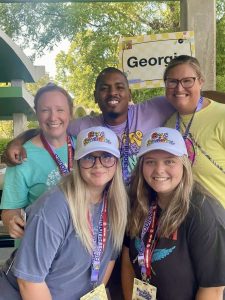
Photo courtesy of Kendra Belcher – Deidre Stewart (top left), Kendra Belcher (top right) and Georgia Best Buddies leader Doug Peters (center) pose with Crabtree and Windsor at the conference.
Each speaker at the conference had an intellectual and/or developmental disability. The girls particularly enjoyed two who run social media accounts with the names Flavor Friend and Kid Autistic. Stewart was impressed by a college athlete who had a traumatic brain injury. The woman shared her story about recovering and moving forward.
Belcher enjoyed hearing from an autistic man who performs on Broadway. She said, “He was told he could never get a part, but now, he’s been in all these huge shows. It shows that people with IDDs can do just as much as we can; they just might have to do it a different way.”
As Crabtree said, “You’re bigger than your disability” is a key phrase for Best Buddies.
Stewart said, “I walked away thinking that we have to let our community know about what’s going on at our school and these students who are pouring their lives into other students.”
At DCHS, Best Buddies meets several times a month for activities during school, but buddies are also encouraged to attend extracurricular events together.
Students with IDDs in Belcher’s functional classroom (called StarKids) spend most of the school day with Belcher, so Best Buddies fosters relationships that otherwise might not naturally happen. Each student in the class is matched with a peer buddy.
Belcher said, “The point of the one-on-one matches is for them to be lifelong friendships. There are people that have been buddies for 20 years or they’re in their buddy’s wedding. Even though they’re only matched for a year, hopefully one out of ten will be a long relationship.”
For example, Crabtree’s buddy from last year moved away, but the two have stayed in touch.
Last year, the program had eight peer buddies. This year, with over 20 peer buddies, there are more than enough students to pair with the functional classroom students.
For several years, Belcher has taken her classroom on tours of businesses (like the post office, library, and grocery store) to show them how to use these parts of everyday life. Last year, they began volunteering at the Dade County Public Library twice a month for an hour before it opened.
This year, Belcher wanted to go even further. While her students can’t participate in typical work-based learning, she initiated a program for them to get work experience. The students split into three groups and work at McDonald’s, Ingles, and the library twice a month.
Belcher said, “People will start seeing them in the community, and hopefully, these employers will see that they’re doing a great job.” Stewart added, “I want every business to know that these kids are hireable, and we want to inspire our general ed kids as well when they see someone with a disability working hard.”
The club is holding a bake sale at a home game of each sport this year. Belcher said, “Some of my students who have never been to a sporting event are getting to come for free, work for a few minutes, then go sit in the stands and watch a game.”
Activities like sporting events aren’t always easy for students with IDDs to attend. Belcher explained that parents may not want or be able to attend an event, but they might not be comfortable dropping their kids off. Belcher coordinated a Best Buddies event so that families of both sets of students could meet. She hopes that parents of students with IDDs will be more comfortable letting their students attend events now that they’ve met the peer buddies.
For Stewart, this topic is personal; she is the mother of a child with an IDD. She explained, “When your child looks, acts, or behaves differently, it’s a lot more work to take your child to activities. It’s a very isolating life. I know our community loves our families, but you may not feel as accepted at these games, so that’s the whole point of Best Buddies: for our community to be aware of all of our special needs children and adults.”
Stewart, Belcher, Crabtree, and Windsor know that encountering someone with a disability can intimidate some people. Crabtree explained, “It can be intimidating because you don’t know how to go about talking to someone with IDD or how they’ll react or if they’re verbal or nonverbal.”
Belcher added, “At the conference, I loved seeing that there are elementary programs. If your first exposure to someone with IDD is when you’re in high school, that can be a shock. It needs to start in elementary school so when students with IDDs get to high school, other students know them, they’ve worked with them, they’re already friends.”
These friendships aren’t just for the IDD students’ benefit; Belcher noted that some of the peer buddies have disabilities that aren’t noticeable, “the quiet disabilities,” and working with IDD students has benefitted them as well.
Similarly, Windsor explained that she has a quiet, shy personality, so she appreciates how some of the outgoing IDD students draw her out of her shell. “A lot of the more open and talkative students, they come up to me and make me more outgoing.”
Crabtree added, “These types of friends, they love and care for you so much more, at least they show it more. One of them, every time she sees me, she gives me a hug. I feel like I have a closer bond with them than with some other friendships.”
Belcher added, “There’s no judgment from them.”
Windsor has enjoyed learning more about fellow students’ individual disabilities. “I think it’s really interesting to learn about how they function and how they work through it because it can’t be easy.”
Crabtree hopes our community will become more aware of IDDs, and she encourages people that even a simple conversation with someone with an IDD can go a long way. Belcher added, “We’re more alike than different.”
As a parent of a special needs child, Stewart knows how jolting an IDD diagnosis of your child can be. “To be honest, you feel like your world has stopped. You just don’t know where to start. You don’t necessarily have the energy or foresight to look for resources and help.”
Therefore, she wants families to know, “There are services, there is community, there’s hope for families, but you do have to look for it.”
Tearing up with emotion, Crabtree reflected, “If I’d never had opportunities to become friends with these kids, I don’t think I would have this much joy in my life right now. Truly, being friends with them has actually changed me as a person. I couldn’t imagine not being around these kids.”
You can follow along with Best Buddies and the StarKids class on Facebook under “DCHS StarKids” and “Dade Co High Best Buddies” and on Instagram with the handle @dchs_best_buddies.