DCSO Continued Training And A Look At The New Facility
By LYDIA BERGLAR
News Editor
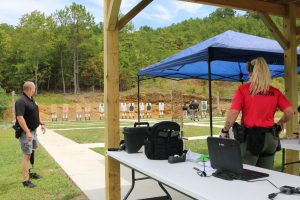
Photo by Lydia Berglar – Major Tommy Bradford and Officer Hailey Geddie observe a practice session at the Dade County Sheriff’s Office’s new shooting range.
Readers who have followed along with Dade County Board of Commissioners meetings will know that over a year ago, the Dade County Sheriff’s Office (DCSO) requested ARPA (American Rescue Plan Act) funds to build a training facility. The commission first approved $100,000 for the project, but when all was said and done, it cost $197,000, with the department completing much of the work themselves. (Also, the Dade County High School’s welding class made the shooting range’s target stands for free.)
At the June commission meeting, Major Tommy Bradford (chief deputy) gave a report on the facility and thanked the commission for these funds.
The Sentinel joined Bradford, Captain Matt Cole, Sergeant Chad Payne (public information officer), and Officer Hailey Geddie (training officer) at the training facility to learn more about the continued training our officers complete each year.
September 19, 2023, marked the first use of the facility. In 2024, 219 hours have been logged at the facility (as of August 13), not including weekly drone and K9 training or individual workout sessions.
The facility is at the old landfill (between Daniels Road and Back Valley Road) because the county already owned the land and (as a landfill) it’s not suitable for much else. The facility is on the eastern edge of the property where a small building could be constructed. The shooting range is also on the eastern edge, just south of the building.
The Trenton Police Department also has a shooting range off Back Valley Road, so the Sentinel asked Bradford why the sheriff’s office couldn’t partner with the city to expand the existing facility to meet both agency’s needs. He explained that the police department required one of their employees to be at the range every time the sheriff’s office used it to train, but the employee was rarely available when the sheriff’s office wanted to schedule a date.
Bradford said, “We don’t have anything against the city, we just wanted to be able to do our own thing. It had become a hassle, so we decided to go to the commission.” He said the Trenton PD officers are invited to all DCSO training sessions, and some have attended.
The building at the city’s range is quite small, and Payne added, “Our ideas of what we wanted to be able to do with it (like hosting community events and offering all these trainings) were much larger than the capabilities they had.”
The Sentinel spoke with Steve Beaudoin (Trenton police chief), asking if Trenton PD would consider a partnership with DCSO to make the new training facility sufficient for both agencies. (If this were to happen, the city could perhaps sell its current range, thereby adding land back to the tax rolls, producing revenue from the sale, and perhaps better stewarding city taxpayers’ funds). Beaudoin said they would not consider that. He believes the city’s range is nicer than DCSO’s.
Beaudoin noted that 4-H and church security groups use the city’s range and work with the Trenton PD training officer for firearm training. He agreed with Bradford that each agency has its own training officers, but the agencies sometimes work together: “They train some of our officers, we train some of theirs.”
Readers may recall that when Bradford first approached the county commission about the training facility, a shooting simulator was part of the idea. He had hoped to get a grant for the simulator but so far has been unsuccessful. However, VR (virtual reality) simulators may prove more affordable and feasible. The main training room could be set up for VR sessions as needed yet still be used for other training sessions.
As for continued training requirements for the sheriff’s office, the state of Georgia requires every officer to complete 20 hours annually of continued training, but DCSO requires 40. Payne said, “We’re not about the bare minimum. We want to encourage people to train as much as we can offer,” and Bradford added, “We put on enough stuff here locally that they can get 40 hours in pretty easy.”
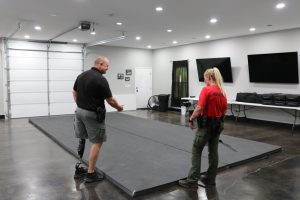
Photo by Lydia Berglar – The training facility’s main room can be set up in a classroom style or with mats (shown here) for defensive tactics training.
The state’s training requirements include firearms and the Governor’s Initiative courses. For firearms, officers must complete an hour each year in each of these categories: pistol, shotgun, back-up weapon, rifle, and low light.
The Governor’s Initiative courses fall under five categories: human trafficking, gang awareness, de-escalation, use of force, and community policing.
Geddie is in charge of setting up all trainings. A small room at the facility will eventually be her office. The other instructors are Cole (firearms), Casey York (firearms and defensive tactics), Payne (firearms and emergency medical), and Mathon Sledge (defensive tactics).
Geddie and Cole noted that Bradford does an excellent job finding officers’ strengths and interests and helping them earn certifications as trainers in those areas. Noting that one agency asked why the department has so many instructors, Bradford said, “If someone’s got a strong point, why not put that to use?”
In addition to the state requirements, the sheriff’s office covers defensive tactics, a Glock shooting and weapons care class, building clearings, scenarios, and a fitness program. Some specialty training (like standardized field sobriety) can’t be done in Dade, so officers complete these elsewhere.
The department practices building clearings at the schools (when they’re empty), and they practice house clearings. Scenario training includes vehicle pullovers (using examples from real life instances in or around Dade) and call scenarios. Bradford said, “We’ll pick out certain calls we’ve had and show different ways they could’ve gone bad.”
He noted that shooting at the range, practicing a building clearing, or going through a call scenario is not the same as encountering these situations in real life, but repeated practice is intended to help officers respond well in real time. “We try to put them under enough pressure to where they don’t fold under it. In real life situations, you don’t have time to think, so it’s not about thinking; it’s about doing because it’s second nature.”
Other agencies from nearby counties recently joined the department’s radar class and Stop the Bleed training (a tactical trauma class). Bradford said, “People ask if we charge other agencies for this, but we don’t. They do stuff for us, and we do stuff for them.”
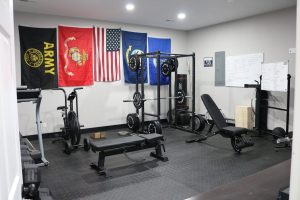
Photo by Lydia Berglar – DCSO officers are allotted one hour per shift (when things are slow) to workout at the new facility’s gym.
With the new fitness program, officers are allowed one hour per shift (when it’s not busy) to work out at the facility’s weight and training room. Several morning group PT sessions have been held at the facility, and the department plans to add an annual obstacle course requirement.
Georgia does not have annual fitness requirements or tests for sheriffs’ offices, but Cole explained that some agencies have their own requirements. Bradford noted that many agencies are getting rid of these requirements because recruiting officers is difficult. “They’re trying to make the standards lower, and I don’t agree with that.”
The department is working on hosting a jail school in partnership with the Walker County Sheriff’s Office so that people can become state certified detention officers right here in Dade/Walker. Many of the DCSO deputies start out as detention officers in the Dade County Jail. In fact, Bradford, Cole, and Sheriff Ray Cross all got their start in the jail.
Per the Georgia Public Safety Training Center’s website, “Georgia public safety personnel who are employed by a state, county, or municipal agency may attend training classes at GPSTC tuition-free under the sponsorship of their employing agency.” DCSO pays for the detention officers to travel to the Georgia Police Academy, but per state law, the candidates must complete a two-year contract with DCSO. If they don’t, they are required to pay the department back for any travel, room, and board fees.
Bradford said, “It gives our detention officers something to look forward to, to work towards, and we get to see how they interact with citizens and inmates. They learn the faces and the inmates’ names, because a lot of the inmates are recidivists.”
After graduating from the academy, candidates complete a roughly three-month Field Training Officer Certification Course with the sheriff’s office. In this time, they learn to apply their training from the academy specifically to Dade County.
With the media filled with topics like police brutality, defund the police, racism, and implicit bias training in recent years, the Sentinel asked if the DCSO completes any training related to these topics and what the department’s stance is on these issues.
As for racism, Bradford’s answer was quick and easy: “If I found out somebody here was racist, that’s a no-brainer: they’re gone. I don’t tolerate that, Sheriff Cross doesn’t, and nobody here is that type of person.”
The Governor’s Initiative teaches appropriate uses of force, de-escalation, and community policing. Bradford explained the department’s stance, saying, “I don’t want our deputies to use no more force than is necessary, but I’m not going to scare them out of doing their job and then someone gets hurt or killed because of that.”
He, Cole, and Payne noted the murder of Kyle Dinkheller in 1998 which is still used for training in police academies. Dinkheller was a deputy with the Laurens County Sheriff’s Office and had been disciplined for pulling his weapon. Bradford explained, “They trained him, don’t pull your weapon unless you’re going to use it,” and Payne added, “He became gun shy.”
Shortly after being disciplined, Dinkheller pulled over Andrew Brannan for speeding (around 98 miles per hour). In an erratic manner, Brannan began shouting at Dinkheller, charged him, and returned to his vehicle for a gun. After Brannan fired several shots, Dinkheller fired his first shot that some suspect was a warning shot. Brannan continued shooting and reloading, while Dinkheller inflicted one gunshot wound to Brannan. In the shoot-out, Brannan murdered Dinkheller before fleeing the scene.
Bradford said, “That’s why we do a lot of scenario training, so officers know how to respond to situations, keeping their guard up but still talking to the public well and always trying to de-escalate things.”
Bradford noted that all law enforcement officers are only human, and therefore, the department has a thorough reporting/review system. “Are they going to make mistakes? Yes, they are. We just ask our officers to be courteous and treat people how they’d want their wife or kid or mom or dad to be treated.”
If a complaint is filed about something like excessive use of force, the sergeants step in to review. Next, the case is reviewed by Geddie, then Cole, and finally Bradford. Body cameras play a large role in investigating such cases, sometimes proving officers’ innocence, and other times, their guilt.
Bradford explained, “There’s disciplinary actions we can take, or it could require more training in that area. Sometimes an action might not be within policy, not because it’s necessarily wrong, but because it’s not how we want things done.”
The ultimate discipline is, of course, termination of employment. Payne said, “The system we have in place, it works. We have discovered, on occasion, that somebody didn’t act appropriately, and it was dealt with like it should’ve been. Had we not had the accountability that we have and that reporting software, we might not have caught it.”
The Sentinel asked if the department has any training or support for mental and emotional health. Bradford explained, “We support each other. Humans are not supposed to see some of the things we see, but we get in the profession because we enjoy helping people, and unfortunately, there’s some bad stuff we have to see.”
When particularly difficult situations occur, the department brings in counselors. Cole remembered Bradford’s accident which resulted in the loss of his leg. “We brought in counselors for the officers in case they needed to talk to somebody.” While it’s difficult to find counselors who have experienced what the officers see on the job, Georgia State Patrol has a few state troopers who are trained in counseling, and there are law enforcement chaplains who have law enforcement backgrounds.
Bradford explained that officers can also use personal time or take extended leave. Years ago, he encouraged one officer to use his built-up personal time off to take care of personal issues. After the leave, the officer was able to continue working.
On one tragic day, two officers responded first to a SIDS (sudden infant death syndrome) call and later to a call about a drowned baby. “With something like that, I make them take time—for my peace of mind to know that they’re okay, because I know how we are; we’re not going to ask for help because we’re the ones that’re supposed to be giving the help.”
The sheriff’s office plans to offer community classes in self-defense and firearms safety and has already led the Scenic City Volleyball team in a self-defense course. Bradford intends for these to be free-of-charge, except firearms training participants will bring their own ammunition.
Regarding firearms safety, Bradford explained, “In Georgia, you’re not required to have any type of training to get a gun permit, and you no longer have to have a permit to carry a handgun.” Therefore, the department would like to encourage safety for gun owners.
He added, “They get to meet us and see that we are out there to help the public, and we want to let the community use this facility some, too. The instructors want to do it because they enjoy teaching it.”