
Ecovillage Community Forms On Sand Mountain, Meet Two Founding Members
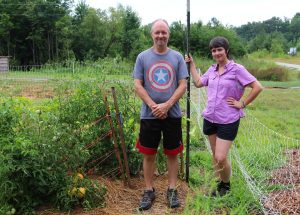
Photo by Lydia Berglar – Paul Ladendorf (left, founder of Harmony Woods Ecovillage) and Elle Jade (right who joined the community in March) pose in the community garden. The goal is to expand food production to the point where the small community is nearly self-sustaining.
By LYDIA BERGLAR
News Editor
Just across the state line on AL-71 heading toward Bryant, Ala., a small group of industrious people are creating a homestead called Harmony Woods Ecovillage. Falling under the two broad categories of “intentional communities” and “ecovillages,” Harmony Woods holds five values: Personal Freedom, Communication, Land Stewardship, Personal Integrity, and Natural Living.
The website (ecovillage.harmonywoods.net) adds that the focus is on “sustainability, land stewardship, conservation/minimalism, local resource use, cooperation/interdependence, education, and freedom of expression.”
Paul Ladendorf founded Harmony Woods after nearly a decade of solo homesteading in Indiana, but his story began years earlier in Chicago, Ill. “I was climbing the corporate ladder in Chicago,” he explained, “and it was pretty obvious that the way we are living as a society is far from ideal, with everything from the financial system to the food system to the housing system. I saw it in what I was eating to where I was living to what I spent my money and time on.”
While he enjoyed his job, he disliked company politics, back-stabbing, and lack of appreciation or reward for good employees. He recalled one exact moment when he realized his days in the city were numbered: “I walked out into downtown Chicago and a bus passed me and blew a huge plume of exhaust in my face. I started making a plan to get out.”
Unhealthy foods combined with his sedentary job had taken a toll on Ladendorf’s health, so one of the first changes he made was cutting out processed foods which led to drastic health improvements. He became more interested in where his food came from and how it was raised, so leaving his life in Chicago, he bought a few acres in rural Indiana. Over the next decade, he transformed the raw land into a livable homestead which he eventually sold, reaping the rewards from his sweat equity.
“It made me a man,” he said. “I matured more in those years than I had my whole life because I’d avoided anything hard and any kind of discomfort. I thought the easy life is where it’s at, but the more I chased that life, the more miserable I became. Building my own house and the challenge of homesteading was exactly what I needed.”
However, he longed to live this lifestyle in a community of others who saw the same downfalls in society and wanted to try something different. Ladendorf researched other intentional communities and ecovillages, but he couldn’t find the perfect fit. As indicated by the word “intentional,” these communities are great fits for very niche sets of people but far from ideal for many others.
Therefore, Ladendorf bought 13 acres on north Sand Mountain in 2021 and began gathering others who shared his values. He narrowed his search to the Chattanooga area because of the natural beauty, outdoor activities, moderate climate, rainfall, soil quality, low cost of living, less restrictive zoning/building codes, and proximity to the city.
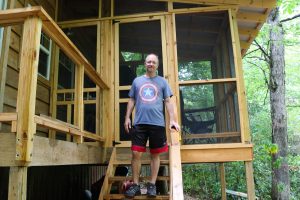
Photo by Lydia Berglar – Ladendorf recently completed his cabin, using as much wood and as few plastics and chemicals as possible.
He’s lived on the land for 2.5 years and recently completed his small home. Five other people have joined him, and a new family is preparing to move to the land.
Members approved to join Harmony Woods purchase a portion of land from Ladendorf, build their own homes, and help with the community garden. Instead of taking the mortgage route, land is purchased and homes are built with cash.
Thus far, the six residents have been occupied setting up their living situations and expanding food options (several already have chickens and two sheep just arrived), but they plan to continue discussing what they want the community to be like.
The community gardens without pesticides and herbicides and limits unnecessary chemicals in their homes. Ladendorf, for example, uses a simple homemade vinegar/baking soda cleaning solution instead of store-bought cleaners.
In addition to these practices, reducing waste, building their own homes, and working to live off the land, Harmony Woods is pursuing communication between neighbors, sharing of resources, conflict resolution, and personal freedom. The plan is to build a shared communal building, thereby reducing the space needed in each home.
Ladendorf said, “It’s easy to have superficial, standard relationships but hard to have intentional relationships. Anyone who is closed off to community would not be a good fit here. This is not an easy lifestyle and we’re more isolated, so it’s important to have support. Adding drama to that is the worst possible thing. None of us are perfect, and we all have our own problems, so we know we’ll have interpersonal issues, but the big thing is that we communicate.”
Not a fan of heavy-handed government regulations or enforced ideologies, Ladendorf values personal freedom, but he also wants to ensure members of the community are good fits. As he wrote on the website, “Instead of rules, we will screen community members carefully to make sure that they share our core values so that only minimal rules will be required to protect our quality of life.”
Rules will be voted on by the community. The website lists a few potential rules: “No disturbing the peace after 9 pm. No junk, garbage, or litter visible to others. No flood or other lights illuminating other’s home sites. No nuisance animals (e.g. dogs that bark incessantly).”
Elle Jade (who joined Harmony Woods in March with her partner, Basil) explained personal freedom as, “Do what you want, but it can’t negatively affect those around you. We are not actively disturbing or creating a problem for the people around us.”
Currently, they are living in a semi-trailer while building their home. One of Jade’s priorities is food sustainability. While living in Sedona, AZ, she told Basil that she wanted to try growing their own food. “We knew we didn’t want to do it by ourselves or be out in the middle of the woods with no one else around.”
Jade and Basil toured other communities before deciding on Harmony Woods, but Jade said, “They were already very established with very strict regimens and places you have to fit in in a certain kind of way. I wanted to go somewhere where I could help create what it is.”
She visited the Foundation for Intentional Community’s website and compared many options. “The criteria that was most important to me was that the values of the community aligned with my values.”
While joining a fledgling homesteading project is risky, Jade said, “We saw the benefit of being able to jump in at the beginning and help shape the community and bring in more people who align with our values.”
Harmony Woods hopes to share resources to reduce waste and wasted space, expense, and to build relationships. Jade explained, “We’re trying to actively share our resources and time and energy to a point where I don’t need to own something because Paul owns it, and if I have something he needs, we share it.”
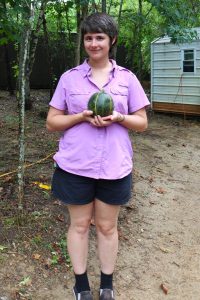
Photo by Lydia Berglar – Creating food security by growing their own food is important to Harmony Woods. Here, Elle Jade holds a homegrown squash.
The Sentinel asked Ladendorf and Jade about potential pitfalls they hope to avoid. Ladendorf said he’s researched communities that used a land trust system with 99-year leases, but this created legal problems. The biggest pitfall, however, is members joining who do not hold the same values, are unable to work through conflict, or are unprepared for the challenge of homesteading.
Much work lies ahead for the six founding members, but Ladendorf doesn’t have a strict end goal. “It’s the journey, not the destination. The goal for me is continual growth and maturing.”
For Jade, however, she is looking forward to producing a significant portion of their own food. “I’m looking forward to having an entire shelf filled with canned goods and freeze-dried food, so I don’t have to go to the grocery store almost ever. It’s a lofty goal that’s going to take some time, but when we reach it, I’ll feel like we’ve gotten something done here.”


Thanks so much for running this story!
You’re welcome, and thanks for sharing about your life with the Sentinel’s readers! -Lydia