An Inside Look At Fire Department Training Burns
Dade County Sentinel – Dade County Fire Station One invited the Sentinel to participate in the June 1 training burn with City of Lookout Mountain firefighters. It was a great experience with a group of knowledgeable, hardworking, fun-loving people.
By LYDIA BERGLAR
News Editor
Dade County Fire Station One invited me to participate in a live training burn on June 1 to catch a glimpse of the work that is so vital to our community. When covering county commission meetings, I’m often writing about fire department funding requests, and in the unfortunate cases of house fires and other emergencies, we are all reminded of the important work of our firefighters. However, recruiting volunteers is a challenge across the county.
Dade’s fire departments have multiple training burns throughout the year that count toward training hours and allow new volunteers to earn their Firefighter One certification. For this specific training, the City of Lookout Mountain, Ga. fire department asked Dade to facilitate a live burn so that several new volunteers on the mountain could complete their Firefighter One certification. I was honored to spend the morning with Dade’s Station One and the City of Lookout Mountain’s firefighters.
Readers may recall that the Dade County Fire Department requested funds for a new burn facility that meets ISO (Insurance Services Office) requirements. This is still a hope for the future, but there is no current movement on the project. The current burn facility (made up of old shipping containers and rearrangeable obstacles) is next to the city’s sewage treatment facility on the eastern edge of the industrial park. This is where the two departments met on June 1.
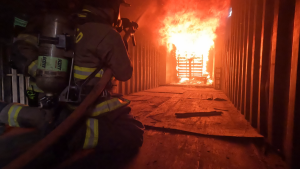
Photo courtesy of Alex Jones – Lookout Mountain and Dade firefighters practiced responding to a live fire in the burn facility. As shown here, we knelt beneath the thermal layer and practiced spray patterns after carrying the hose through obstacles.
Jerry Henegar (lieutenant) led me and the Lookout Mountain crew on a walkthrough of the burn container, explaining exactly what we needed to do. The Lookout Mountain crew completed several runs while I sat in the back of the container watching with Shan Anderson (captain) who offered helpful explanations. Then, I joined the Lookout Mountain crew. We carried the hose through the container and each took turns spraying the fire.
Henegar explained that rising heat from fire creates a thermal layer in buildings. Sensors positioned at the top and the bottom of the burn container showed the major difference between the thermal layer and the area closer to the floor. The sensors read roughly 900 degrees Fahrenheit at the top but only 300 degrees lower down. When no one was in the container, we closed the doors and let the fire build until the top sensor reached about 1,300 degrees Fahrenheit while the bottom one was around 500 degrees.
While the gear was heavy, I didn’t notice the weight of it as much as the awkwardness in maneuvering with the thick clothes, large boots, and limited visibility in the dark, smoke-filled rooms. For the training, we used small air tanks with a 30-minute supply, but the department also has larger, heavier tanks that last longer. Breathing through the air mask (SCBA: self contained breathing apparatus) also took some getting used to, and I can’t recommend firefighting for the claustrophobic.
The experience helped me catch a glimpse of what firefighting is like, but it was unique from real emergencies for several reasons:
- We were already on the scene with no need to rush through traffic or communicate with the 911 call center.
- We weren’t searching for any people or animals (although the department has dummies they can hide in the facility to be found using thermal imaging).
- We knew exactly where to go and where the obstacles were, but in a real fire, the layout and obstacles are unknown. (One of the firefighters explained that the homes of hoarders are particularly dangerous for firefighters because of excessive obstacles and blocked exits.)
- Seasoned firefighters were stationed in the container as “safeties.” They warned me that if I tapped my head (the signal for help), they would immediately drag me out, no questions asked.
- We weren’t rushing to save a home or building, and the flames weren’t spreading through the container. In fact, we kept the fire going so that everyone could practice spraying it, letting it build back up before each turn.
It was impressive how quickly the water brought the flames down. We primarily used two spraying patterns: a T and a Z, starting at the top and working down the flames.
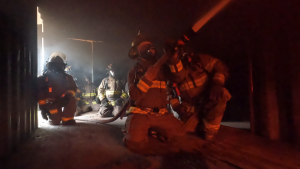
Alex Jones used a heat resistant camera attached to our helmets to capture images inside the burn container.
I was also impressed by how well the gear protected me from the heat. The longer we were in the burn containers, the more uncomfortable it became, but I would’ve thought that sitting in temps of 300+ degrees would be unbearable.
The firefighters talked about how much fire gear has improved over the years. One commented that the gear can almost make you feel invincible but it is NOT fireproof; it’s only heat resistant. Several other firefighters explained a recent situation in another county where two firefighters’ suits caught fire, but the special pants underneath protected their legs from extreme damage.
The gear is expensive (with one complete set costing around $4,000), but this pales in comparison to the equipment and vehicle costs. Alex Case (Emergency Management Agency director) noted that a Chattanooga station recently purchased a ladder truck (the most expensive fire truck) for over $2 million. Readers may recall that May’s county commission meeting included an approved expense of over $50,000 for Station One’s new compressed air/tank system, (not including extra funds for Station Four’s system). These examples barely scratch the surface of the expense needed for fire protection.
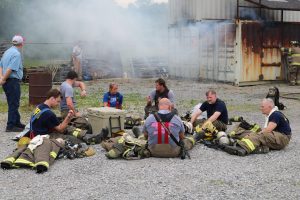
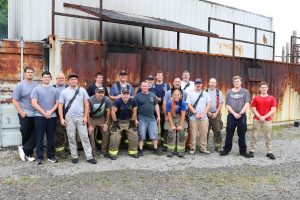
Dade County Sentinel – The newest batch of City of Lookout Mountain firefighters (several pictured here) used this live burn to complete their Firefighter One certification. Several Dade firemen completed practice runs, and experienced Dade firefighters led the training.
I asked Henegar what makes recruiting volunteers so difficult, and he explained that it’s the time component. Unlike most other volunteer work, responding to an emergency can’t be planned to fit into your schedule. Not only must volunteers be ready to get up in the middle of the night, leave a family dinner, or interrupt their day off to respond to a call, but time and effort is also required to go through the training and Firefighter One course. Then, volunteers must complete 24 training hours each year.
Additionally, many of the volunteer firefighters work outside of the county, some in Chattanooga, some further away, so fire protection in the county is particularly sparse during the day. Station One made significant progress in this area a year and a half ago when they added two part-time paid day shifts to the two-person staff of Jerry Kyzer (fire chief) and Ansel Smith (assistant chief). (See the December 28, 2022 issue of the Sentinel.)
However, the camaraderie amongst our firefighters is apparent to anyone who spends a few minutes with them. At the training burn, they welcomed me and the Lookout Mountain crew eagerly, supported one another, and had a blast together. For them, the camaraderie and opportunity to serve our community is well worth the time and effort.