Mt. Fuji To Sand Mountain: Higdon Family Raises Wagyu
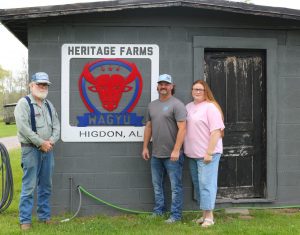
Photo by Lydia Berglar – Heritage Farms Wagyu thrives thanks to a family team of three (from left: James Horton, Chris Wooten, and Melissa Wooten) who each bring something unique to the table.
By LYDIA BERGLAR
News Editor
Four years ago, a Sand Mountain family of cattle ranchers switched from raising American Angus cattle to Wagyu–a word meaning “Japanese cow” that covers four breeds of Japanese cows. Chris and Melissa Wooten and Melissa’s father, James Horton, made the switch after researching and then tasting Wagyu beef.
Chris and Melissa both grew up on Sand Mountain; Chris in Douglas, Ala. near Gadsden, and Melissa in Higdon, Ala. Melissa’s family has a history of cattle ranching, and the land where they now raise Wagyu has been in the family since the 1950s. The Wootens moved back to Higdon 12 years ago and began helping James with his cattle.
Melissa explained, “He produced great American beef, but like so many farmers, he was just making enough to get through the next year.” The couple wanted to become partners in the farm and began looking into ways to make a profitable business. That’s when they learned about Wagyu’s status as a delicacy, read about how the meat measures up health-wise to typical American beef, and then tasted the difference for themselves.
Melissa said, “The couple we bought our very first pair of Wagyu from would not sell them until we had tried it.” The Wootens and Horton did a blind taste test with Wagyu from their newfound friends and the Angus they’d been raising and eating for years. The difference was immediately apparent, and they knew they wouldn’t go back to Angus.
Heritage Farms Wagyu was born, with the word “heritage” playing on the Horton family legacy of raising cattle.
Regarding Wagyu’s health aspects, Chris explained that although the meat has a high amount of fat, it has a higher percentage of monounsaturated fat (the healthy fat), rather than the high saturated fat of standard beef. The meat is also high in Omega-3 and Omega-6. All in all, Wagyu is considered better for fighting heart disease and high cholesterol.
One study about this topic is “Characteristics and Health Benefit of Highly Marbled Wagyu and Hanwoo Beef” by Takafumi Gotoh and Seon-Tea Joo, available on the National Library of Medicine’s website.
While these health benefits have attracted some Heritage Farms customers, many become fans of Wagyu because of the taste. Chris said, “The high fat content changes the taste, giving it a buttery rich flavor. You do not have to use any oil or butter when cooking it. With the fat content in it, it’s always going to be juicy and tender.” He recommends using salt, pepper, perhaps some garlic, but skipping marinades. He notes that Wagyu cooks faster than typical beef.
The Sentinel put it to a taste test, thanks to some samples from the farm, and indeed, Chris did not lie. The strip steak turned out incredibly tender and flavorful with nothing needed but a cast iron skillet and some salt and pepper. The ground beef, cooked the same way, melted into rich, perfectly browned bits that begged to be eaten plain.
Both genetics and lifestyle impact Wagyu taste and texture. The process of raising Wagyu is twice as long as the typical style of ranching, and it includes specific feed programs. Melissa said, “For our feed program, we tried to copy as close as we could to some of the best in the country with what we could get in the area, sourcing everything locally.”
The Wootens said that geneticists and nutritionists have studied how to feed Wagyu outside of Japan, in an attempt to replicate as closely as possible the vegetation Wagyu would find naturally in Japan. Heritage Farms does not use hormones or antibiotics, but they make sure the cattle get minerals.
Studies from Japan show that the less stressed Wagyu are in their life, the more tender their meat is, so Heritage Farms keeps the pastures calm, Melissa walks through the cattle each day and talks to them, and classical music plays in the barn. Wagyu are very docile, and when the Sentinel visited the farm, the cows were quite interested in the newcomer.
As for genetics, Chris said, “We’ve tried really hard to make sure our genetics are as top of the line as we could afford. Everything we have is registered through the American Wagyu Association which involves a strict policy and process.”
Grading scales indicate the genetic makeup of the cattle. Japan uses an A1-A5 grading scale, while America and Australia (the largest producer of Wagyu) follow an F1-full-blood scale. An F1 is 50 percent Wagyu, and a full-blood is 100 percent Wagyu.
The Wootens reported that some people have taste preferences for a certain grade. One rancher they’ve met who only raises full-blood prefers to eat F1. Melissa also prefers F1, while Chris prefers full-blood.
Four Wagyu bulls first came to the United States in 1976, and ranchers started cross-breeding with American cows to see how the genetics would work out. After 1996, Japan stopped exporting any live Wagyu and began limiting how much of the highest quality meat can be exported. A pound of ribeye with an A5 grade (the highest ranking) sells for around $450.
The American Wagyu Association estimates that fewer than 5,000 Wagyu in America are full-blood. In May 2020, Heritage Farms began with one bull and one cow. Today, the farm has over 43 full-blood Wagyu and about 190 F1 Wagyu. While it was a large investment on the front end, they reported that the endeavor has paid off.
Melissa said the team of three (Chris, herself, and Horton) is one key part of the farm’s success. All three balance the farm with their full-time jobs and must work together to care for the cattle and run the business.

Photo by Lydia Berglar – The Wootens greet the Wagyu cows as they explain how genetics, environment, and diet make these cows some of the most desirable in the world.
Chris thrives when brainstorming marketing ideas, creating logos, and researching genetics and best practices. He said, “I love sales, research, talking to people, and going to local events and markets. One thing I’ve been learning through the research on genetics is that the curlier their hair is, the higher marbling they have.”
Horton brought decades of ranching experience and knowledge to the table, as well as the land, Melissa said, “There’s so much we couldn’t have done without him.”
As for herself, Melissa enjoys the labor, saying, “I’ve loved cows since I was a little girl. My happy place is out here in the pasture.”
Wagyu is one of the most expensive meats in the world. Because of the quality, the livestock is an expensive investment. On top of that, the feed is expensive, and the process takes much longer than commercial Angus beef farms. Chris was told that the expensive products wouldn’t sell in this area, but he believed in the desirability of Wagyu.
He came up with a special offer: For $250, customers get a griller bag with a ten-pound combination of ground beef, steaks, sausage or ribs, and two reusable $50 discount cards for future griller bag purchases. The farm calculates the retail value to be $500. Repeat customers using the discount cards get a 60 percent discount.
Melissa said, “Our meat is a delicacy. This is something you can’t get at a chain steakhouse or other places.” The Wootens describe dining on Wagyu as an experience, and while some repeat customers have added Wagyu to their regular diet, others find that it makes a special gift or sets weddings and events apart.
While the farm is just across the state line, the Wootens say much of their business is in Dade. They’ve recently found a market through Cloudland Canyon and vacation rentals. Chris said, “We’re really starting to cater to the vacation rentals and campgrounds for people who want to make their vacation an extra special experience. We’ll deliver the meat to them in a cooler bag.”
Heritage Farms sells every type of steak (even less common types such as Denver and picanha steaks) as well as ground beef, sausage, and beef bacon. Regarding the beef bacon, Chris said, “We have a lot of clients who are Jewish or Kosher and clients who don’t eat pork for health reasons.”
The farm can be found on Facebook and Google Maps or contacted at 423-802-7891.