Dade Primary Debate Over, Early Voting Begins
By LYDIA BERGLAR
News Editor
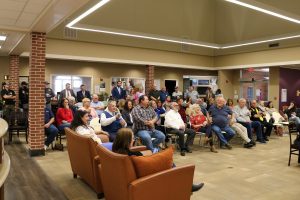
Photo by Lydia Berglar – On April 22, the Dade County Primary Debate (held by Discover Dade/KWN News Now and the Dade County Republican Party) saw a good turnout at the Dade County Public Library. Pictured here, candidates and citizens settle in for what would be a long night (concluding shortly before 11:30 p.m.).
Ahead of the April 29th early voting start date, the Dade County Primary Debate took place on April 22nd. A good-sized crowd showed up for the event at the Dade County Public Library, with standing room only at the beginning. As the night wore on (concluding shortly before 11:30 p.m.), the crowd thinned, but a handful stayed through the end while many others watched online.
Discover Dade/KWN News Now and the Dade County Republican Party organized the event, and the video of the full debate is available on discoverdade.com and the KWN News Now Facebook page (no login needed).
Citizens had the opportunity to submit questions by April 19th, but the questions were not given to the candidates ahead of time. Cindy Cross (Dade County GOP chairwoman) assured the Sentinel that, from everything she personally witnessed and was told, no one had the questions except for the moderator, Chris Goforth. Some candidates opted to prepare notes based on well-known topics of interest, questions from the Sentinel Q+As, and relevant documents, while others did not.
Mike Cameron (incumbent, Georgia House of Representatives) spoke before the debate officially began since (being a Republican debate) his Democrat opponent Jack Zibluk was not in attendance. See the accompanying Q+A in this edition for further information about each candidate. Johnny Warren, running uncontested for the school board, also spoke briefly.
The debates (in order) were:
- Georgia Senate: Colton Moore and Angela Pence
- Superior Court Judge (Lookout Mountain Judicial Circuit): Melissa Hise and Ann Fiddler
- Dade County Board of Education: Carolyn Bradford and Steve Forester, then Jayne Griffin and Patrick Hickey
- Dade County Board of Commissioners: Jerry Henegar and Bob Woods, then Melissa Bradford and B.J. Hartline
- Dade County Executive: Don Townsend, Robby Ryan, and Daniel Case
Aside from some slight but noticeable friction during the senate and superior court judge debates, the tone of the evening was pleasant with a clear focus on serving Dade County.
Answers to many questions were similar. (For example, all county candidates agreed that the animal shelter must be built, but we don’t have a plan for how to staff it, a plan to fund it year after year, or the necessary animal control ordinances.) Also, some of the questions have already been addressed in the Sentinel Q+As and candidacy announcements, so here are just a few highlights from each debate.
During the state senate debate, Moore and Pence were asked about the difference in enforcement of Second Amendment rights at the state and federal levels.
Pence supports Second Amendment rights and said we should rely on the state to protect this freedom, saying she is in favor of limited government. She said, “If [I’m] a law-abiding citizen and the government has it, I should be able to have it too.”
Moore explained that should the federal government require infringement of Second Amendment rights, he would not put state or local law enforcement officers on the line to enforce such a ruling.
When asked how they would prevent tax dollars from going to other counties, Moore said we should be wary of grants such as rural workforce housing grants. He said infrastructure, public safety, and public education are where taxes should be spent.
Pence explained that everyone (including herself) dislikes taxes, but she will advocate to bring funding back to District 53.
When asked how they would contribute to economic development and infrastructure in the district, Moore said, “It’s time government get out of the way,” again noting that focusing on government-led housing is a detriment to focusing on roads and safety. He is in favor of reducing the income tax in order to attract workers and businesses.
Pence cited her work with the Walker County Chamber of Commerce, explaining that our district benefits from tourism. Therefore, she would work with local chambers of commerce to improve economic development via tourism.
During the superior court judge debate, Hise and Fiddler were asked what they think about the various accountability courts, such as drug court and mental health court. Hise (also mentioning parental accountability court and veterans court) believes they are effective in leading to rehabilitation and decreased recidivism.
Fiddler is also a fan of the courts, but she said that the two official accountability courts are drug court and mental health court, while the others have slightly different classifications. She believes there is room to improve and grow rehabilitation courts.
When asked if the constitutions (state and federal) are open to interpretation, both agreed that they stand on their own merits, and the job of judge must uphold constitutions and laws.
When asked why she is the best candidate, Fiddler explained that at 42 years old, she has many more years to serve (if reelected), referencing other judges who served many terms. She believes this would bring consistency, cohesiveness, and efficiency to the Lookout Mountain Judicial Circuit.
Hise answered, “I have the most experience in the most diverse practice of law.” She countered that she is not a career judge, nor is she planning to retire out of this role. She thinks career politicians/judges are a problem in America, and as far as reelection, she said, “I’m looking for the next four years, and then we’ll talk about four more years after that.”
During the Board of Education District Four debate, Bradford and Forester were asked what they would consider cutting from the budget to lessen the burden on taxpayers. Bradford did not list anything she would consider cutting. Forester also didn’t list anything, aside from saying he would consider activities that involve the least number of students so as to minimize the impact of budget cuts.
When asked about their views on the school choice bill, Forester said he is not in favor of it because he is a strong advocate for public schools. Bradford is pro-school choice, explaining that responsibility lies with parents.
When asked how sexual orientation and pronoun usage should be handled in the classroom, Forester explained that he taught grammar in his career as a teacher. “We learn which pronouns are singular, which are plural, which pronouns are masculine, which pronouns are feminine, and there’s no blurring of those…Anything that is trendy and has to be redefined to fit social and cultural norms should not be given much attention.”
Bradford is also not in favor of these topics being discussed in the classroom.
When asked if the 65 and five acres law should be changed to require residents to live in the county for five years before qualifying for the exemption, Bradford noted that the school board has taken the issue to the state before to change the current law. She is in favor of a five-year residency requirement.
Forester thinks it would be complicated to track years of residence. He also mentioned the need to consider those who are moving from communities in which they’ve already qualified for the exemption.
Regarding funding the library, Forester explained why he strongly values the library (noting that he is on the library board), how it impacts students, and the difficulties the library faces from having a tight budget.
Bradford explained that the school board had previously cut funding to the library when faced with financial constraints, but funding has been restored. She believes funding the library is up to the county and the state. She said the school system has fostered a working relationship with the library through field trips and the library cards for all students (called Play Cards).
During the Board of Education At Large debate, Griffin and Hickey were asked the same questions as the previous pair.
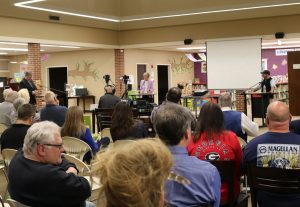
Photo by Lydia Berglar – Jayne Griffin and Patrick Hickey were the second pair of school board candidates to debate.
Regarding budget cuts, Griffin suggested “shaving” instead of “cutting,” meaning cutting back in multiple areas instead of doing away with entire programs/budget items. Hickey agreed with Griffin.
Regarding school choice, Hickey is in favor of it but also voiced his appreciation of Dade County schools. Griffin agreed, saying, “Some children might thrive in different environments.” At the same time, she is a fan of public schools and Dade County schools in particular, and she believes tax dollars need to fund public schools.
Regarding sexual orientation and pronouns, Hickey simply said that he is not in favor of these topics being brought into the classroom because personal ideas should not be forced on other students.
Griffin began, “We live in a very conservative community. Some people move here because it is a conservative community, and I think the schools need to reflect that.” She is in favor of offering enough exposure to prepare students “for what they’re seeing around them,” but she prioritizes parents’ rights and strongly believes the schools must not take that role of moral education away from parents. She said, “The parent has the right to explain their own values to their children.”
During the County Commission District Three debate, Henegar and Woods were asked what budget items they would consider cutting or reducing. Neither answered with specific departments or budget items.
Woods said that by talking with many citizens, he has heard a variety of opinions about budget priorities. He is in favor of getting input from citizens about what budget items they consider important.
Henegar said that with new members on the commission, the board will be positioned to start fresh, learn about each department, and take an in-depth look at potential budget cuts. Throughout the debate, he expressed his desire to keep the millage rate low and tighten the budget.
When asked if they know about each board that the commission appoints members to, neither candidate directly answered the question.
Henegar said, “I’m not even sure the people sitting on those boards know what their roles are. You’ve seen some of the things that have come out of what they’re trying to do, and it’s totally against what they’re supposed to be doing, and they’re having to go back and correct themselves. Do we have too many boards trying to run things? Do we need to limit what they’re able to do?”
Woods simply said that to appoint a board member, he must know that person’s views, heart, and intentions.
When asked about plans to address traffic problems in Trenton, Woods brought up the once-proposed additional exit north of town so that trucks could access the industrial park from the interstate without driving through town. He noted that this would be expensive and complicated.
Henegar said, “We did this [by] putting government buildings inside city limits…three schools inside the city limits.” He believes any further government or school buildings must be outside the city limits. He also proposed asking local industries to stagger shift change times to decrease heavy traffic times.
When asked about the fire protection in the county and how to add more volunteer firefighters, Henegar said he’s not sure if citizens know how poor of a position the fire departments are in. When volunteers are at work, departments are left without anyone available to respond to calls, even with the established incentives for responding.
Henegar said, “You get what you pay for…You don’t know for sure, when you call 911, if you’ve got somebody.” Henegar believes this issue needs to be addressed, but it will be difficult. He recognizes that funding fire departments is a tax burden because the departments bring in no revenue. He proposes increasing the number of paid firefighters.
Woods also recognized the significance of the issue and proposed tiered incentives for volunteers. (For example, responding to house fire calls would pay the most while medical calls would pay less.)
During the County Commission District Four debate, Bradford and Hartline were asked the same questions as the previous pair.
When asked about land use management/zoning laws, Hartline said he is against such ordinances. He said, “It’s a double-edged sword.” He noted the role of the Special Use Permit Board. If zoning were to be addressed in the ordinances, Hartline believes the commission must thoroughly research the matter, include the community in the discussion, and ultimately put it to a vote by the citizens.
Bradford believes there is a difference between zoning and land use management. She wants people to have control over their properties, but she believes industry and vacation rentals need some restrictions about location. She thinks a lot of work is needed on this topic.
Regarding knowledge of county boards, Bradford said she worked to learn about each board early in her time as a commissioner and has been to several meetings of each board. She believes each board needs improved procedures, transparency, and communication with commissioners, and she is unhappy with the current lack of communication/clarity.
Hartline admitted he does not know about each board and needs to research them further. Like Woods, he said he must know a person’s character in order to appoint them to a board.
When asked if they would be in favor of mailing notices to all taxpayers prior to a property tax increase, neither Bradford nor Hartline were in favor of it because of the additional expense it would create. They cited the two tax notices that are already sent prior to tax bills, the likelihood of mail being unread, and the easy access to news outlets, social media, and the county website.
Bradford said that the two tax notices are “your opportunities to go out and appeal those figures if you’re not happy with them.” Hartline added, “If you’re not going to take heed to that…I don’t know why one more letter in the mail would change that.”
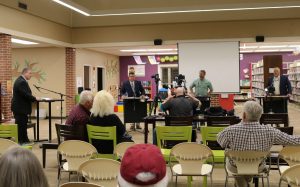
Photo by Lydia Berglar – Closing out the night, (from left) Don Townsend, Robby Ryan, and Daniel Case answered questions related to the role of county executive.
During the County Executive debate, Case, Townsend, and Ryan were asked the same questions as the commissioner candidates, along with a few extras.
Regarding handling the county budget and any areas to cut or reduce, Townsend said, “I’ve been working on the budgets now for 18 years.” He said that the major increases in the budget in the past two years were almost all due to inflation.
Case cited his business experience and time on the school board. Neither he nor Townsend mentioned any specific ways to reduce the budget.
Ryan cited his career and experience negotiating prices. He thinks an area of the budget that could be looked at is general expenditures.
Of the land use management/zoning question, Case said he is not a fan of zoning, but he sees the advantage of land management ordinances. Saying, “I know that scares everyone,” he echoed Hartline and Bradford’s statements about extensive research, community discussion, and ultimately a vote by citizens. He proposed that ordinances be developed individually for each district, saying, “I think the property owners within those districts ought to have an active say in the ordinances that help protect their property.”
Ryan simply said that he would put the topic before the people.
Townsend explained that, with the goal of protecting personal freedom/preventing excessive government control, he is not a fan of zoning, but he has heard people ask why Dade County can’t get nice establishments such as McLemore. He said, “If you’re going to invest ten million dollars in a motel or hotel, you want some assurance that something is not going to pop up right next door to you that’s undesirable, that you’re not going to be able to rent one room out one night.” He echoed the other candidates’ plans for thorough discussion and allowing the people to vote.
When asked about the expansion of industry and the creation of new jobs in the county, Townsend said small businesses are the backbone of Dade County, but industrial jobs are also important. He said that one manufacturing job creates three other jobs in a community. He recognized recent issues related to industrial development, but he said that over the last 18 years, industry growth has reduced the tax burden on citizens. He does not want industry or manufacturing to interfere with homes, and he would like well-planned buffer zones.
Case said that while industrial development is a need, he fears too much industrial growth, especially if filling jobs requires significant growth in population. He said his vision is centered on hospitality and tourism. If industrial development grows too much, he fears subpar workforce housing and industries that become obsolete, leaving empty buildings and empty housing behind. He said, “I’m not saying that’s exactly how it’d go, but in a town this size, I don’t think it should be our primary focus.”
Ryan said he is not fond of industrial expansion because of his experience working in manufacturing jobs. Like Case, he said tourism should be our focus over industry/manufacturing.
As to the many county boards and how they operate, Ryan knows about a few and is the chairman of the Special Use Permit Board. Case does not know all of them. Townsend knows them very well (due to his current job). He said he’s visited every board, knows the members, and knows the purpose of each board.
When asked about a ten-year vision for Dade and how it can come to fruition, Case again pointed to tourism as a way to “harness the heritage that we all hold so dear but still allow us to have the things we all like.” With this route, he believes Dade can attract things we want, such as a steakhouse. He believes empty buildings need to be addressed, noting that his family has plans for the empty building that they own on the square.
Ryan proposed a partnership between the city and county to improve city aesthetics.
Townsend said the county has grown steadily in recent years, and he would like that to continue. He would like to see more tourism and attractions, and he believes historic preservation is important. He wants to maintain a good quality of life, expand arts, music, and culture, and protect our natural resources.
Regarding the traffic question, Townsend said the county previously attempted to pass TSPLOST with an exit north of town as a flagship program, but voters voted down TSPLOST. Like Woods, Townsend sees this exit as a solution to industrial park truck traffic.
Case said that a lack of long-term planning got us into this situation, saying we should plan for the next 50 to 100 years. He said that some larger cities don’t allow commercial traffic to travel through town except for local deliveries. As an immediate temporary solution, he suggested moving the white stop lines further back so tractor trailers have room to turn.
Ryan is in favor of forcing truck traffic to use the Wildwood interstate exit.
Regarding the fire departments and need for volunteer firefighters, Case said he is not satisfied with the current system, and he served as a volunteer firefighter for many years before quitting to prioritize his family. He thinks the county could tighten the budget in other areas to be able to pay a few full-time firefighters.
Ryan pointed to other candidates’ answers and said he would like to talk to current volunteer firefighters.
Townsend, however, said, “One thing I’ve heard throughout the night [is] talking about tightening our belt. We’ve been tightening our belts for 18 years.” He looked at the library staff and the district attorneys who were in the crowd and asked if they could tighten their budgets any more. Both shook their heads emphatically.
Townsend continued, “I don’t know what the solution is, because a full-time fire department with 36 employees in this county would be about 4.5 mills. No one wants a 4.5 mill increase.”
When asked what should be done with the old North Dade School, Ryan said he would like to see a vocational/tech school go there, but the topic needs discussion and citizen input.
Townsend said the building is in bad shape. He said the county has discussed using the lower building as environmentally controlled storage for the Dade County Sheriff’s Office and adding a storm shelter to the property if the county receives another grant.
Case said he does not know the state of the building, and he thought it would’ve made a great elections building. He suggested that, should we ever need a larger jail, it shouldn’t be built on prime real estate in Trenton, and somewhere like the North Dade School could be a better location.
Remember, all registered voters vote for all districts, rather than being limited to voting for candidates representing their district of residence.