County Alcohol Ordinance Changes Under Consideration
By LYDIA BERGLAR
News Editor
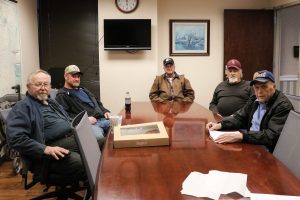
Photo by Lydia Berglar – To get a beer and wine license and also update the county’s ordinances regarding liquor, Canyon Grill has talked with the ABC Board, pictured here from left: John Gothard, Darrell Pardue, Rooster (Dorayne Stephens), Peanut (Doug Moore, chairman), Smokey (Robert Russell). Melissa Bradford has also taken a leading role from the county commission side to help clean up the ordinances governing alcohol.
As discussed at the March Dade County Board of Commissioners meeting, some of the county ordinances that govern serving alcohol might be changing. The Alcoholic Beverage Control (ABC) Board has recommended three ordinance changes, and the commission will go through a second reading at the next county commission meeting (April 4th) before voting.
The proposed changes can be viewed on the county’s website under the March 7th workshop meeting.
The first proposal’s title reads, “To define premises; to provide for the alcoholic beverage licensing requirements for golf courses; to repeal conflicting ordinances,” and the new ordinance would read, “Notwithstanding any provisions to the contrary, the ABC Board shall have authority to issue a Class 7 (a) – Golf Course License for the sale of malted beverages and wine, and a Class 7 (b) – Golf Course License for the sale of distilled spirits.”
It also provides clear guidance about what a golf course is, such as being 90 acres or more dedicated to playing golf.
Melissa Bradford (District 4 commissioner) has taken a leading role in working through these ordinances, and she told the Sentinel, “We’ve had many, many questions about the golf course. We’ve gone back and forth with them for the last year, and I’ve done a lot of research on golf courses.”
She felt that a separate category covering golf courses (instead of lumping them under restaurants) was needed.
The title of the second proposal reads, “Regarding certain location and distance requirements for onsite consumption of alcoholic beverages; to repeal conflicting ordinances.” Canyon Grill approached the ABC Board about this change.
The amendments would delete “from Section 8(e) all distance and location requirements concerning proximity to State Highways or exit or entrance ramps to an interstate highway” and “from Section 9(e) all distance and location requirements concerning proximity to exit or entrance ramps to an interstate highway.”
Instead, the location requirements would read, “The licensed location must be readily accessible by police and emergency services personnel.” Distance requirements from churches and schools would not change.
Currently, only restaurants within a two-mile distance from an interstate exit can serve liquor, limiting these establishments to the Rising Fawn, Trenton, Slygo, and 299 exits. This requirement was new to the ordinances in 2017. Bradford said, “To me, it’s ludicrous that these other restaurants don’t have the opportunity [to serve spirits].”
Canyon Grill owner, Johnny Holland, also feels that this requirement puts businesses on unequal footing. Jefferson’s, for example, can sell something that Canyon Grill and other restaurants cannot.
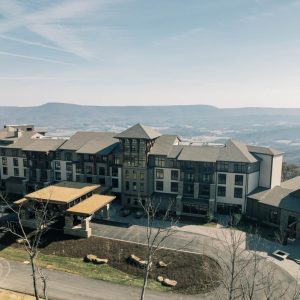
With McLemore Golf Resort just ten minutes away, Canyon Grill loses business from guests who want cocktails. Holland said, “We go there to eat, their guests come here to eat. I like having options, but we lose guests to them because we don’t sell alcohol, like cocktails.”
Holland added, “Let’s say I was trying to sell my business as a higher end restaurant but liquor can’t be sold here because of the location. That hurts my ability to sell. Restrictions like this hurt businesses.”
The ordinance change would still carefully outline what constitutes a restaurant in order to prevent bars from coming to Dade under the pretense of being a restaurant. Bradford said, “We had to make it very clear what a restaurant is, like having at least 60 seats, having a parking lot, a certain percentage of food sales, etc.”
The title of the third proposal reads, “Regarding brown bagging of alcoholic beverages for on-site consumption; to repeal conflicting ordinances.” It would delete the two ordinance sections that read, “Brown-bagging not permitted. No licensee under this section shall permit anyone from consuming or bringing onto the premises of the licensee any alcoholic beverages not purchased from the licensee at this retail consumption outlet.”
Under the current ordinances, brown bagging on the golf course has been allowed because it is separate from The 1945 restaurant, and the brown bagging only applied to restaurants. Under the current ordinances, brown bagging is not permitted at restaurants that have their beer and wine and/or liquor licenses, but it is allowed at non-licensed restaurants.
However, the state ordinances do allow brown bagging and corkage fees. Bradford explained, “The point is to take out the sections that talk about brown bagging because at a state level, it’s already in place and corking is already in place.”
Bradford’s goals in working on these changes with the ABC Board, golf course, and Canyon Grill are threefold: Provide clearer ordinances, align with the state ordinances, and “help out the small businesses here who are doing a great job so people come here to eat instead of going somewhere else.”
Clearer ordinances will not only help venues, restaurants, etc. have more control and know what they can and can’t serve, but it will also help the ABC Board handle requests instead of running all decisions through the county commission.
As to why Dade isn’t already aligned with the state and why the ordinances haven’t been cleaned up earlier, Bradford noted that many people in the area are not in favor of alcohol sales. She said, “Because of that, I don’t think anyone on the board wanted to pick it up and work on it, but we knew we’d have to pick this up again to clean up things. I was waiting for the right time. I feel like this would be a step forward for us, for the county, for the people, for the restaurants.”
The ABC Board met twice in February, first hearing from Canyon Grill owners and again to approve Canyon Grill’s beer and wine license. A number of citizens and business owners attended the first meeting to show support for Canyon Grill and speak about the restaurant.
Holland later told the Sentinel, “The people on the board were very kind. They asked questions that needed to be asked. They took the time to listen and voted to push it through to the commissions. I really appreciate them.”
The Sentinel asked the board members how they go about making decisions. Without going into much detail, they collectively explained that if they don’t feel that something in the ordinance needs to be amended, they deny the request.
They said that other businesses have come to them about changing the distance requirement, but the board did not act until now. When asked why it is now worth amending the ordinance, Peanut (Doug) Moore (chairman) said, “There’s some language changing going on.” During the county meeting, he said, “It’s time to move along with what the future’s showing.”
Moore told the Sentinel that while Canyon Grill was the catalyst for this change, it is not specific to that restaurant, and the board saw this as a good time to revise the ordinances in general.
Holland told the Sentinel that he has not been interested in selling alcohol, but financially, Canyon Grill needs the added revenue from mixed drinks to survive.
In 2017, when beer and wine by the drink were added to the ordinances, Holland told the commission that he didn’t have any interest in selling alcohol unless forced. “By forced,” he explained to the Sentinel, “I mean we’re not making enough of a profit to update refrigeration, paint the building, etc. Our margins have become super thin.”
Holland listed several factors that have pushed the restaurant into a tight spot. When the Hollands first took over the business, they increased their employees’ base wage from the state minimum to $10 an hour. Since COVID-19, they’ve had a difficult time recruiting and retaining staff, so they increased to $15 an hour for new hires (also giving current employees a relevant raise). Holland said, “We had to compete with places like McDonald’s that are offering $15 an hour.”
He spoke highly of his staff and clearly wanted to enable them to keep working at Canyon Grill. “We have a lot of great employees, a lot of young people from the local high schools, and a lot of people who are still with us from the early days in the 90s.”
Also, Canyon Grill faces the same inflation and skyrocketing expenses that everyone else faces. Holland reported that their gas bill doubled in the last year. “Everything across the board’s gone up. We’ve had to increase prices, and we don’t like increasing prices.”
Holland strongly emphasized that he does not want to increase prices further and dislikes that they’ve already had to take this step. He’s looked into studies and done the math, finding that money is in mixed drinks and liquor. Beer and wine can help increase revenue, but not as much as mixed drinks.
He said, “This is a way to increase our revenue, with a new stream we haven’t had before. We’re not in a location to do lunch, and a seven-day week doesn’t work because of our employee structure.”
Holland explained that he started working at the restaurant as a fry cook, and he wants to stay in this community. “I could take Canyon Grill to a bigger city and make much more, but that’s not what I want to do. I love being here.”
Holland explained all of this to the ABC Board.
He told the Sentinel that Canyon Grill will take on more liability and responsibility if they sell alcohol. With the current brown bagging, the staff has little control over how much people are drinking or who is drinking, but they do pay attention to patrons who seem over-intoxicated.
However, with the restaurant selling alcohol, all employees who serve the drinks must go through a background check and complete a test. Holland said, “We’ll have to do a test where you learn the rules, handling age requirements, making sure guests aren’t coming in intoxicated or being over-served. We have to have additional insurance.”
He explained that even with the current brown bagging, the restaurant does not want people to leave intoxicated. He noted that their guests seem to all have designated drivers, and this is something they would continue to keep an eye on (with a higher level of liability) should they serve alcohol.
Holland said he does not plan to charge excessively high corkage fees, but even smaller fees would help the restaurant with revenue. He said, “Most higher end restaurants have corkage fees, and some charge extremely high prices. It’s a way for people to bring in the exact bottle they want, and we make a little bit of money. It’s a win-win.”
Holland noted that patrons to the restaurant come from all around the world, and many drive from Birmingham, Nashville, and Atlanta. “We’re a destination restaurant, and we have some locals who come. The tourists bring their money here to Dade County. We take pride that some people drive over an hour to come here, and we try to make sure we provide the best service and food that we can.”