Microbiology Testing Lab Opens On Sand Mountain
By LYDIA BERGLAR
News Editor
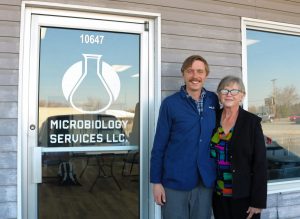
Photo by Lydia Berglar – Johnny Wimpee, Rachel Wimpee (not pictured), and Julia McBarron opened a microbiology lab in Ider, Ala. and received accreditation last month.
As of February 6th, Microbiology Services LLC in Ider, Ala. is a fully accredited microbiology laboratory. The lab has been open for about six months, but accreditation was an important milestone for the business.
Johnny Wimpee, the CEO and CTO (chief technical officer), holds a professional trade certification called GLPCP (Good Laboratory Practices Certified Professional). Originally from the greater Nashville, Tenn. area, he graduated from Middle Tennessee State University with a degree in genetics and biotechnology. He worked at a food and cosmetics lab in Cleveland, Tenn. before becoming a lab director at Chattanooga Environmental, a pharmaceutical microbiology lab.
He said, “In that role, I saw what it would take to run a lab, and the idea for Microbiology Services evolved out of that.”
Wimpee’s wife, Rachel, is Microbiology Service’s CFO (chief financial officer) and office manager, and Julia McBarron (Rachel’s mother) is the senior consultant. McBarron’s first career was as a food scientist, and she now helps with the lab’s marketing and operations.
While Ider might seem like an unlikely location for a lab, it works well for Microbiology Services and the Wimpees. When looking for a home and a bit of land, Wimpee found an affordable place in Ider and commuted to Chattanooga before beginning this lab.
Also, location is not an important factor for microbiology testing services. Wimpee explained, “The industry standard is that samples are shipped to the laboratory. Sometimes people want pick up/drop off services, but typically, location is insignificant.”
In Wimpee’s words, “Our testing is mostly related to consumables: things people will either eat, drink, or smear on their face.” They test pharmaceuticals (typically topical solutions), food, and environments.
Wimpee explained that large pharmaceutical companies like Pfizer usually have internal labs, but medium-sized producers, small businesses, and niche products use labs like Microbiology Services.
Regarding food testing, he said, “Food is heavily regulated for purity by the federal and state governments. It can’t have salmonella, listeria, E.Coli–those are the big three. There’s also spoilage testing where we look for things that are not necessarily a threat to human health but could result in product spoilage, loss, or recall.”
While potable water is regulated by the EPA and has its own testing requirements, Microbiology Services specializes in process water–the water used to make products like makeup.
Regarding cosmetics, Wimpee explained, “With makeup, we’re often testing for skin pathogens, like Staphylococcus aureus which causes a staph infection, Pseudomonas aeruginosa which is a green flesh-eating bacteria, E. coli which causes sepsis, or Candida albicans which causes thrush.”
He knew of a makeup seller who was doing well on Amazon, but reviews rolled in showing photos of moldy containers. “That’s not the threat to health that E. coli is for example, but it ruined his brand. That’s why he goes through testing now.”
Environmental testing examines the environment where food is produced rather than the food itself. Wimpee explained, “Often, they’ll test food per lot, but they’ll test environmentally each week or each quarter, depending on their HACCP (hazard analysis and critical control points) plan.”
The lab’s accreditation includes a list of what the lab can test for, but Wimpee added, “We also have the ability to test for things that fall outside of our scope, but we notify the customer that it’s for research only.” If the lab saw a high enough demand for something outside of their scope, they could add it to their accredited services without much difficulty.
Wimpee explained, “You can, in theory, start up a lab without any accreditation, but you’ll have a hard time getting customers. For example, a lot of our customers are regulated by the Georgia Department of Agriculture which requires that you use an accredited or certified lab. We were accredited to the ISO/IEC 17025 standard of the International Standards Organization which is specific to what we’re doing and is standard for laboratories.”
When going through proficiency testing, the lab received samples with (or without) contaminants from the accreditation company and had to correctly test and report back about what was or wasn’t in the samples. Lot traceability also examined the equipment and supplies at the lab. Ongoing assessments are completed to maintain accreditation.
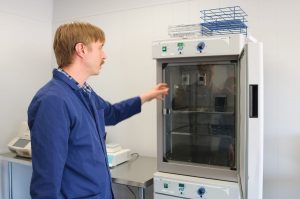
Photo by Lydia Berglar – Wimpee shows off some of the lab’s equipment. He is particularly excited about the Bio-Rad qPCR machine (in the back corner), calling it the industry gold standard.
McBarron said, “What laboratories do is so important to health and consumer well-being, to the product and the producer’s finances and brand. One litigation will ruin everybody. Accreditation is a series of checks and balances, and Johnny’s careful reporting and systems ensure that he can stand firmly behind our results.”
Of the lab’s equipment, Wimpee is particularly excited about the Bio-Rad qPCR machine, calling it the industry gold standard.
He believes that nearly any business wanting to take its brand to the next level can benefit from testing, giving the example of a roadside produce stand that may want to add their produce to store shelves. “If you have any kind of a product that you’re trying to get to the market, there’s probably some capacity for testing that you could benefit from. I’ve even met jewelers who had a miniature materials lab where they tested for things like gold content.”
The team hopes to connect with science clubs at local schools, and some college students have already expressed interest in learning more about the lab. McBarron’s interest in food science and nutrition began through her chemistry and biology club in high school, and she hopes local students might find their future career by learning about the lab.
She said, “I enjoyed food and home economics and I was really good at chemistry. I wanted to know how metabolism and your body works. When I got to college, the counselor said, ‘You want to be a dietician.’ A kid with an interest in science might find our lab interesting and then go on and become a microbiologist. Who knows? Years later, they might start their own lab.”
The team has already offered tours to a few people who were simply interested about this new business in Ider. McBarron said, “When we put the sign up and started moving the equipment in, it created a lot of local interest.”
Wimpee would also like to eventually hire interns, whether they be college students, recent graduates, or microbiologists seeking experience.
To learn more about the lab, visit www.microbiologyservicesllc.com.