
DCHS Students Learn About Employability Skills Through Georgia Power “Learning Power”
By LYDIA BERGLAR
News Editor
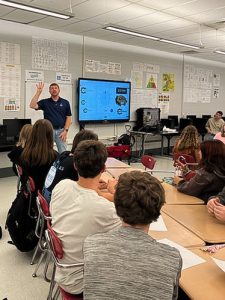
Photo courtesy of Al Barton – Camden Wallace (Georgia Power education coordinator) talks with 180 Dade County High School students about energy and employability skills during this October’s Learning Power day.
On Oct. 14, a representative from Georgia Power visited Dade County High School (DCHS) to talk with 180 students in Career, Technical, and Agricultural Education (CTAE) pathways about energy, energy efficiency, employability, and soft skills. Georgia Power’s “Learning Power” program currently comes to DCHS once a year.
Learning Power is a statewide initiative by Georgia Power to work with schools and focus on STEM (science, technology, engineering, and math) subjects across all grades. While the program is intended to interest and educate students about STEM topics, it is also intended to share tips with families about energy efficiency to cut down on power bills.
Al Barton (DCHS computer applications teacher/business and technology CTAE pathway teacher) was delighted to welcome Camden Wallace (Georgia Power education coordinator) to the classroom. Barton reported, “Students saw firsthand how education and the business sector work together. This enhances each student’s skill set and increases knowledge about careers and opportunities that are available and what to expect after high school.”
Five students in Barton’s pathway shared their experience during the Learning Power day with the Sentinel. Lauren Lou (freshman) explained that Wallace listed the top ten most valuable skills needed to be employable in the business world (communication, teamwork, reliability, problem-solving, organization, planning, initiative, self-management, leadership, and technology).
Then, “We practiced partnering with four people to see how communication plays a huge role in the workforce,” Lou said. “We built towers with toothpicks and molding clay.” Each group assigned one student to be the CEO, one to be a manager, and two to be employees.
For Savannah Lumpkin (junior), “What stood out to me was what it takes to be a good employee. He taught us about the soft skills and pure basics of what you need to be a good employee.”
The students also learned about factors that contribute to high electrical bills, and this stood out to Rocksy McCabe (senior) who said, “Electricity is expensive!” Wallace told DCHS students that even when devices aren’t in use, they use back-up power when plugged in. Ever since the Learning Power day, McCabe unplugs all devices when not in use or charging.
Ashley Gonzalez (senior) learned that adjusting the thermostat often instead of maintaining the same temperature can increase power usage, so she avoids adjusting the thermostat at home now.
For Emily Dehlinger (sophomore), the importance of nonverbal communication was a key takeaway from the day. “Focusing on other forms of communication skills stuck out to me. He made us do an exercise where we couldn’t talk but still had to communicate.”
Lou explained that the students used body language, humming, and pointing to communicate. As a babysitter, she’s found that appropriately communicating with both children and parents is essential.
Lumpkin has also noticed nonverbal cues at play in everyday life. She pays attention to signals from people around her even when no words are said. As a bus helper, she also practices communication and leadership skills on the bus.
Barton is excited about the CTAE department’s collaboration with not only Georgia Power but also 48 other business partners across the tri-state area that are actively recruiting.
He explained that these partnerships are mutually beneficial because students will one day be looking for jobs and the businesses are currently looking for quality employees. “Career and Technical Education continually adds value by building relationships that will last forever. It is a huge win for families in Dade County and the local economy. The business sector benefits from employees that are work ready.”
Barton firmly believes in the importance of developing multi-faceted students who then launch from DCHS as employable young adults, equipped with basic skills (reading, writing, arithmetic), hard skills (often gained through specific CTAE pathways), and soft skills (like the ones Learning Power discussed). With this trifecta, graduates can thrive in the workplace.
“Surviving is one thing, but many of them already ‘survive,’” he reflected. “It’s time to show them how to thrive. School systems, power companies, it doesn’t matter; we’re developing employability skills. CTAE classrooms are unified on that. We teach different subjects, and students will all have different jobs, but they leave here with transferable skills.”
Referencing one company’s list of the ten best forward-thinking jobs, Barton listed some that align with his CTAE pathway. These include data analyst, digital content specialist, engineer, and information security analyst. “We’re seeing the demand for well-rounded employees in these fields. All we’re doing is following industry demand.”




I believe the public school system’s STEM.programs are supported by the Bill and Melinda Gates Foundation.