Two Veterans Reflect On Service, Grit, Discipline
By LYDIA BERGLAR
News Editor
In celebration of Veterans Day this week, the Sentinel had the honor of sitting down with two Dade County veterans who shared about why they joined the military, what they learned in their years of service, and prominent memories from those years.
Of his four years in the United States Marine Corps, Rudy Shelton says, “I would do it again in a heartbeat. For an 18-year-old guy, if you got some stuff in you, you want to be disciplined, learn how to treat people, how to be treated, and what this country stands for without reading it in a book, then it’s a good place to be.”
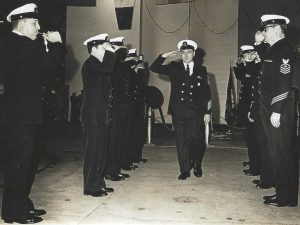
Photo courtesy of Charles Johnson – Charles Johnson during his 1975 retirement ceremony as he was “piped over the side” in a traditional Navy ceremony.
Of what he learned from his 25 years in the United States Navy, Charles Johson says, “I’ve always tried to maintain my military posture in everything: If you start a job, you finish a job. You do a good job and care about people because in the military you have to count on each other—whether you’re in combat or not.”
Before Shelton graduated from Pisgah High School on Sand Mountain, he signed up for the Marines in December 1958 through the buddy plan (which recruited groups of friends to sign up and train together). Two days after their 1959 high school graduation, he and a friend were at Parris Island, S.C., for bootcamp. Although his friend was set back by two weeks, Shelton graduated bootcamp on his 18th birthday and finished second in his platoon.
Shelton was a lance corporal before he was honorably discharged in 1962 due to a knee injury from playing football on a combined Marine/Navy team. Playing on this team was one of his favorite parts of his time in the Marines. “We got to travel all over Europe playing in football leagues,” he recalls.
The appeal of seeing more of the world also convinced Shelton to join the Marines, and a few friends had joined the year before him.
For Shelton, bootcamp wasn’t too much of a struggle. “I grew up on a farm on Sand Mountain. Physical activity was a little bit better for me than it was for a lot of the guys. It was a good fit for me.”
Joining the Marines led to many firsts for Shelton: his first time riding a commercial bus and a train, first time in New York City, first time aboard a ship going overseas, and first time in an airplane. “All of that before I ever got to my duty station,” he says.
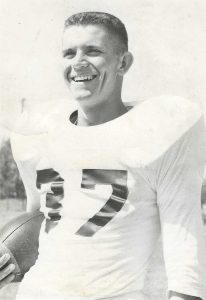
Photo courtesy of Rudy Shelton – Rudy Shelton in his football uniform when he played on the Marine/Navy combined team.
After bootcamp, Shelton’s first duty station was in Morocco for 18 months. Due to the civil war earlier in the 50s that ended France’s colonial rule over Morocco, the Marines were stationed there not to participate in the war but to defend U.S. communications sites.
“Morocco was a good thing for a young Marine,” says Shelton, “because you got to see some semblance of what war was like, and you got to travel. You got to learn a lot about Arab people. That stuck with me.”
In addition to playing football, working for the “Stars and Stripes” newspaper kept Shelton entertained while in Morocco. “It was really just a hobby shop that we had,” he explains.
Other more somber memories from Morocco have stuck with Shelton. He remembers the 1960 earthquake in Agadir which buried the town. The Marines helped dig people out, and Shelton says soberly, “That was pretty hectic for an 18 year old.”
He also remembers shooting pool in the rec room one day when a call came in that the U.S. Air Force base in Sidi Slimane had been attacked resulting in injuries. Shelton was one of about ten Marines who loaded up immediately and went to the base.
“Two Air Force guys were supposed to be patrolling the perimeter, but the Mohammed—that’s what we called them—had gotten inside the gate and killed both of them, cut their heads off and killed their dog.” Shelton remembers seeing the heads in the moat by the base.
“They caught the guy the next day, but the Arabs didn’t imprison their own people. They only imprisoned people that they could get money out of, so they gave him what they call the death of a thousand cuts. All of that was pretty hectic for an 18-year-old kid to see, but you learn some things. You learn how to maneuver and how to handle yourself. You just grow up.”
The July 16, 2015, Armed Forces Career Center and U.S. Navy Reserve attacks in Chattanooga have also stuck with Shelton. “The regret is they don’t allow off-duty Marines or reserve Marines to carry weapons. Had they had weapons, that probably would not have happened.” Instead, four Marines and a Navy sailor were killed and a Marine recruiter and police officer were wounded by Muhammad Youssef Abdulazeez.
After Morocco, Shelton was sent back to the states to a reconnaissance battalion for a little over a year. According to Shelton, “Reconnaissance is the toughest part of the military with mountain climbing, rappelling, swimming in the ocean, parachuting out of helicopters.”
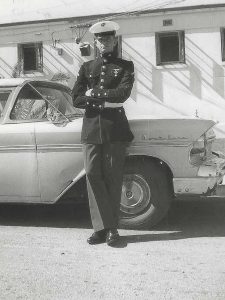
Photo courtesy of Rudy Shelton – A young Shelton poses in his dress blues. To this day, Shelton talks with young people about joining the Marines.
Shelton is an emeritus member of the Marines honor society called the Military Order of the Devil Dogs, and he made friends with comrades from all over the country and still keeps in contact with some of them. He is also a lifetime member of the Marine Corps League, a civic organization made up of Marines that continues to serve communities through projects like Toys for Tots.
After the Marines, Shelton’s main career was as an Allstate insurance agent in Chattanooga. He and his wife returned to Sand Mountain after he retired in 2001, and they own the Barn at Sunrise Farms.
Two activities around Veterans Day are particularly notable to Shelton: the Nov. 11 Veterans Day ceremony at the Chattanooga National Cemetery and the Nov. 10 Marine Corps Birthday Ball. He encourages anyone who has never been to the ceremony at the National Cemetery to attend, saying, “It’s pretty somber.” The ceremony is held each year at the eleventh hour of the eleventh day of the eleventh month.
On Nov. 10 each year, the Marine Corps celebrates its birthday with balls at bases across the world. This year was its 250th birthday. The Marine Corps was founded one year before the United States in 1775, an interesting bit of history that Shelton learned once he joined the service.
Shelton encourages any young man or woman who wants to learn discipline and maturity to join the Marine Corps. “I’ve talked to a lot of kids. Some of them go in, and some don’t. Some make it, some don’t. Discipline is a big thing in the Marine Corps. Physical fitness is a big thing in the Marine Corps, and you never stop being a Marine. You’re always going to be a Marine.”
The biggest change he’s seen since his time in the Marines is more women in the service, “and I’m proud of them,” he says. “The women that really want to be there are a good fit, and Marines respect that. But you’ve got to be a man or a woman or you won’t make it. If you do what you’re required to do, you will never regret it.”
Like Shelton, Johnson did not regret one minute of his time in the U.S. military. Joining the Navy was something of a family tradition, and he says, “The reason I picked the Navy is the family wouldn’t allow me to go anywhere else.”
Johnson attended schools in the Chattanooga area, but the Navy provided an escape from high school. He was two years behind his classmates, and he didn’t want to be older than his peers for the rest of high school. The Korean War broke out in June 1950, so that August, Johnson turned 17 and joined the Navy instead of starting his sophomore year of high school.
Since then, Johnson has come to value education. “The biggest regret I have in my life is that I did not go to high school. A good high school platform is your first great foundation and education. It prepares you for everything else, for your whole life. If you don’t get it, you’ll struggle.”
He completed his GED while in the Navy, however, and became a lifelong learner and a proponent of education, especially appreciating the accessibility of community colleges.
After recruit training at Naval Station Great Lakes in Illinois, Johnson was assigned to a tanker out of Newport, R.I., at the end of 1950. “We went on a Mediterranean cruise, and I spent my 18th birthday on the Island of Crete. Being young like that, I didn’t know what I was doing.”
Johnson says his first four years in the Navy were difficult, but he grew up a lot. After the tanker, he was stationed on two salvage ships and then a repair ship. He also married his wife, Joy, at age 19.
When his contract was up, he left the Navy with 90 days to reenlist. He reenlisted on the 88th day because “there were no jobs in the Chattanooga area. Military pay wasn’t the greatest pay, but it was some pay,” Johnson laughs. “It was not until I reenlisted that I really made a career out of it.”
In the first four years, he only earned one promotion, but after reenlisting, he earned two promotions in two years. Johnson feels that his lack of education made his road bumpier and promotions slower. However, he eventually earned the rank of chief petty officer.
Johnson earned a Naval Commendation Medal in the early 1970s for excellent recruiting work, and he enjoyed being a pistol instructor for Naval Station Norfolk. At the end of his naval career, he was chief navy counselor on the USS Nimitz.
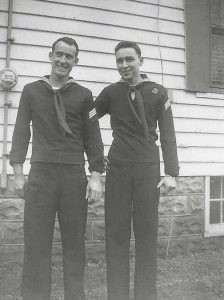
Photo courtesy of Charles Johnson – Johnson (right) and a shipmate from the first ship he served on pose together during a visit to Johnson’s family in Chattanooga.
Johnson was part of the 1962 Cuba blockade, but this was the closest he got to battle because his time was mostly spent on support ships. During the Vietnam War, he volunteered to serve on a battleship but “they didn’t need my skills,” he laughs.
Johnson retired from the Navy in 1975, and the family moved to Joy’s childhood home of Dade County. “I thought I was going to make a living painting houses,” Johnson says, “but I didn’t have the heart to charge people, so I lost money on that.”
Instead, he became a substitute mail carrier in Rising Fawn and then a full-time carrier in Flintstone before retiring at 65 years old.
Johnson doesn’t call himself a hero. “I just did my job. I think that’s the main thing of all military people: They do their job. They fall into situations sometimes where they’re called on to do more. Those are the heroes. The true heroes in my mind are the ones left over there in the Pacific Ocean, on the battlefields, in Korea, Vietnam.”
While he may not place himself in the category of hero, Johnson knows he was a hardworking “squared away” sailor. Of what it takes to be a good sailor, he says, “Caring about your job and yourself. I always did more in my job than it called for and always took care of my dress. My uniform was always squared away. You have the same thing in the military as in civilian life—the ones who do their jobs well and care and others that just don’t care.”
Johnson says, “I think it could benefit every young person to have a couple year stint in the military before or after college.”
While he values education, he adds, “The books are not everything. Young people now are given many things and often don’t start doing things for themselves until they’re in their 20s, but I’ve been on my own since I was 17. The military would give them experience and teach them to take care of themselves.”
Just like the Marine Corps was a good match for Shelton, the Navy was a perfect fit for Johnson. “I’m just a true and blue sailor, never got away from that mindset. I miss running up and down those old decks and ladders. There’s nothing like it. I wish I could go back to those oceans.”