Explaining The Recall Process And Two Recent/Ongoing Recall Attempts
By LYDIA BERGLAR
News Editor
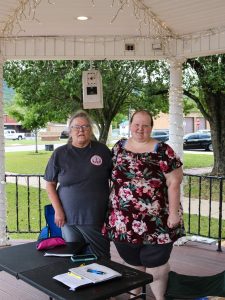
Photo by Lydia Berglar – Rebecca Conkle Cartwright (right) and Grace Sanders (left) gather signatures for a recall application against Don Townsend at Veterans Memorial Park on Sept. 25.
If you’ve been enjoying some peace living under a metaphorical rock for the last month or two, you might be unaware that the process of recalling elected officials has come to the forefront of local conversations. The Sentinel is aware of at least two recent recall applications with the goal of removing Don Townsend (county executive) from office, so we spoke with the petition chairpersons and reviewed details of the recall process.
First, let’s look at the complete recall process in Georgia. The Sentinel asked Lowanna Vaughan (elections supervisor) for information on how to go about the process, such as whatever information the elections office gives to residents who want to begin a recall. Vaughan gave the Sentinel a packet with the necessary steps and relevant sections of the Official Code of Georgia (O.C.G.A.).
Per O.C.G.A. 21-4-5, no recall petition can be filed against an official during the first or last 180 days of his/her term, and per O.C.G.A. 21-4-3, grounds for recall means:
“That the official has, while holding public office, conducted himself or herself in a manner which relates to and adversely affects the administration of his or her office and adversely affects the rights and interests of the public; and that the official: has committed an act or acts of malfeasance while in office; has violated his or her oath of office; has committed an act of misconduct in office; is guilty of a failure to perform duties prescribed by law; or has willfully misused, converted, or misappropriated, without authority, public property or public funds entrusted to or associated with the elective office to which the official has been elected or appointed.”
To get the process started, a citizen (called the petition chairperson) must fill out a “recall application,” listing the statutory ground(s) for the recall and providing evidence that supports the ground(s). This application must include either 100 signatures or signatures from ten percent of registered voters in the last election for the office in question, whichever is fewer. In our current situation, 100 signatures are needed.
The signees must have been registered to vote at the time of the election for this office. Also, per O.C.G.A. 21-4-8, signees must be eligible to vote in the potential recall election and still live in the district in question. In this case, the district is all of Dade County.
Each page of signatures must be notarized.
After the petition chairperson drops off the completed application and signatures, the elections office has five business days to verify the application. The elections superintendent (Vaughan) determines the legal sufficiency of the application by confirming the petition signatures.
Per O.C.G.A. 21-4-3, “legal sufficiency” when applied to the elections superintendent refers only to confirming the signatures—not assessing the grounds and evidence for a recall.
The public officer in question is notified when an application is issued, when it’s returned for verification, and the verification outcome. Within four business days of submission for verification, the officer may petition the superior court to review the ground(s) and supporting facts.
Per O.C.G.A. 21-4-6, it appears that this is the only reason the superior court would get involved. During such a review, the petition chairperson is responsible for providing facts that support the grounds for recall.
If the recall application is deemed sufficient by the elections superintendent (and not dismissed by the superior court should the official request a review), the petition chairperson is issued a “recall petition.” The chairperson then has 15 days (the instructions did not specify business days this time) to get signatures from 30 percent of registered voters in the election for the office in question.
At the time of the Nov. 5, 2024, election, Dade had 11,498 registered voters, so 3,450 signatures would be needed. As with the application signatures, these signatures must also be certified by the elections office. (The instructions did not say that these sheets must be notarized.)
The instructions did not say how long the elections office has to certify the petition this time, but once certified, a recall election must be called within ten days. The person responsible for calling the election depends on the position being recalled. In this case, Vaughan would be responsible.
The recall election must be conducted between 30-45 days after this point. If a primary or general election is held in that timeframe, the recall election should be combined with that election.
It is a simple yes or no majority vote. O.C.G.A. 21-4-13 reads, “If more than one-half of the votes cast on such question are in favor of recall, the public office in question shall immediately become vacant.” Otherwise, the official stays in office.
If this election creates a vacancy, a special election must be called within ten days and held within 30-45 days of being called. The person who has been recalled can run again in the special called election.
Coy Williams was the first citizen this fall to start a recall application against Townsend, but he did not get the sheets of signatures notarized before dropping them off at the elections office. The elections office told him he could get them notarized at Bank of Dade, but Williams was dealing with a medical emergency and didn’t have time to get them notarized before going to the hospital. Therefore, his application was dismissed.
Williams told the Sentinel that when he first began the recall process, the elections office only gave him the petition sheets for signatures, not the instructions and O.C.G.A. references that the Sentinel received from Vaughan.
Williams said that Vaughan brought further information to his attention over the next week or so, and a week and a half after he first picked up the petition sheets, he received the rest of the packet that the Sentinel received. He was unaware of the notarization requirement until he dropped off the application.
The Sentinel asked Williams what ground(s) he listed on the application. Williams said, “I just felt like he wasn’t doing his job. They weren’t listening to the people of the town.”
He explained that even if the recall wasn’t successful, he hoped the process would draw Townsend’s attention to people’s opinions, specifically about the proposed elections building and overall county spending.
Citing inflation and taxes across the board, he said, “Everything’s gone up. I was worried about elderly people losing their houses in Dade County.”
Williams saw that many of the comments on Facebook regarding the elections building did not get a direct response, so he felt that Townsend was not paying attention to these comments.
The Sentinel asked what supporting evidence Williams had for the stated grounds, but aside from the lack of response on Facebook, the only other piece of evidence he mentioned was a video from KWN’s Newsmaker segment in which Townsend talked about speaking with a friend who was at the county administrative building to vote.
Williams said this was his first time getting involved in local politics to this extent, and he had expected the elections office to guide him through everything he needed to do.
He is supportive of the second recall application of which Rebecca Conkle Cartwright is the chairperson. She turned the application in on Oct. 3.
Cartwright explained to the Sentinel that her application is not a personal vendetta against Townsend. Rather, she sees it as a way to keep the government accountable and make citizens’ voices heard. Like Williams, her concerns are about spending.
She cited misappropriation of funds as grounds for the recall, specifically that Townsend used some American Rescue Plan Act funds for office renovations and furniture.
She gathered quite a bit of information about ARPA’s intended use and the county administrative building and found that some of the expenses were allowed but others appear not to fall under the stated appropriate uses for ARPA.
One portion of a Facebook post by Cartwright read, “Other replacements that I am struggling with are the $2,000 each cost of several purchased bookcases, the purchase of numerous desk/office chairs that cost hundreds of dollars each, one of which was said to have cost almost $1,000 on its own, the purchase of desks, and the $1,800 price tag to install all of the new furniture all of which was paid for with ARPA funds.”
She noted that some of the old furniture was moved to other departments/offices and wrote, “If it was still in good enough condition to donate to the Historical Society, the Prosecutor’s Office at The Depot, and the Juvenile Court for use then, that means the County could have kept it and not spent ARPA funds on new furniture.”
The Sentinel will follow up on this recall once more is known about next steps and signature validation.