“I Don’t Want To Learn It All, But I Would Like To Learn A Little Bit”
By LYDIA BERGLAR
News Editor
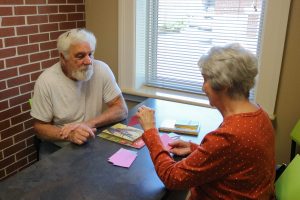
Photo by Lydia Berglar – Rena Hammond and Tommy Jackson run through vocabulary flashcards at the start of a tutoring session earlier this summer at the Dade County Public Library.
“Back then, they didn’t care if you went to school or not. They said, if you’re working, go to work. So that’s what I done my whole life.” So said Tommy Jackson, a 72-year-old talented, hardworking bricklayer from Sand Mountain, Ala. “I done block and brick work for 40 years, and I made good money.”
Jackson attended school until about the sixth grade. He is great with his hands and good with numbers, but he never mastered reading or writing.
When Jackson’s physical therapist, Laura Durel at Performance Physical Therapy in Trenton, heard his story, she asked him if he had any interest in working with a tutor to improve his reading and writing abilities.
A few years back, a high school teacher had talked to Jackson about helping him. “He asked if I knew anything about computers,” Jackson recalled. “I said I don’t know the first thing about computers, and he said they don’t use books no more. They use computers, so he decided he didn’t even want to fool with me.”
Aside from this instance, Jackson had never thought about finding a tutor until Durel suggested it. Even if he had wanted to pursue it himself, Jackson said he wouldn’t have known where to turn.
Durel set to work, trying to find a volunteer tutor for adults. She called Dade County Schools, Covenant College, and the Dade County Senior Center, but no one called back. Even the Dade County Public Library didn’t know anyone who could help. While Time With Teacher connects students with free tutors (see the Aug. 14, 2024, Sentinel), there weren’t any resources for adults.
While speaking with the library staff, Durel ran into Rena Hammond, another former patient, who volunteered to help. Hammond taught for 37 years, 28 of which were in Dade County Schools.
She shared, “Dade County is really dear to me. I loved teaching. I’m not saying every day was a great day, but every day had its good parts.”
Hammond firmly believes in the importance of literacy, even for people who don’t have the desire to sit down with a book just for fun because, “If someone can read, they can do well in life.”
Durel connected Hammond and Jackson, and they’ve been meeting at the library for about four months now. Jackson has made great progress. Hammond said, “He’s motivated, and he can read better than he thinks he can. He’s a smart man. It’s amazing to hear him tell his story. He built his own house and has a lot of skill.”
Hammond has been working with him on road signs, days of the week, and months of the year. They’ve used the classifieds in the Sentinel to find common words, and eventually, they’ll look at menus from local restaurants.
Jackson turned 72 this July and lives in Bryant, Al., where his family moved when he was ten. He’s been working with his hands since he was a young child, and after dropping out of school, he began working full time. By age 15, he was independent and out on his own doing block and brickwork.
“I didn’t think I needed no schooling,” he said, “but now, since Rena’s been helping me, I’m getting where I’m liking it, and I’m learning a lot. I don’t want to learn it all, but I would like to learn a little bit. I never could read or write. I can’t even write my name in cursive.”
Hammond, however, said that Jackson knows more than he thinks he knows.
Jackson was one of 13 children—seven boys and six girls. His dad was also a bricklayer, and his mom managed the household. “She cooked a lot of beans and taters. We lived a poor life, but we had a good life. We loved one another.”
Of the bricklaying work, Jackson said, “I loved that work. I still like it, but I’ve got back problems and shoulder problems.” The job was easy for him when he was young, but over the decades, it took a toll on his body. It’s too painful for him to lay twelve-inch block now, so he sticks to brick and is mostly retired.
The skills he gained in this career served him well, allowing him to build his own home on Sand Mountain. “I know how to do construction work, and I ain’t scared of hard work,” he said. “You had to work hard to live. I can build anything; I just can’t do the hard stuff anymore.”
Jackson has noticed how the world has changed since he was growing up. “You didn’t have to have an education to work, but now, you have to have a high school diploma to flip hamburgers. Nowadays, some people work their brains more than they work their bodies, and that may not be good neither.”
Jackson and Hamond shared about the importance of balance and the value of both hands-on labor and mental work. Hammond recalled the home economics and shop classes from her years as a student. “Those classes taught life skills, but somewhere in the 50s or 60s, schools moved away from that.”
While she believes a university education can be a great path for the right people, she also sees the value of the practical classes of the past (which Dade County Schools have thankfully brought back with Career, Technical, and Agricultural Education pathways).
Hammond’s tip for helping guide young people as they consider their future is, “Find out what they’re really interested in. If they’re interested in something that doesn’t require college, encourage that. I know of several people who have gone to college and have a degree in something, but that’s not what they pursued in their career.”
These days, Jackson mostly volunteers his skills to help other people with projects, free of charge, like helping a woman build a 16×10 storage building. He’s an active person who enjoys being outside, and although the idea of sitting down to read for fun isn’t appealing to him, he is excited to put his improved skills to use in everyday life.
“I didn’t think I’d ever need it when I was coming up, but when you get older, you say you wish you would’ve learned a little more,” he reflected, but he added that it’s never too late to learn new things. Also, although literacy was a challenge for him, he has a talent for mathematics. He’s good with numbers, partly because figuring was needed in his career.
Not being able to read well has made parts of life much more difficult for Jackson. For example, when he signed up for social security, he had to ask an employee at the agency to fill out the forms for him. Similarly, he can’t fill out paperwork at doctor’s offices. Some offices have employees who will help, but others don’t. In the latter situations, he must take the paperwork with him, ask one of his sisters to fill it out, and return for the appointment at a later date.
Jackson started driving as a young kid, and he’s traveled to many different states for work. He navigates well, but if he does get lost, it’s harder for him to figure out where to go without being able to read. “I know the street signs, but when Rena gave me these papers with the signs on them, it was hard for me to figure it out. But if I see a sign on the road, I know what it means.”
When ordering food at restaurants, he can’t read the menus, so sometimes he asks wait staff to read them to him. “I’m not ashamed to ask, because if you can’t do it, you can’t do it,” he said.
As Jackson and Hammond continue working together, Jackson will soon find these everyday situations a bit easier. Hammond is a testament to the impact educators have on our society, even when their years in the classroom are over, and Jackson is a testament to hard work and a “never too late to learn” mindset.