High Garden Tea Makes A Home On Lookout Mountain
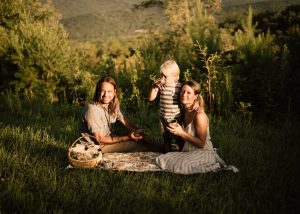
Photo courtesy of High Garden Tea – The Larabell family is moving their tea company to Lookout Mountain and plan to open a tea house in 2026, inviting guests to relax and sip tea in the forest.
By LYDIA BERGLAR
News Editor
“A few words come to mind when thinking about herbalism,” said Leah Larabell. “One is empowerment. I can’t imagine having a stopped-up head or stomachache but not knowing what to do about it with what’s right outside my door.”
Leah and her husband, Joel, are eager to share this empowerment—and some great cups of tea—with others out of High Garden’s new home on Lookout Mountain. Their herbalism and tea company has been around for over a decade but just recently moved its operations from Nashville to the mountain. The Larabells plan to open a teahouse next spring so the public can come enjoy sipping tea in the forest setting.
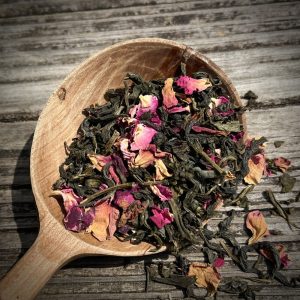
Photo courtesy of High Garden Tea – High Garden’s Garden Party Green tea features jasmine, bergamot, and rose petals.
Currently, High Garden teas are served in many coffee shops, cafes, and markets throughout Tennessee (including eight in Chattanooga), as well as several in Virginia, Maryland, New Jersey, Indiana, California, and Alabama, but the company’s story starts before the couple met.
Joel fell in love with tea while on humanitarian trips in places like the Philippines and Ukraine. He said, “We were in gypsy villages in the Ukraine where our interpreter couldn’t even communicate with these folks, but we could all share a pot of tea. We didn’t have to share the same language; we could share some tea.”
His expertise lies in true tea, while Leah’s expertise is in herbal tea. White, green, yellow, pu’er, oolong, and black teas all come from camellia sinensis, the tea plant. Everything else (chamomile, peppermint, ginger tea, etc.) falls under the herbal category. As Joel put it, “Leah works with hundreds of plants; I work with one.”
Leah’s journey started after she tried modern medicine for her own health needs but reached a dead end. She then turned to an herbalist and found relief, so she began studying herbs herself. After going through many trainings, she now teaches others about herbalism.
Leah told the Sentinel about the difference between herbal teas found on grocery store shelves and true herbalism. Generally, mass-produced herbal teas don’t contain enough of the herb to be effective, and the herbs might be old. “It doesn’t have very much potency or life in it anymore, so they spray these perfumes and flavorings on it, and for the medicinal herbal teas to be $6 on a shelf, they don’t use enough of the herb to be potent,” she explained.
High Garden generally doesn’t blend medicinal teas with true teas because the steep times for each are different. Tea needs a short steep time or else tannins are released, which not only taste bitter but also interfere with the absorption of nutrients.
Herbal teas, on the other hand, need a long steep time to release their full potential benefits. Adding herbs to tea shortchanges one or the other, but High Garden does use a few aromatic herbs for fun tea flavors (like Tennessee Honeysuckle and Creamsicle Oolong) rather than for medicinal benefits.
The Larabells started making teas and herbal teas in their kitchen, and word spread to friends and neighbors. Eventually, their teas were offered in a few coffee shops and restaurants around Nashville, so they needed a commercial-grade kitchen that could pass inspection.
They were invited to use a small space in a business incubator (a company that offers space to help entrepreneurs test out ideas) while they kept working their other jobs. Joel was a singer, and Leah worked as a therapist and guidance counselor (which is how she discovered her love of connecting people with nature as a form of therapy).
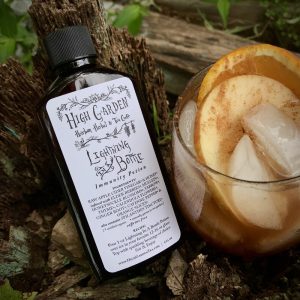
Photo courtesy of High Garden Tea – Along with teas, herbal blends, individual herbs, and tinctures, High Garden sells potions: apple cider vinegar and honey infused with herbs. Pictured here, Lighting in a Bottle is intended to boost your immune system. It’s infused with elderberries, mullein, honeysuckle, yarrow, thyme, calendula flower, ginger root, cayenne pepper, orange slices, and spilanthes tincture.
To help Joel’s voice and treat bronchitis, Leah created High Garden’s signature Sing tea which contains peppermint, marshmallow root, licorice root, plantain, stone root, wild cherry bark, hyssop, sage, and calendula. The tea worked. Country star Kenny Chesney heard about the tea, tried it, and loved it, and word spread throughout the Nashville music scene.
Leah said, “We’ve never done much marketing, but the teas work, so people talk about them. Nashville received the shop extremely well.” After moving to a larger incubator space for a season, they built their own shop around 2010.
After a successful decade, 2020 brought challenges and change for the family, first in the form of a tornado that destroyed their beloved shop, and second in the form of COVID-19. With their shop gone and COVID impacting coffee shop and restaurant business, the team focused on wholesale and online sales.
This season also gave the Larabells the opportunity to move. They said, “We wanted some rock faces and waterfalls in our life, so we looked toward Chattanooga. We worked every minute of every day in our shop, but we’re passionate about hiking and being in nature. We loved our teashop, but we couldn’t be the people we wanted to be in life.”
With a competent team of employees remaining in Nashville, the Larabells found a home in Trenton and began running the wholesale operations from afar. Next, they found land on Lookout Mountain in the Hinkle/Mount Olive area and began work on the future home of High Garden Tea.
This spring, the operation side of the business is coming to the mountain, and next spring, the Larabells anticipate being able to invite guests to High Garden’s teahouse.
The Larabells said, “Our point is to bring people to the forest.” Everything at the shop will be themed around nature. They’re planting native herbs and adding animal statues to create the High Garden Woodland Wisdom Walk. Signs won’t only include the plants’ and animals’ names but also stories to help guests remember each one.
The High Garden Naturescape play area will invite kids to play in the forest behind the teahouse, and guests can walk the path down to the creek. The outdoor patio will be covered and heated in colder months.
Leah said, “We want to be a place where you can drink tea, have elixirs, bring your kids, and just play in a forest.”
The second floor is where she teaches herbalism courses, and the Larabells have big plans for that space, like bringing in conservationists and offering other classes.
Although Leah had once hoped to grow her own herbs, she quickly realized that this was unrealistic given the amount of land needed and the difficult process of properly drying herbs. Therefore, High Garden supports regional growers as much as possible and partners with farmers in the Appalachian Beginning Forest Farm Coalition.
As for the tea, they carefully selected thousand-year-old farms, mainly in Japan and Taiwan, to purchase from so as not to encourage deforestation which can happen when creating new tea farms. They trust their suppliers’ handling of the plant over mass-produced methods.
This all makes the tea more expensive, but as Joel said, “The world of good tea is a lot like the world of coffee or good wine. Where and how the plant is grown, handled, and processed has everything to do with how good it is.”
The Larabells firmly believe that their herbal blends work, but the family isn’t anti-modern medicine. Rather, they believe both methods can be useful in the appropriate contexts.
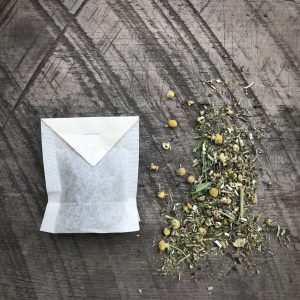
Photo courtesy of High Garden Tea – This Dreams blend is one of High Garden’s best sellers, used to improve sleep.
Their teas offer benefits like immune support (the Get Well blend, for example), anti-inflammation (Muscle Ease, for example), digestive health (Burn blend), sleep aid (Dreams blend), and more.
However, the Larabells noted that the herbs cannot necessarily offset poor lifestyle choices. Consider the Dreams blend, which is their best seller. The tea can’t overcome too much caffeine or other lifestyle factors that majorly impact sleep. Also, their Detox blend won’t necessarily help someone who continues to drink too much alcohol. For the Larabells, balance in all things is key.
As for their own health, the family drinks tea, herbal teas, and consume herbs on a daily basis simply as part of their lifestyle and wellness routine. Then, if they feel themselves getting sick or facing a particular issue, they’ll take specific herbal blends.
Leah said our culture is quick to dismiss the wellness that can come from plants. “Our deepest being knows we’re supposed to know these things about plants, but instead, we rely on modern conveniences. I think that’s why, during COVID, people turned to gardening and herbalism; we know where to turn. There are so many plants outside people’s front doors that instead of being celebrated as food and medicine are seen as weeds.”
As an example, Leah mentioned cleavers (galium aparine). “They’re probably in everybody’s yard, and they’re the strongest lymphatic tonic I can get my hands on. It helps clear the body of toxins.” She added that violet leaves help with lymphatic stagnation and sore throats, and chickweed (stellaria media) is simply full of nutrients.
If you do a quick search online for studies and opinions on herbalism, the results are fascinating. Scientific studies proving the efficacy of herbs are difficult to find, but many people on forums share anecdotal evidence about positive results from herbal remedies while pointing out the many downfalls of modern medicine.
One article in the National Library of Medicine (“Herbal Medicine in the United States: Review of Efficacy, Safety, and Regulation”) found that, “Of the top 10 herbs, 5 (ginkgo, garlic, St. John’s wort, soy, and kava) have scientific evidence suggesting efficacy, but concerns over safety and a consideration of other medical therapies may temper the decision to use these products.”
This article and others in the NLM and other scientific journals point to evidence that some herbs do work, but these sources cite the lack of regulation as a concern, as well as the lack of copious studies on herbs.
When the Sentinel spoke with the Larabells about arguments against herbalism, they were full of information and thoughtful answers, but the topic gets quite complex.
For example, the Larabells explained the difference between herbalism and herbal supplements. In supplement form, the plant is no longer surrounded by all of its constituents. Instead, supplements extract one compound from plants to make it more potent, but true herbalists believe that the plant is most effective with a much smaller risk of adverse reactions when the plant has all of its constituents.
As for the safety of regularly consuming herbs, the Larabells said, “There are certain herbs that we call active, power herbs that you want to only work with when they’re needed, but then there are nutritive herbs that you’d have a hard time eating too much of.”
Leah said, “Plants are not to be feared, but they’re to be respected. You don’t shove handfuls of something you don’t know in your mouth; that’s not respect. You put the time in to know the plant and know how much to eat.”
Joel added, “One of the reasons Leah’s herbal blends are so good is because she has done so much research, studying, and practicing to put herbs together in a synergistic way.” He said an inexperienced herbalist might combine a relaxing herb and an energizing herb, but taken together, these would be counterproductive. Leah, instead, has studied each herb to know how to use it appropriately.
There’s so much more to the High Garden story (such as their conservation efforts, sustainable packaging, and seed paper cards in each package), so visit highgardentea.com to learn more. You’ll also find educational resources, like their podcast (which is also on Apple Podcasts and Spotify), Leah’s research paper on using herbalism to treat interstitial cystitis, and upcoming workshops. You can also follow along on Instagram where Leah posts educational videos.
Leah concluded, “I just hope we can help people fall in love with one of the most ancient medicines there is.”