
Is Hang Gliding A Dying Sport? Not In Dade County
By LYDIA BERGLAR
News Editor
In 2019, “Smithsonian Magazine” posited that, although beloved by participants, hang gliding is a dying sport. The topic has been discussed on online forums for many years, with some people agreeing with the magazine while others say the sport is alive and well. Here in Dade County (home of the second oldest school of hang gliding in the world), the sport remains an iconic fixture of the community, and flight park staff have not witnessed a decline in hang gliding.
“Smithsonian Magazine” wrote, “For all its appeal, by every metric of participation—the number of manufacturers, schools, new pilots getting rated—hang gliding is in decline and has been for years. There are multiple factors at play: lack of exposure, persistent negative perceptions of safety, an aging pilot population, and new ways to see Earth from above, like Google Earth and drones.”
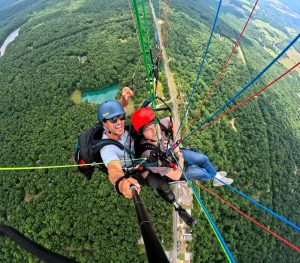
Photo courtesy of Lookout Mountain Flight Park – While tandem hang gliding flights are Lookout Mountain Flight Park’s bread and butter, tandem paragliding flights (pictured here) are also popular. The flight park teaches lessons in both sports.
The article further explained that paragliding is growing in popularity. Partly because it is perceived as safer, paragliding is hang gliding’s biggest competition. The Lookout Mountain Flight Park (LMFP) offers both sports in the forms of tandem flights and lessons, so the Sentinel asked the flight park what they’re seeing in the world of air sports.
Jen Richards (general manager) said that across the world, more people are taking up paragliding than hang gliding, but the local business is not experiencing a decrease in the interest in hang gliding. “It’s kind of like skiing and snowboarding back when snowboarding first got really popular,” Richards said. In the 1980s and 1990s, some speculated that snowboarding would push skiing into oblivion. “It seemed like snowboarding was going to take over skiing and no one would ever ski again, but obviously that’s not the case. Same thing with these sports.”
LMFP has been teaching hang gliding since the school started in 1978 (just four years after Kitty Hawk Kites, the oldest hang gliding school in the world, began). It wasn’t until six years ago that LMFP added paragliding, so the school is still primarily known for hang gliding. However, Richards said both sports are thriving at the flight park.
Most people come to LMFP to fly tandem rather than to take lessons. Richards reported that while paragliding tandems are popular, “numbers-wise, hang gliding tandems are the most prolific thing that we do.”
There are several primary differences between the two sports, but as Richards said, “We’re both playing in the same place.” She added that trying both sports is not uncommon for those who spend their lives playing in the skies.
Hang gliders are steered by the pilots shifting their weight to the side they want to turn. The pilots pull the control bar (also called base tube) toward them to turn downward, and they push it forward to turn upward.
Hang gliders weigh about 50-60 pounds and are difficult to transport because of their size. (When flying, the weight is evenly distributed across the wings, so it doesn’t feel like a 50 pound weight on your back.) Meanwhile, paragliders can be as light as about five pounds or as heavy as 35 pounds.
Alejandro Albornoz (LMFP paragliding instructor) explained that paragliders are steered by leaning to the side you want to go and using what are called brakes. Like the wing flaps on airplanes that create drag, paraglider brakes increase the resistance on one side so that the opposite side moves forward, thereby turning the craft.
The sport originated with French rock climbers, hikers, and base jumpers who experimented with modifications to their parachutes so that they could fly out after ascending the Alps. Both hang gliding and paragliding host competitions and feature cross country travel, but “hike and fly” belongs solely to paragliding because it requires a lightweight, portable craft for the ascent, hence the paragliders that weigh just a few pounds.
Albornoz explained, “One of the rules in paragliding is that it has to be foldable in every way. There cannot be anything rigid that you cannot fold. There’s a big discussion of which sport is safer or easier. I just like people to think that they’re two different things, like windsurfing and kite surfing.”
“Smithsonian Magazine” cited safety as one reason for a potential decline in hang gliding: “Wills Wing, a hang glider manufacturing company, estimates on its website one death per thousand participants. According to the site, that statistic makes hang gliding more dangerous than driving a car. But when student flights are factored in, the rate decreases, given the large number of student flights with very rare fatalities. According to USHPA’s annual fatality reports, there were 10 hang gliding fatalities in 2015, eight in 2016, one in 2017, and two by June 2018.”
Richards and Albornoz, however, are not worried about the safety of flying any more than the safety of driving a car, participating in other action and adventure sports, or just living life. Richards said, “If you stay within your skillset—if you don’t fly in conditions that are beyond your skills or a glider that’s over your skills or at a site that’s over your skill level—you can fly without incident forever.”
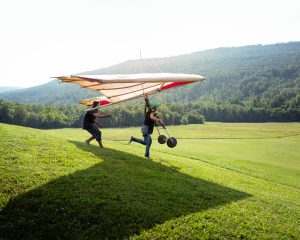
Photo courtesy of Lookout Mountain Flight Park – A student learns to pilot a hang glider by foot launching from the training hills at LMFP’s site in the valley.
Albornoz noted that he’s flown at least 10,000 times without any serious accident. Although the probability of an accident increases with each flight, so does the pilot’s competence.
The Sentinel asked if equipment failure ever causes accidents. Richards said that in most cases when a glider breaks, it’s due to the pilot performing aerobatics (flying loops and other showy maneuvers) when the gliders aren’t rated to fly loops. She said, “People have flown loops for the past 40 years with nothing really happening, but it’s pushing the craft past its operating limits.”
Albornoz and Richards also cited the importance of proper maintenance and inspecting the equipment before every flight. According to them, the sports themselves are not dangerous; rather, accidents happen when pilots neglect proper maintenance, push gliders past their limits, or get cocky.
After first learning to fly, pilots get more comfortable and can begin to become too sure of themselves which leads to mistakes. Richards said, “We call it intermediate syndrome, which translates into many things in life. That’s what you have to watch in yourself: your ego.”
As to whether hang gliding or paragliding is safer, Albornoz said, “If you ask one or the other, both will tell you their sport is safer, but they often speak from a place of not understanding the other. We’re both playing with air, so there is always a risk, but both are super safe. The biggest risk is to live life without being happy and doing the things that you like to do.”
Beyond just the enjoyment of flying, hang gliders and paragliders also enjoy being part of a tight-knit community. Even though it’s a worldwide sport, participants have often met each other, and the community isn’t just the pilots; it’s their families as well. Richards explained that her son grew up at the flight park, coming home from the hospital straight to the landing zone.
Aside from the United States, the primarily places LMFP welcomes guests from are South America, Central America, Europe, and Canada.
Albornoz (who grew up in Venezuela) has special insight into the worldwide nature of these air sports. A few years after learning to fly, he moved to Italy to continue flying and then to the Basque Country in Spain. He’s also flown in Serbia, Argentina, Croatia, Slovenia, and Portugal.
“I think flying has created, at least for me, another perspective of the world,” he said. “It gave me that cultural view of the world. It didn’t only give me the flying part. I’ve met so many people, and I know that they look at life with a different perspective than many other people.”
Richards said that people often watch from the bluff thinking they could never fly, but in reality, the sport is for anyone. “I never thought I could do it when I was 20 years old, but you can fly. That’s what we try to let people know. Our goal at the flight park is to keep these sports available for people and have a place for people to come together to learn to fly.”
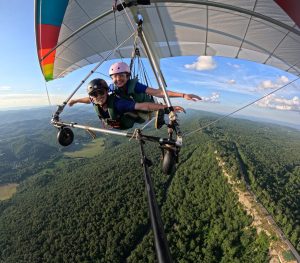
Photo courtesy of Lookout Mountain Flight Park – Fans of hang gliding describe the experience of flying through the air and seeing the world from the sky as peaceful and a way to disconnect from the rest of life.
The flight park recently sustained damage to the launch on top of the mountain due to a mudslide. The team started a GoFundMe, “Help Rebuild Lookout Mountain’s Launch Site,” with the goal of raising $25,000 for repairs.
Albornoz said, “Some people think this is a business that makes millions, but it just makes enough to cover costs and pay employees. It’s a family-owned business, and it’s incredible that they’ve kept it alive.”
Part of the launch repair project is adding drains to prevent future erosion and building cement walls and footers by the ramp. As of press time, $6,285 has been raised on GoFundMe, and the team is thankful for all who consider donating to the project.
For Albornoz and the other instructors, one of the best parts of their job is positively impacting people’s lives. He said, “When you teach someone to fly, you touch their life. That’s why it’s important to teach them well, because you want to change their life for good, for them to enjoy life—not for them to be getting into accidents.”
He recalled one client who came to fly tandem who was in a bad spot in life—going through a breakup, physically unhealthy, and working a very lucrative but draining job that offered no fulfillment. Three years later, the man returned to thank Albornoz for taking him flying and to tell him how his life had drastically changed. Now, he was living a simple life, he’d turned his health around, and he flew every day.
The trip to LMFP offered him peace and a glimpse of a different way of living. As Richards said, “It’s total disconnect; you don’t worry about all of life’s problems when you’re flying.”





There are some more lacks