Save Georgia’s Hemlocks Helps You Protect Your Trees From Invasive Woolly Adelgid
By LYDIA BERGLAR
News Editor
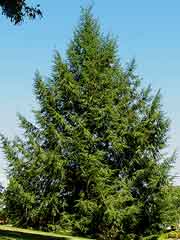
Photo courtesy of Save Georgia’s Hemlocks – This is a healthy, 30-year-old hemlock standing at 60 feet tall.
In 2024, Save Georgia’s Hemlocks treated about 12,000-15,000 hemlock trees in Dade County, Walker County, and two other nearby areas with a product that protects the trees from the tiny, aphid-like hemlock woolly adelgid (HWA).
The Save Georgia’s Hemlocks volunteer for our area, Jimmy Stewart, first saw the HWA in northwest Georgia in the late 1990s and early 2000s. He didn’t see them in Dade until 2016, which is when he knew he needed to get involved in saving hemlocks.
After enjoying successful careers as professional gardeners in north Atlanta, Stewart and his wife moved to Lookout Mountain to continue their beloved careers in a calmer setting. When Stewart saw the HWA in Dade, he became the Dade/Walker volunteer for Save Georgia’s Hemlocks, a 501(c)(3) founded in 2009. The Dade/Walker region also adopted Signal Mountain, Tenn., and Mentone, Ala.
The HWA, an invasive species, came to Canada from Asia (likely on hemlock boughs used as packing materials) and moved from hemlock to hemlock all the way down through the northeastern mountain ranges. The insects lay little white egg sacs that appear woolly (hence the name) at the base of the hemlock needles.
Each sac contains anywhere from 30 to 300 woolly adelgids, leading to a quickly multiplying population. Stewart said, “That’s the disaster. You can’t ignore it because they reproduce so quickly.”

Photo courtesy of Save Georgia’s Hemlocks – This hemlock is dying due to an infestation of the hemlock woolly adelgid.
In Asia, native beetles eat lots and lots of adelgids—about 250 an hour, in fact. There, the HWA is just a natural part of the food chain. Stewart explained that Washington state and a part of Canada have another type of beetle that keeps the HWA under control, but the rest of America doesn’t have these beetles.
The University of Georgia has been working to introduce the beetle from Asia to specific areas, but so far, attempts have been unsuccessful. The beetles aren’t surviving in climates other than their native home, so the work of Save Georgia’s Hemlocks remains important to protect the trees.
Credit for what the nonprofit is able to do lies with the late Donna Sherar. Once the threat of the HWA became apparent in the southeast in the early 2000s, she began researching solutions. Sherar worked with the University of Georgia, North Carolina State University, University of North Carolina, and Auburn University to figure out how to use imidacloprid safely to save hemlocks.
Imidacloprid used to be sprayed as a pesticide. However, Stewart said, “The label was wrong, the EPA was wrong, everybody was wrong. We’d go into a greenhouse and spray a whole greenhouse of impatiens, and they’d never have a bug the whole season, but nobody told us it went into the flower and the flower parts. The bees that pollinated the flowers were killed by the imidacloprid. It’s a great product, but it was very poorly labeled and marketed.”
Sherar and fellow researchers designed injectors that insert the product directly into the ground at the base of hemlocks and disperse exactly a quarter ounce per pump. The hemlock absorbs it without any bugs or bees being affected. (Plus, hemlocks don’t flower, so they don’t attract bees anyway.)
Stewart said, “So much great research has been done to prove that imidacloprid does work and is safe when used properly.”
Sherar’s method is very simple, but the injector costs $700. Therefore, Save Georgia’s Hemlocks provides the injector and manpower free of charge; property owners only have to cover the cost of the imidacloprid (which can be over $100 per gallon), and the nonprofit asks them to consider making a donation.
Cloudland Canyon State Park treats its hemlocks through the Friends of Cloudland Canyon, and Lula Lake Land Trust also has a group that handles its hemlocks, so Stewart primarily works with individuals. He noted that the key is getting the word out that there are hemlocks in Dade County and the impact of the adelgids.
While Dade has a few hemlocks in the valley, the vast majority are on Lookout Mountain. Not everyone is aware of what hemlocks look like. Red cedar looks similar to hemlocks, so if you’re unsure whether you’re looking at a hemlock or Red Cedar, Stewart is happy to check for you.
Save Georgia’s Hemlocks also keeps records of which trees/properties have been treated, so if you just recently bought property, Stewart can tell you if your trees have been treated in the last five years.
Even if egg sacs aren’t visible or the tree is not yet sick, the nonprofit treats all hemlocks, because, as Stewart said, “There’s only two kinds of hemlocks: one that has the woolly adelgid and one that’s going to.”
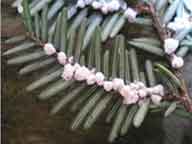
Photo courtesy of Save Georgia’s Hemlocks – The hemlock woolly adelgid egg sacs (shown here) are most visible in spring and summer.
He’s talked with some people who won’t treat their trees, but their reasoning is unclear. “I’ve got people on the Tennessee side of Lookout Mountain with beautiful hemlocks on their property that they won’t treat. If you’re on the Tennessee side of Lookout Mountain, it’s not the money that’s a barrier. Instead of treating, they’ll have to spend about $20,000 to have the trees taken down.”
Hemlocks can live 900 years and grow to 175 feet tall. They are the most shade tolerant trees in North America, thriving with only five percent sunlight. They grow next to water because they have shallow roots and are susceptible to drought. If you find a hemlock not near a stream or water source, it’s because someone planted it for landscaping.
The Save Georgia’s Hemlocks team can tell the color difference between a tree without the HWA and one with. “Trees with the woolly adelgid, the green is not green. We call it gray-green. The tree just isn’t happy.”
If 50 percent of the tree is still alive, it has a chance to survive, but the nonprofit has also treated those that were past the 50 percent mark: some came back, and some did not.
Beyond the loss of a beautiful tree, it’s a problem when hemlocks die because they provide shade for streams which protects the species living in the stream. Like other trees, they provide a habitat for birds and animals.
They’re also a primary shade source for native wildflowers. “If hemlocks are gone, the shade wildflowers die,” said Stewart.
As with any dying tree, it can be dangerous when it falls. “North Carolina did not treat. Around Asheville, the Blue Ridge Parkway, Highlands, and Cashiers, they’re dead as a doornail. They’re going to fall on hikers, on people driving.”
Additionally, dead hemlocks are great fire starters and can fuel forest fires. Stewart calls them “fat lighter,” because they’re full of resin, like pine trees.
Whether you know for certain your hemlocks haven’t been treated in the last five years or you’re not quite sure your trees are even hemlocks, call Stewart at 423-413-6420, and he’ll be glad to help you out. Visit www.savegeorgiashemlocks.org for more information.
Stewart concluded, “If we don’t treat our hemlocks, they’re going to die.”