Further Information About Animal Control, Proposed Facility, Potential Costs, And Two Commissioners’ Input
By LYDIA BERGLAR
News Editor
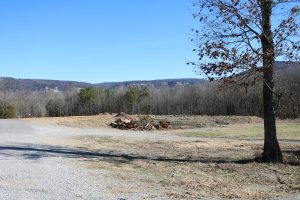
Photo by Lydia Berglar – This is what the location of the future animal control facility looked like at the end of February. Groundwork was done here before the location had been voted on.
Last week’s Sentinel covered the animal control facility joint meeting between the Dade County Board of Commissioners and City of Trenton. This week, on March 4, the committee formed at this joint meeting met for the first time. Check back in future issues for updates on that committee, but for now, here are some more details about the topic and input from Monda Wooten (Trenton street commissioner) and Phillip Hartline (District Two county commissioner).
Commissioners and citizens have thrown around the phrase “the people voted for an animal shelter” for years now, but what wording was actually used on the ballots? Contrary to commonly heard statements, this was not a simple “Should Dade County build an animal shelter?” question with a yes or no option.
The word “shelter” was not used anywhere on the ballots, and “animal control” was just one of many potential uses for the Special Purpose Local Option Sales Tax (SPLOST) dollars. Per the 2014 and 2008 primary ballot, the question starts by asking, “Shall a one percent sales and use tax be imposed in Dade County…” before running through a long list of projects and purchases that the tax funds can be used for.
In the midst of the county’s portion of that list, it reads “adding to, remodeling and renovating county facilities and acquiring any property, both real and personal, and equipment necessary therefor, including the transfer station, county jail, recreation facilities, animal control…” and the list continues.
It later lists under the City of Trenton’s section, “new construction, renovations and equipment for parks and recreation and city animal control facilities…” etc.
During the joint meeting, the commissioners were looking at the floor plan drafted by the city. The Sentinel submitted an open records request asking for this floor plan as well as the following:
- Proposed budget to build the facility
- Proposed annual operational budget with line items of expenses
- List of grants being pursued for construction and/or operation
- List of potential in-house revenue sources (rabies clinics, spay/neuter clinics, etc.) and estimated annual revenue from each
The only documents received in response to the request were the city’s current animal control budget ($77,490) and the floor plan. Of the city’s budget, $59,140 alone is for animal control staff (salaries, taxes, insurance, pensions, workers comp, and uniform allowance). $12,000 is for the contracted veterinarian, leaving $6,350 for gas and oil, communications, insurance (auto, building, and liability), supplies, equipment, vehicles, and fees.
If we can infer anything from this information, it’s that personnel and a vet for the new facility will be the most expensive annual items. That’s assuming the facility is used strictly for animal control and not for animal rehabilitation, complete veterinary care, or long-term housing (i.e. rescue and shelter).
The proposed floor plan is 4,626 square feet. It includes dog isolation and cat isolation areas, a medical room, triage room, reception area, training room, wash area, and separate spaces for cats and puppies. While the city has voted on the plan, the county has yet to vote on it.
The Sentinel asked for clarification from Don Townsend (county executive) about what was decided on at the joint meeting. He said, “The only thing decided is that we are going to construct a facility, and it will be behind the transfer station. Until we get plans out for proposal, we really won’t know what it will cost to build.”
Townsend said the floor plan will need to be sent to engineers for the MEP plan (Mechanical Electrical Plan) before a true cost is known.
As for operational costs, the only information we have at this time is what it’s costing other counties. The joint meeting referred to some Georgia counties that provide animal control for a relatively small budget, but Walker County budgeted $970,050 for Animal Services for fiscal year 2025 (FY25) and $953,050 for FY24. (The FY24 amended budget was also $953,050.)
The FY26 budget is not yet published online, but Dade’s commissioners reported that Walker scaled back by about $200,000 for a budget of around $700,000—about $10 per resident. If we apply this to Dade County, we can expect to spend over $160,000 per year on animal services.
For FY25, Walker planned for $13,400 in revenue from animal-related fees (classifications, adoptions, return to owner, owner surrender, transport, microchip), leaving a net expense of $956,650 or nearly $14 per resident. For FY24, Walker budgeted for and made $22,000 in revenue from animal-related fees, leaving a net expense of $931,050 (over $13 per resident).
According to Walker County’s website, “Officers will respond to emergency calls including sick or injured animals, animals in immediate danger, aggressive animals, dog bites that are actively at large, and law enforcement assistance. Animal Control is not the Animal Shelter. Animal Control responds to reports of stray animals, bite cases, aggressive animals, etc. The Animal Shelter is where animals are housed and cared for until reclaimed by their owners, adopted or rescued.”
Next, let’s look at Cherokee County, since the city used Cherokee’s facility as a sample when drafting the floor plan. According to Cherokee’s website, “The Animal Control officers are guided by the ordinances enacted by the Cherokee County Government, laws and regulations of the State of Georgia, as well as the Constitution of the United States. Such ordinances include animal cruelty and animal neglect. Animal Control also enforces ordinances concerning stray or abandoned animals, animal attacks, animal bites, loose and unattended animals, vicious animals and nuisance animals.”
Cherokee budgeted $2,148,710 for Animal Services for FY25 and $1,953,553 for FY24. (FY24’s actual expense came in at $1,939,682, just below the budgeted amount.)
The FY26 budget is not yet published online, but Cherokee budgeted about $7.50 per resident on animal services in FY25 and spent nearly $7 per resident in FY24. If we apply this to Dade County, we can expect to spend between $112,000-$120,000 per year on animal services—a better number than the Walker estimate.
For FY25, Cherokee budgeted $205,200 for revenue from animal shelter fees, leaving a net expense of $1,943,510 or nearly $7 per resident. For FY24, Cherokee made $186,149 (about $11,000 below the estimate) from animal shelter fees leaving a net expense of $1,753,533 (just over $6 per resident).
Using either of these counties as examples, it’s clear that fines and fees come nowhere near funding the entire operating budget.
A question that didn’t come up at Dade-Trenton’s joint meeting is that of animals from neighboring states. The Sentinel asked Wooten if she and other rescuers see many animals getting dumped from out of state. Wooten said she isn’t aware of this happening often. She and Audray Luck mostly get calls about hoarding cases and from locals who have unwanted litters or who want to surrender their dogs.
To people who don’t want to be taxed to pay for animal control or care, Wooten said that there are people who don’t have children in school, yet they still pay large amounts of property tax to the school system. “I don’t complain about that because I feel like it’s an investment in the community,” she said.
She also cited the senior center, transit system, and sports complex as services that all taxpayers fund but might not use.
Wooten is hopeful that with two new commissioners and a new county executive in office the animal control facility will gain some traction, and she wasn’t afraid to share her frustrations. “I have watched those commission seats turn over and turn over, and the only one who put forth some true effort about animal control was Lamar Lowery. I’ve had several tell me they’re concerned but produce no results. The city has tried to have animal control all these years, but the county has done nothing.”
She added that citizens who aren’t in animal rescue circles are often unaware that animals are an issue in our area. “People who are not dealing with it have no idea of the problem we have.”
However, Wooten said the community overall has made huge strides in the last few years, citing Luck’s Rescue and other individuals and nonprofits that care for animals, as well as the many people who have had animals spayed or neutered through the Dade County Pet Project. “The community has really stepped up. They have proven that, when given the resources, they will respond.”
According to Wooten, other shelters have two to four good volunteers that they can depend on.
She added that euthanasia isn’t the worst fate for an animal; the worst fate is being left to roam hungry, uncared for, and in danger.
Wooten also shared her frustration about other ways the county spends money instead of completing the animal control facility. “The Dade County Community Forest on the side of the mountain makes as much sense to me as buying that hole on Sells Lane for a water reservoir that won’t even hold water and now is used for growing corn and pumpkins.”
The Sentinel also spoke with Hartline who noted that he does get calls about animals, and he does believe we need some sort of animal control facility—but not a Taj Mahal. He is against a shelter, housing animals for extended periods of time, and covering extensive veterinary care, but he is not against having animal control in the county.
Hartline simply wants clarity on the cost to build and run the facility, how that cost will be split between the city and county, and how the facility will operate. He’s concerned about the lack of consensus on what this building will be, explaining that there are two groups of people: those who want a fully operational shelter, and those who believe it should be limited to a public safety focus.
He said no one has given a clear definition of which it will be and “the questions I’ve asked have not been answered. I don’t want to build a million dollar building when we only have $400,000.”
The Sentinel asked why Hartline is willing to spend money on the Dade County Community Forest but is more resistant when it comes to the animal facility topic. He answered, “With the forest, you’re opening up land for the whole community. It’s already off the tax rolls, so we should get to use the land. If we’re not going to get any taxes from it, let’s let everyone be able to use it.”
He continued, “We won’t spend any more money on that land until we have the grants. We’re taking half a million dollars and turning it into three or four million dollars, if we get all the grants.” Besides the $50,000 already spent on due diligence costs, no more money will be spent until/if enough grants are secured. Additionally, once the forest is purchased and established, the annual operational cost should (in theory) be low.
As for the animal facility, Wooten believes it must be built first—even if incomplete—before grants and donations (of an unknown amount) can be sought. Through Trust for Public Land, the commission was given a breakdown of exactly how much can be expected to fund the forest project and when. For the animal facility, nothing is known at this point.
Hartline concluded, “I feel like this building is only going to get bigger. Anywhere you go, they don’t get smaller; they only get bigger.” During the joint meeting, it was noted that McKamey Animal Center and Walker’s facility both started small but grew. This was implied to be a positive thing, but perhaps government growth isn’t positive.
As for volunteers and rescue groups staying involved, Hartline agreed that it’s not unusual for individuals to step out when the government steps in. For example, Hartline reported that there used to be five baseball fields on Sand Mountain at churches, parks, etc. before the Dade County Sports Complex was built. Now, there are none.