Founder Of Dade’s First Physical Therapy Office Retires After 36 Years In Trenton
By LYDIA BERGLAR
News Editor
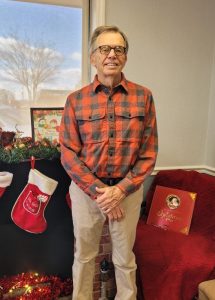
Photo courtesy of George Reed – After an almost 50-year-long physical therapy career, George Reed retired at the end of 2024, but his legacy of patient-centered care will continue.
George Reed opened the first physical therapy practice in Dade County in 1988. At the end of 2024—after 36 years practicing in Trenton and 46 years total in his career—he retired to enjoy more time with his family, pursue his many hobbies, and volunteer. However, the legacy of Trenton Physical Therapy will continue under Performance Physical Therapy and Sports Medicine.
Looking back on his career, Reed called physical therapy a fun and rewarding occupation. “It’s an enabling profession. You’re hitting head on problems people have using physical medicine. You’re getting patients from point A to point B, enabling them, and improving their quality of life.”
Reed grew up in Atlanta and Chattanooga before his family moved to Dade County when he was in high school. Graduating from Dade County High School and meeting his wife in Dade gave him roots in the community.
When Reed started his freshman year at Berea College, he didn’t know what path he wanted to pursue, but he started out as a math major. When taking an anatomy and physiology class as part of his gen eds, he realized that he wanted to go into a profession that involved patient care. He landed on physical therapy.
Reed then earned his Doctor of Physical Therapy from Georgia State University. Wanting to work at a teaching hospital, he applied to the University of Alabama at Birmingham, Vanderbilt, and Erlanger. His wife wanted to stay near the Chattanooga/Dade County area, so he took the job at Erlanger and worked there for six years. The couple lived in Chattanooga first before moving to a small farm in Wildwood.
Reed opened a private practice with three partners, establishing an office in Chattanooga, one in LaFayette, and one in Marion County. Reed then decided to add a fourth location in Trenton because they had many patients coming from the area, particularly the northeast Alabama portion of Sand Mountain.
He recalled, “I didn’t know if an office would work here; I didn’t know if we’d have enough business. What helped me make the decision was that Dr. Filler [Judson Filler was a family practice physician in Dade for many years] told me, ‘George, I think you need to do it.’”
In 1988, Trenton Physical Therapy became Dade County’s first outpatient option for physical therapy. Reed started with just a few afternoons at the office each week, but that gradually grew, and the staff expanded.
Reed also got involved in the community in several ways. Dade Health and Rehab (which was called Sandmont at the time) asked him for help starting their PT program, so he gave them some guidance.
He volunteered with Dade County High School as the athletic trainer for about 15 years, attending games and stopping by practices when an athlete needed to be assessed. The school didn’t have an athletic trainer until he came along.
Reed has also served on the Dade County Board of Health for over 20 years (and counting), some of those years as chairman. He reflected, “I really enjoy serving on the Board of Health. It’s good that we have a physical therapist on that board.”
The board offers input into many different things. Reed called it a sounding board. “We don’t make that many critical decisions, but groups get input from us, whether it’s the environmentalists who do the permits for new housing or the county nurse on matters like vaccinations and scoliosis screening in schools.”
Reed said that during COVID-19, the board didn’t have much input into pandemic matters because most decisions came down from the state, the Center for Disease Control and Prevention, and the World Health Organization.
All of these pursuits kept Reed very busy, as he was building the Trenton practice and still working in the Chattanooga office. He said, “I had a lot of irons in the fire.”
A key part of Reed’s practice was patient-centered care, which meant that instead of packing patients into business hours, he worked longer days. “When your reimbursements stay the same, but your expenses go up (which is the way healthcare is), then you either have to work longer days or compress patients into a given period of time, which means less time with each patient.”
What Reed loved about his job was working with patients, so he certainly didn’t want to cut back on the time he spent with each one. “Physical therapy is different from some areas of medicine in that we have the opportunity to spend a good bit of time with patients. Most physicians, therapists, nurse practitioners, etc. come out of school with the intention of being a very personalized care provider, but they get thrown into jobs that don’t allow that. By being in private practice, I had the ability to decide what our priorities are.”
Reed said that what he’ll miss the most in retirement is the people—the staff and patients. As for what he’ll miss the least, he said, “I won’t miss the reimbursement debacle we have in our country of healthcare financing, of having to jump through all the hoops to get paid for what you’re doing.”
As for his retirement plans, Reed is focused on family. His two children and one grandchild live in the area, and he and his wife want to care well for their aging parents.
Reed also enjoys agricultural pursuits. He gardens and is using his newfound time to learn to propagate plants. The family has two donkeys and a mule on their small farm.
With a curious mind and an emphasis on staying active and engaged, Reed enjoys exercising, golfing, and reading. “Patients through the years have turned me on to so many good books.”
He also plans to volunteer. “I’ve never understood the notion of being bored in retirement. There are so many volunteer opportunities. I’m going to spend more time volunteering at my church (Grace Episcopal Church in Chattanooga) and with the Friends of Cloudland Canyon State Park.”
It’s been just a month since Reed retired, but he’s already enjoying the slower pace of life. “The biggest thing I’ve noticed already is that I’m no longer in a hurry. I have a lot of things I enjoy doing, things I want to do, and things I need to do. I have more time to do them now.”
Reed entered retirement gradually, going from five days a week to four, then selling the practice in October 2022 to Performance Physical Therapy and Sports Medicine, then going down to three days a week.
Of the new company, Reed said, “I was very picky about who acquired the practice. I had overtures from other folks, some of them corporate, but I didn’t want to sell to a corporation. Performance is based out of Rome, and it took us about two years to work out the details, but I sold it to the right people. They have the same philosophy I do. We have an excellent staff here, and I feel good about handing the baton over to a very capable group.”
One of Reed’s co-physical therapists, Laura Durel, said, “This is his legacy, and it will continue on because another company saw George’s business as a worthwhile investment. Patient-centered care was always important to George, and we’ll be able to keep providing that.”
Durel specifically chose to work at Reed’s practice because she wanted to be in a small community. “Working for somebody who is so embedded in the community, he’s modeled for me what it’s like to be able to work in the community where you live. He’s a great clinician; his outcomes are wonderful.”
Sharon Ellis, office manager, noted Reed’s kindness toward everyone. “The care he gives his patients is what built this office. He has a way of keeping you calm.”
Anita Ringer, medical secretary, worked with Reed for 34 years, starting at the Chattanooga office before moving to the Trenton location. She said the people made the job especially fulfilling, and she emphasized how well Reed knew his patients and the community, and how he created an enjoyable work environment.
Katie Forshee, a new employee at the office, had her first experiences at the clinic as a patient in 2017. She said, “My first impression was that George is super compassionate and knowledgeable and caring. I had a serious hand injury, and we didn’t know how much function I would get back, but he was steadfast and encouraging, but also realistic. Then working for him, he’s pretty much the exact same: kind, consistent, and calm.”