
City Opens Door To D.R. Horton By Beginning Annexation And New Zone Creation Process
By LYDIA BERGLAR
News Editor
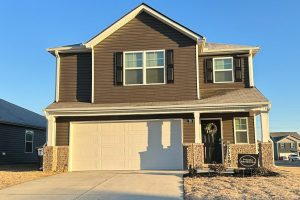
Photo courtesy of Monda Wooten – The day after the city meeting, Monda Wooten visited the two D.R. Horton developments in Walker County and sent this photo from the Price’s Crossing neighborhood, noting that she went inside several homes and found them to be beautiful.
The January 13 meeting of the City of Trenton Board of Commissioners was a long one, with much discussion about annexing the property D.R. Horton hopes to buy and creating a new micro-lot zone.
There was no discussion of Georgia House Bill 581’s new exemption (as discussed at recent school board and county commission meetings). Later in the week, Alex Case (mayor) explained that it simply slipped his mind, but he will ask the commissioners to research it before discussing it at the February meeting. Case told the Sentinel that he will recommend staying in rather than opting out of the exemption because the people voted for it.
First, the board approved a Special Purpose Local Option Sales Tax (SPLOST) expenditure for LED lights at Jenkins Park. Terry Powell (parks/animal control commissioner) explained that the current lights at the ballfields are obsolete, so the city hasn’t been able to find replacement parts. The city will replace the large field and batting cage lights but keep the current lights at the small field, holding onto the lights from the large field to use as backups.
The board approved the lowest of three bids for $21,330 and will be getting quotes on labor.
The board also approved a SPLOST expenditure of $52,583.42 for the sewer project that the city’s been working on for about a year (installing bar screens to filter out debris). This is the final payment for the project, and the last of the city’s remaining American Rescue Plan Act (ARPA) funds have been used up for the project.
Then, the board discussed the property annexation and creation of a new residential zone that would give D.R. Horton (DRH) the opportunity to build a subdivision in Trenton. See the Dec. 18, 2024, Sentinel for further details from last month’s meeting and information about the infamous development company.
Gil Milton, a land acquisitions representative from DRH, attended the meeting. He mentioned the two DRH developments in Walker County that are currently being built (Price’s Crossing in the City of LaFayette and Hawk’s Ridge by Ridgeland High School) as well as one in Ooltewah, Tenn. and one in Cleveland, Tenn.
Milton said DRH likes the 78 acres off Sells Lane that they’re hoping to purchase. He continued, “Chattanooga’s running out of space…As I’ve researched, there are people coming to Trenton from not just Chattanooga but different parts of the country…It’s a good spot, we like what we’re doing, and we’ve had some good meetings.”
Monda Wooten (street commissioner) asked multiple questions about the project scope and plans. She asked how many homes would be built, but Milton said they haven’t finalized a number. Case said it would depend on zoning decisions from the city.
Wooten asked what price and size the homes would be. Milton said they’d be sold for $275,000-$325,000 and range from 1,800 square feet to 2,400 square feet.
Wooten asked how long it would take to complete all of the homes. Milton said they don’t want to oversaturate the market, so the homes would be built out over nearly six years.
Case explained that infrastructure is the city’s first concern when approached with projects like this one. He said the Dade County Water and Sewer Authority, Don Townsend (county executive), and Ted Rumley (before the end of his term as county executive) were brought into the loop early on. Ladd Engineering (the city and water authority’s engineers) said that the water and sewer infrastructure can handle the growth, but the GA-136 pump station beside Hope House Cafe will need updated pumps.
DRH will pay for and handle all of the infrastructure work except for streetlights—the city will cover the lights.
Wooten asked about the HOA (homeowners’ association) that DRH plans to establish in the subdivision, saying, “They seem to start out really good, but then they fall by the wayside.” Milton said DRH is the HOA until the subdivision is completed. Then, the HOA will be transferred to everyone who bought the homes.
He said the fee hasn’t been set for Trenton or the Walker County developments. He didn’t want to offer an estimate based on other comparable developments but planned to send Case that information once he looked into it.
Citizen Melissa Faircloth was in attendance and asked about the price per square foot. Using the numbers mentioned earlier, the smaller houses would sell for about $153 per square foot and the larger houses would sell for about $135 per square foot.
Wooten asked, “Can you build a house for $135 a foot?” but Faircloth noted that this is the sale price. Assuming DRH makes a profit, the cost to build would be less. Case reminded Faircloth that this was the work session of the commission and not the public input portion of the meeting.
Case then explained that DRH’s planned homes (like the Woodford at Glenview development) would not be micro-homes (i.e. tiny homes, which are not allowed inside the city) but would be on micro-lots. Case proposed creating a new zone for micro-lots.
Currently, zone R1 minimums are 10,000 square feet for the lot size, 1,000 square feet for the home, front property width of 100 feet, 35 feet of frontage, a combined 25 feet on both sides, and 25 feet on the rear.
Like the current R1, the new zone would be single-family residential homes, but the space requirements would be reduced to minimums of 7,500 square feet for the lot size, the same 1,000 square feet for the home, front property width of 50 feet, a combined 20 feet on both sides, and 20 feet on the rear. Case said building closer together than this causes fire protection issues.
Case explained his opinion that these smaller lots shouldn’t be allowed at random within the city, hence the need for a new zone, saying, “I don’t think we need to be letting anyone in R1 residential decide to put two homes on a lot. You want to keep your R1s as the bigger lots.” He proposed that for the zone to be applied, the builder would have to build at least ten homes.
Returning to DRH, Mike Norris (police commissioner) said, “With our average pay here in Dade County, a $275,000 house is going to be a push for the average person to pay for. If they build all these houses and they can’t sell them, if they revert them back to rentals and Airbnbs or whatever, that’s what we’re going to try to avoid, right?”
Case explained that R1 can’t have apartments, but there’s nothing preventing someone from renting out the homes.
Norris also said that Cedar Lane and Sells Lane would need to be widened. Case said the city would work with the county on the roads.
Of the horror stories about DRH, Case said he talked to Milton about the concerns and cited the responsibility of the inspections department, saying, “Nothing is insulated until everything is inspected…We’ve seen too many people take advantage of people.”
Wooten asked Milton if DRH purchases supplies locally, uses local laborers, or otherwise spends money locally. Milton said DRH has a strong group of contractors and subcontractors.
The board members all agreed to begin the process of annexation and creation of a new zone. Powell and Lucretia Houts (fire and utility commissioner) did not ask questions but said they were in favor of the development. Norris also agreed.
Throughout the meeting, Wooten expressed her opinion, saying, “I’m a landlord, and I know that for years we’ve desperately needed homes. I get contacted every single day…I don’t know enough to stand here and jump up and down and say I’m all for this, but I sure don’t know enough to stand up and say we need to kill this…We can’t make it hard for people to do business here…They don’t look like inferior houses.”
The Sentinel also contacted Josh Ingle (Dade County Schools superintendent) about whether or not the schools can handle the potential influx of students. He reported that before the 2011 tornadoes, the school system had around 2,300-2,400 students enrolled, but now there are only about 2,000 enrolled. Even if all of the new homes were sold to families new to the county with two school-aged children per home, the school system could accommodate the influx as far as classroom space. Ingle noted that they would have to add some staff.
Moving on with the meeting, Case explained that a percentage of the city’s hotel/motel excise tax funds are designated by the state for maintenance and operations. Once the historic courthouse restoration is complete, the city will contribute a portion of this tax to help keep up the building.
Norris read the police report. In December, the Trenton Police Department answered 154 calls for service, conducted 1,463 business checks, answered three animal complaint calls, responded to four domestic disturbances, two trespassing, and 11 suspicious activity calls, and worked 12 traffic crashes. From 77 traffic stops, 97 citations were issued.
Powell reported that there were nine animal control work orders in December and one bite dog in the county. There are currently four dogs in the city shelter.
Houts reported that the Trenton Fire Department answered 120 calls in December, 14 of which were fire related and 54 of which were canceled en route. She reported that there were 1,340 total dispatched Trenton Fire Department calls in 2024, and Case added that the total 911 calls in the county was about 40,000 in 2024.
Case then recapped the concerns about sewage and interactions with Georgia Environmental Protection Division (EPD). Refer to the Nov. 20, 2024, Sentinel for a lengthy article about it. Someone reported the city to EPD who then called the city. Case said, “We dealt with that with EPD over the phone.”
Someone contacted EPD again, so a representative made a visit to Trenton. The city showed the representative around each of the locations that were reported, and a third party tested the water. EPD found no problems.
Case explained that the city also tested six water sources inside the city, one in the county, and one in Tennessee. Naturally, none of them were potable without treatment, but none were in concerning ranges. Case said Town Creek was 88 MPN/100-ml, and Dewayne Moore (Trenton utilities director) noted that a normal level for streams is about 100 MPN/100-ml.
Over 200 MPN/100-ml is when water is considered polluted. Out of all of the tests, the highest was 148 MPN/100-ml from a water source in the county. Moore said, “It doesn’t show anything out of the ordinary for what’s actually out there in everyday life. We don’t feel like we have any problems that we can identify anyway.”
Then, someone contacted the U.S. Environmental Protection Agency (EPA) who contacted EPD and Moore. Once again, EPD found no problems. Moore noted that the city reports weekly to EPD.
Case said, “It’s like we’re getting thrown under the bus, people saying we’re not doing our job when we are doing our jobs…We ask that if anybody ever sees anything wrong to call us immediately and we’ll fix it.”
Case asked for the go-ahead from the commissioners to schedule a joint work session with the Dade County Board of Commissioners about the animal control facility, explaining that they need to develop an inter-governmental agreement for property and use the designated SPLOST money before it is taken by the state. The board agreed, and the Sentinel plans to cover the joint meeting when it happens.





Did anyone mention traffic? Go are our road systems going to handle this much traffic?
Yes, traffic has been mentioned by some citizens, but it wasn’t discussed at the meeting, just the need to widen the roads.