Never Fight Alone: A Mighty Oaks Testimony
By LYDIA BERGLAR
News Editor
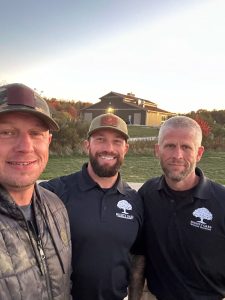
Photo courtesy of Gene Nelson –
Gene Nelson (left) with Mark Carducci (center) and Dennis Nash (right) at a Mighty Oaks leadership training this fall. Nash was Nelson’s original team leader and also his leader at the training. Carducci is another new team leader.
“One time when my daughter’s arm had fallen asleep, she said her arm was gray. When she said that, I thought, “My entire body feels gray all the time.’ Just a shell, just existing.” So said Gene Nelson when reflecting on the toll that years of crime scene investigation, patrol, and SWAT operations with the Chattanooga Police Department (CPD) had taken.
All of this changed when Nelson went to Mighty Oaks, a six-day retreat for veterans, active-duty military members, first responders, and spouses. Through the Mighty Oaks program, God brought Nelson out of a dark place, and he now has the opportunity to help others as a Mighty Oaks team leader.
Nelson and his wife, Jamie, both grew up on Sand Mountain and graduated from Dade County High School. They live in Lookout Valley with their two daughters, Jamie teaches at Dade Elementary School, and Nelson works with CPD. He is the breacher on the department’s SWAT team, meaning he breaks down doors in dangerous situations (like high-risk warrants, barricaded suspects, and hostage situations).
Nelson went through the police academy in 2011, and in 2014, he joined CPD’s crime scene unit and the SWAT team. Having majored in forensics in college, crime scene investigation was his goal, but he recalled, “Right away, I knew I couldn’t stay in that unit. It was pretty terrible—infant deaths, homicides, overdoses, traffic fatalities.”
After three years with the unit, he switched to patrol and continued with the SWAT team. Nelson first noticed changes within himself while still with the crime scene unit, but it was years before the magnitude of the change became apparent. He explained, “Over your career, it’s kind of a slow drip. You don’t realize how much you’ve changed.”
Jamie and his parents also began noticing changes. Nelson said, “I had a shorter fuse, I was losing compassion and empathy.”
At that time, Nelson didn’t know that many law enforcement officers deal with similar issues. “When you work those scenes, you can’t be emotional. Everybody’s kind of wearing a mask and pulling it together for work. I think the mentality in policing is just deal with it. The more people I’ve talked to, especially since going through Mighty Oaks, I find that there’s a lot of people dealing with this, but they think they’re the one that’s broke.”
Reflecting on why it’s difficult to ask for help in these careers, Nelson said, “I think we think we can fix it. We don’t want to show weakness, vulnerability, and transparency. At Mighty Oaks, I remember hearing instructors giving their testimonies. I was thinking, ‘I think that and feel that, but I would never say that in public.’”
Over time, more patrol and SWAT incidents piled up, adding to previous trauma from crime scene investigation. Nelson said, “The effects of some of those calls from when I worked in crime scene had lain dormant. It was that slow drip of working traumatic events and just packing them away and not really dealing with them. Then, I really started going off the rails.”
He started having nightmares and noticing visceral reactions when driving down certain stretches of road. By 2018, Nelson felt like a shell. “I really had no emotion. I masked everything and filled voids. I’d find something to try to find happiness, but it’d be temporary happiness, so I’d try something else, but again it was temporary happiness.”
Something he often turned to was alcohol, particularly in social settings. “Just to numb me up enough to want to be around people, but that ends up backfiring on the downer side of it. When everybody leaves, you’re worse than you were—at least I was.”
He even began thinking that it would be better if he wasn’t alive.
Jamie tried everything she could to help her husband, but to no avail. Nelson said, “She used to go to bed and pray for God to change my heart because she knew there was nothing she could do.”
Then, in 2019, Jamie was diagnosed with breast cancer. Nelson said, “That kind of snapped me out of it. I think I went into cop mode to try and fix it and learned everything about chemo. I was really mad at God during that time.”
Nelson did not know the Lord when he and Jamie married, but some seeds were planted through several Christian events and retreats. In 2013, he read “More Than a Carpenter” which is when he became a Christian. “That was the first time I’d heard about prophecies being fulfilled and the statistics about how unlikely that is.”
However, Nelson said he was a cultural Christian. “I believed, but I never submitted. I was a surface-level Christian.”
The Nelsons are thankful that Jamie has now passed the five-year mark of being in remission, but when she first reached remission, Nelson’s state worsened. One of his Mighty Oaks instructors used law enforcement’s soft body armor as an illustration of how much trauma a person can take. Nelson said, “With that armor on, a .45, a nine millimeter, all these different calibers might hurt and break a rib, but you’re okay.”
What happens when the armor takes too many rounds in the same spot? “It could penetrate, and a rifle round like a 5.56 blows right through it. You never know when one too many or that 5.56 round is coming. I think the cancer was like a 5.56 round. It doesn’t make sense why I wouldn’t be grateful that she was pulling out of it, but I was almost colder, more like a shell.”
In the fall of 2021, the family went on a camping trip, and Nelson recalled, “I was drinking, like usual, and staring at the fire, thinking terrible things.” On this trip, he told Jamie that he wished he would’ve died in the line of duty.
Nelson’s brother-in-law had gone to Mighty Oaks that summer and had been urging Nelson to go as well. After the camping trip, the family fully realized the seriousness of Nelson’s state and pushed him to go to Mighty Oaks. In May 2022, he went through the organization’s Legacy Program for Men.
Mighty Oaks was founded by Chad Robichaux, a former Force Recon Marine and Department of Defense contractor who served on eight deployments to Afghanistan. After overcoming PTSD, Robichaux founded Mighty Oaks “to restore the brokenhearted through Christ, to build leaders of leaders to rise up from the ashes; they will be called mighty oaks of righteousness” (so the website reads, citing Isaiah 61).
The transparency at Mighty Oaks was eye-opening for Nelson. He said, “You realize that you’re not alone, you’re not broke. There are a lot of people dealing with these same issues; it’s just nobody’s talking about it. We’re wearing masks at work, being a chameleon everywhere, but at home, our families get the worst of it.”
Mighty Oaks works to eliminate suicide and increase resiliency in the military and first responder communities, but the program also focuses on family, battling against divorce, and helping build healthy families.
Nelson said, “A lot of times, we pour way more energy into our career, and the family gets what’s left. That balance should be weighted much more toward the family. If I quit the police department tomorrow, they’ll replace me, but my family’s still going to be there.”
At the retreat, Nelson was struck by Mighty Oaks’ emphasis on the heart. “I remember hearing a lot about softening the heart, having a malleable heart instead of a heart of stone. I was thinking about our girls and how soft their hearts are. If something happens one night, they totally forget and get up the next morning and it’s a new day.”
Discussion of Psalm 139 (“Search me, O God, and know my heart…lead me in the way everlasting”) challenged Nelson to ask God to search him. During one of the free blocks, he went up on a hill to pray. “I’m praying about my calloused heart and repenting. I prayed, ‘God, search my heart.’”
Images of alcohol and beer signs immediately came to his eye. “I was not happy with that. I was hoping it would be dirt bikes, but God showed me I needed to get rid of the crutch of alcohol.”
Nelson said the change was immediate, dramatic, and freeing. “When I walked back down that hill, I knew everything had changed. Like it says in Ezekiel, God definitely took out my heart of stone and gave me a heart of flesh. I cared about stuff again. I felt relief to not feel numb and gray anymore.”
Before participants return home, Mighty Oaks prepares them with the four be’s: Be in the Word, be in prayer, be in touch with a cornerman, be involved in a local church. Nelson said, “They tell us, ‘You’re coming off a mountaintop high this week, but you’re going home to whatever disaster you may have created there and back to work. These four be’s will keep you prepared and sharp.”
He described a cornerman as someone you trust who tells you what you need to hear—not what you want to hear. Mighty Oaks uses the phrase “never fight alone,” because a support system that includes a cornerman and a church is essential for long-term resiliency.
Nelson implemented the four be’s when he returned home. “It was still work when I got home, getting into the Word and into prayer.”
He described how his attitude became one of submission to God and engaging in community. “It’s kind of contagious. With a lot of the guys I was around when I got back, we started having a lot of deeper conversations. The desire to be involved at church and at work was like a fire lit in me.”
So far, six members of Nelson’s SWAT team have gone through Mighty Oaks. He said, “We have a big support group. We have a SWAT Bible study with ten or 15 of us, we pray on the way to warrants, and I think we have a better inner working on our team and closer ties.”
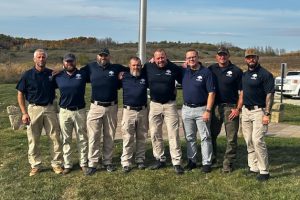
Photo courtesy of Gene Nelson – Gene Nelson (second from the right) and Mighty Oaks team leaders pose at a leadership training earlier this year.
Mighty Oaks team leaders and Jamie asked Nelson if he’d consider becoming a team leader. While he doesn’t like public speaking and is far more comfortable breaking down doors, Nelson overcame that hesitancy. He went through two leadership training sessions this year and signed up to lead at three retreats in 2025. As part of the training, he shared his testimony in front of the group, and as a team leader, he’ll teach some of the classes, lead small groups in breakout sessions, and follow up with participants after the retreat.
Mighty Oaks has locations in Ohio, Texas, Virginia, and California, and it is completely free to veterans of all ages, active-duty military, and first responders. Eliminating as many obstacles as possible, Mighty Oaks pays for and books participants’ flights—all you have to do is show up at the airport. The program can also count as continuing education so that vacation days from work aren’t needed.
Mighty Oaks also has outposts in various cities, and Nelson is getting one started in Chattanooga. The outposts offer connection and support both for those who’ve completed the program and those who haven’t but are looking for support.
To anyone currently in the dark place where Nelson was, he encourages you, “Reach out. Talk about it. Find some people around you. Find a church. Realize you’re not alone.” Noting that there are other programs out there in addition to Mighty Oaks (like Warrior’s Heart), he said, “There is hope. You don’t have to live in that forever. God will pull you out of it.”
He encourages anyone interested in attending Mighty Oaks to apply online at www.mightyoaksprograms.org. If anyone has questions or simply needs to talk, Nelson can be contacted at denelson@chattanooga.gov.