
Dade’s EMS Coverage And The Challenges It Faces
By LYDIA BERGLAR
News Editor
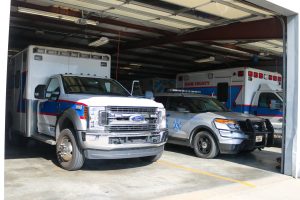
Photo by Lydia Berglar – Dade’s ambulances and a licensed first responder vehicle sit in their garage behind Trenton City Hall ready to respond to calls.
Emergency Medical Services in Dade County face a number of challenges, some of which aren’t unique to Dade and some that are. The Sentinel spoke with Alex Case (Emergency Management Agency director) and Kyle Gross (EMS chief) about the current system, what works well, ongoing challenges, and what misuse of the system (a national problem) looks like in Dade.
One challenge is that it isn’t profitable enough for private EMS companies to operate in Dade. Lower call volume than in highly populated areas and high rates of uninsured patients and delinquent medical bills mean that private companies don’t want to operate here. Ambulance services in general have a low profit margin, but that’s exaggerated in our area.
Case and Gross also explained geographical challenges: We’re in a corner between Tennessee and Alabama, and state licensure laws prevent EMS from crossing over states. Rural roads can be difficult for ambulances to navigate, which is why Dade’s ambulances are four-wheel drive. Taking patients to hospitals in Chattanooga is at least a one-and-a-half hour round trip for ambulances, sometimes more when traffic is bad.
Waiting for patients to be unloaded at the emergency room can take anywhere from 15 minutes to multiple hours. Gross and Cody Doyle recently ran a call where the ambulance waited at the ER for four hours before their patient was unloaded. Gross said, “That’s a national problem. It’s something the state is looking into to see what can be done on the hospital side of that.”
Currently, Dade County pays CHI Memorial Ambulance Service $400,000 a year. This covers EMTs, supplies, fuel, and maintenance. An additional $22,000 in Dade’s budget covers additional supplies and equipment.
The county provides Memorial with two county-owned ambulances. Case noted that the county is stringent about Memorial keeping the trucks in good shape. Memorial can also be charged if response times are outside the acceptable time range.
If the county did not supply the two trucks, Memorial would charge about $1.8 million a year. Case said, “Can we afford $1.8 million a year for them to provide every piece of equipment, trucks and all? No. We’d have to raise the millage rate to cover that.”
In addition to Memorial’s contracted service, Dade has its own EMS license, called “Dade EMS” or “Dade County Station Nine.” This back-up crew includes employees like Case, Gross, Daniel Jones (assistant 911 director), Thomas Lyons (deputy 911 director) and others in the 911 call center and emergency response jobs who are trained EMTs.
When Hutcheson Medical Center stopped its EMS service in 2008, Dade and Walker worked together to get local government control over contracts. One step in the process required the county to own an ambulance, which is how Dade began buying ambulances. Case said all have been purchased with grants or Special Purpose Local Option Sales Tax.
Today, Dade owns both of the trucks used by Memorial as well as two others ready to go. A fifth one is currently being worked on. Switching out ambulances in the middle of calls isn’t uncommon. Case and Gross recalled responding to ambulance flat tires in the middle of the night, broken air conditioner systems, and ambulances getting stuck in mud.
Walker and Dade provide back-up coverage to each other, but Walker’s stations can take 45 minutes or longer to respond due to the distance over Lookout Mountain. Therefore, Dade EMS provides an extra level of back up to the contract with Memorial.
Case explained that “status zero” is when both of the Memorial ambulances are responding to calls, but because of Dade EMS and Walker, we aren’t left without coverage.
Dade is the only county in the state with just one bordering county that can provide back-up EMS. Walker has other neighboring counties that can help them out, and even the other corners of the state have more than one bordering county.
Overall, Case and Gross are happy with the current system, and they’re very thankful for the partnership with Walker, but Case added, “I don’t think you could ever get it perfect. All five ambulances could be staffed and equipped, and we’d still have times where we run into problems, like big accidents on the interstates.”
Compared to the previous contract with Puckett EMS, Case and Gross are much more satisfied with Memorial. Puckett also had contracts with Marion County and East Ridge, Tenn., and Case reported that they would spend 12-16 hours a day out of Dade County. Puckett had one truck, and Dade provided the other. “They would pull their truck and leave us here with nothing.”
Dade had 2,446 ambulance calls in 2023, an average of 6.7 calls a day, so call volume is generally manageable. The dilemma is that calls aren’t always spread out; they sometimes hit all at once. Some days might have 15 calls while others have one or two.
For example, a wreck on I-59 this year resulted in seven patients. Memorial and Dade EMS worked together to transport all seven patients to Erlanger in just three ambulances.
Case and Gross noted several other instances where Dade EMS played a key role in saving lives because Memorial was already responding to calls with the main two ambulances.
This year, a train versus van accident on the evening of Aug. 11 resulted in two critical patients. Critical patients can only be transported one at a time, so two ambulances were needed, but one was out of the county having already responded to a call. While a back-up from Walker was available, it was 45 minutes away.
Dade EMS was able to respond with back-up ambulances and personnel on this Sunday evening, with members like Gross, Case, and Tim Sharp hearing the call while at home and responding as quickly as possible.
Another accident many locals will remember was when Major Tommy Bradford (Dade County Sheriff’s Office chief deputy) was hit during a police chase. Case and Gross remember sitting at the 911 call center while Dade was at status zero. One ambulance was responding to a call on Sand Mountain, and the other was transporting a patient to the hospital.
Listening to the chase on the police scanner, they heard that Bradford had been hit, and they responded to the scene. The sheriff’s office had given Dade EMS an old patrol car to use as a licensed first responder vehicle. It’s stocked with nearly everything an ambulance has except for a stretcher. Case drove straight to the scene in his vehicle while Gross got the patrol car. Case said, “If we hadn’t had that, we wouldn’t have been able to take care of him correctly.”
The Trenton Police Department has since given Dade EMS a Ford Explorer that is now the licensed first responder vehicle. Dade EMS can’t transport patients with it, but it plays a big role in saving lives.
Case and Gross joined Sergeant Chad Payne and other DCSO officers who were already caring for Bradford. Case put on a tourniquet and recalled Payne adding at least one more tourniquet. Gross administered and IV and pain medications.
Meanwhile, the call on Sand Mountain turned out to be a case where the patient could have driven himself to urgent care. Sharp (the EMT driving that ambulance) was able to leave and come to the scene with Bradford before the ambulance from Walker arrived.
According to trauma doctors at Erlanger, the early care provided by Dade’s trained first responders saved Bradford’s life.
While it’s unavoidable that on occasion we won’t have enough ambulances immediately available, situations like these are why it’s extremely important not to call for one unless it’s truly needed.
Misuse of ambulance services is a national and even international problem. A study of paramedics in southwestern Ontario titled “Inappropriate Ambulance Use: A Qualitative Study of Paramedics’ Views” reported:
“While blatantly ‘inappropriate’ use is extraordinary, ‘misuse’ is more common, and paramedics determine misuse largely by interpreting patients’ abilities to cope with their situations…In the future, paramedic-informed, contextual and non-clinical criteria might supplement clinically based criteria for emergency service-use evaluation and may inform more patient-centered policy interventions to reduce ambulance misuse and inappropriate use.”
In Great Britain, BBC News also covered the issue (and the ambulance workers’ strike in England and Wales) in a January 2023 article titled, “Ambulance service being misused, paramedics say.”
The article begins, “The public is too quick to call an ambulance for non-life-threatening situations, says one paramedic, and people will readily treat the service as a ‘24-hour anything and everything Uber-lance.’”
Closer to home, the “Muscogee Muckraker” in Columbus, Ga. published an article in July 2023 titled, “Public Abusing EMS Service As ‘Taxicabs’; City To Fight Back.”
The summary reads, “An audit of Columbus Fire and EMS recently revealed the city’s ambulance service is bogged down by members of the public who abuse the system by effectively using it as a taxicab. Now, the city is discussing a new ‘cry wolf’ policy to help fight back against the illegal 911 abuse, which has previously worked well in other public safety departments.”
Per the Official Code of Georgia 16-10-29, it is a misdemeanor to request an ambulance when there is “no reasonable need” for it. However, when callers say they need medical aid, EMS is required by law to respond.
Case said, “What’s a true 911 call? We can’t really say, but things like a toothache, headache, or if you’ve got somebody who can take you to urgent care or drive yourself, it’s not an emergency.”
Gross also explained, “A lot of avoidable calls are people who’ve been nauseous and vomiting for days, but when we ask if they’ve been to their primary care doctor, they say no. That’s the problem the hospitals are running into. They’re trying to get people to visit their primary care doctors first because the hospitals are overrun. Some people are going to the hospital for seasonal allergies, stomach bugs, and stuff like that when they could go to their doctor.”
Some, however, are blatantly abusing the system. Gross noted that he’s responded to calls that are an attempt to abuse pain medication. He’s even had people at the Wildwood Greyhound bus station who use ambulances as a taxi service to get further into Chattanooga.
Callers know what to say to get a response, commonly saying they’re experiencing chest pain or abdominal pain. Case said, “They’re giving a legitimate complaint that falls within our protocols.”
Gross added, “You can fake being sick or in pain, but what doesn’t fake it is your vital signs.” The cardiac monitor helps assess this, but it is still a liability on EMS teams if they’re mistaken. It’s like the boy who cried wolf; someone might have called five times in a month without a real emergency, but the sixth time is a life-threatening situation. EMS can’t call someone’s bluff without being liable.
Regarding the state law, Gross noted that they’ve spoken with the sheriff’s office about some situations. Officers have explained the law to people who were calling unnecessarily, but this has not made much of a difference.
There are also situations that aren’t life-threatening but do require help, like when elderly people fall but don’t have anyone to call aside from 911. Dade EMS and Memorial respond to many lift assist calls, but in the case of life-threatening injuries at an accident, ambulances would be directed there first.
Gross said, “We have to pick which one we think is the least severe, the least critical, that can take more time.” Case added, “We don’t stop responding; it just may take a little longer to get to them.”
Another factor at play is indigent (uninsured) residents. Case reported that in 2023, 21 percent of Dade County residents were indigent. (Walker County was at 19 percent.) This is excluding anyone on Medicare or Medicaid; as Case said, “We’re talking about true no health insurance. Even if we were our own true service, we would be having to bill those people’s coverage, or we’d be eating that cost.”
Even with the challenges Dade’s EMS teams face, saving lives is the reason they do what they do. As Case said, “We’re in the life-saving business. That’s the heart that we all have. When it says emergency services, we’re taking every resource we have and using them to save lives.”



These guys are so professional and caring. I appreciate them treating me with respect and get me safely to the hospital.