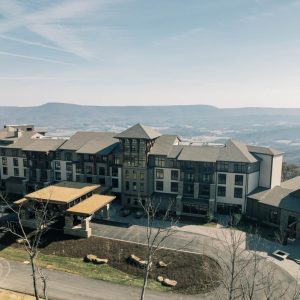
City Sewage Concerns Explained By Citizen, City Representatives, And Watershed Expert
By LYDIA BERGLAR
News Editor
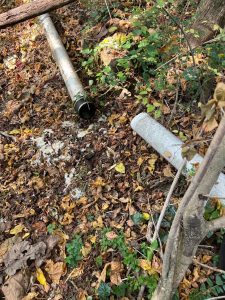
Before this line on private property was repaired, Goins took this photo of the broken pipe.
Near the end of October, Anthony Goins (nature enthusiast and owner of Goins Flooring) began publicly sharing his concerns about Trenton’s sewer system. The topic was covered briefly by Chattanooga news stations, on the Nov. 14 KWN News talk show, and at this month’s county commission meeting and city commission meeting.
To get the full story, the Sentinel met with Goins, contacted Lucretia Houts (Trenton fire and utility commissioner), sat down with Alex Case (Trenton mayor) and Dewayne Moore (Trenton utilities director), and spoke with Stephen Bontekoe (executive director of Limestone Valley Resource Conservation & Development Council).
The bottom line from these interviews: Is the city’s aging sewer system in need of major improvements? Yes. Is there an immediate crisis that citizens should be concerned about? No.
Houts directed the Sentinel to Case and Moore for all the details, but she was not concerned about any immediate crisis. She said Goins and the Chattanooga news stations did not contact her.
In the interview with the Sentinel and at the county meeting, Goins expressed his concern that he would face retribution from law enforcement and lose business because he spoke out. However, his testimony should not result in either of these hardships. In fact, the city is thankful that he came forward about the problems he’s seen.
The city encourages any citizens who notice problems with infrastructure to let them know. In Case’s words, “Anthony did the right thing. He found something and let us know, and we jumped on it. We can’t see every line and every area every day.”
“Since I was a young kid, I’ve been passionate about nature,” Goins said. “I would find trash no matter where I go. Even two miles deep in the woods where there’s nothing, I’d find tires—but that’s another issue. Ten or 15 years ago, I realized that water is the greatest natural resource. The cleaner the water, the better, right?”
Goins enjoys walking his dog around town and through the woods. This is how he found three specific locations that caused his concern. One manhole is near the Bank of Dade, another was a manhole he said is eroding, and the third is a sewer line in the woods between Hardees, Dade Elementary, and I-59.
Goins was walking at this third location and picking up garbage about a year ago. “Then I saw something in the water, so I climbed down the bank and checked it out. It was a tampon. Then I saw human feces and toilet paper.”
Months went by until February 2024, when Goins saw Case around town and mentioned the problem to him. Goins reported that Case thanked him for bringing the problem up and said that the city would get to work on it right away.
Goins then met with Moore to show the sewer team the specific sites. Curious to see how the problems had been addressed, Goins returned to the sites and found that they were sealed with concrete. He said, “There were no more solids coming out, but they’re not going to be able to stop liquid from coming out.”
However, this is not quite accurate. While concrete is porous, the city uses a sealant to prevent seepage. Case and Moore explained that it’s common practice in the sewage industry for repairs to be made with concrete and sealant. Case added, “When the sewer department sees something like a possible crack, they inspect it from the inside and the outside.”
The Sentinel explained this to Goins after the first interview. He said, “That would be a great temporary fix for pipes only. The manholes need to be rebuilt because they are literally washing down the creek banks.” He called it a temporary fix because the sewer lines still need to be replaced at some point.
Goins said, “So long as sewage is contained and not seeing the light of day until it gets to the treatment plant, that’s all I’m looking for.”
Curious about Town Creek’s water, Goins contacted the UGA Extension Office to find out where he could get water samples tested. The office directed him to the University of Georgia, so he collected a sample and sent it to UGA.
Goins told the Sentinel, “I’m not schooled in reading those types of labs,” but the numbers were concerning to him. The report showed 24,196 MPN/100-ml (most probable number per milliliter) of total coliform and 2,613 MPN/100-ml of E. coli. Both of these results are listed as not acceptable.
However, Moore explained that samples must be collected in a certain manner. Bacteria grow over time, resulting in false readings. The city must deliver samples to a lab in Cleveland, Tenn. within six hours of the time of collection. (Total coliform tests have a longer time frame of 24 hours).
The report Goins received listed the sample time as 10:00 a.m. on Oct. 22 and the analysis time as 12:40 p.m. on Oct. 23—a nearly 27-hour time period.
Additionally, samples shouldn’t be collected after rainfall because rain washes animal feces into the water, resulting in artificially high results. Per online weather history sites, there was very little rain in the days leading up to Oct. 22, so that may not have impacted Goins’ sample.
The Sentinel asked Goins if the lab was specifically testing for drinking water, but he was under the impression that the results applied to overall creek health. However, Moore explained that results of E. coli tests apply to drinking water and sometimes wastewater standards. Total coliform test results are for drinking water.
The city sewer department is extremely familiar with the requirements for these tests because they must send monthly reports to Georgia Environmental Protection Division (EPD). They also test the sewage coming in and going out. Case said, “We’re doing 24-hour tests. If it’s not clean, we have to divert it back and process it again.” Once sewer water is fully clean, it’s returned to the creek.
A representative from EPD (Katie Meade) came up to inspect Goins concerns, but he felt that she dismissed him and the situation. In Goins words, “I got animated. I wasn’t screaming and hollering. I was there with Dewayne Moore and his two people. Katie Meade dismissed me because she did not see anything. I kept saying, ‘Let me show you.’ She took a few steps off the hill and looked down one of the pipelines and said she didn’t see a problem.”
Goins, however, said he saw human feces and toilet paper at this location. “All she had to do was take two or three more steps.”
According to the city, Meade found no issues. Moore said, “We showed up on site at the private line with EPD. Anthony came up before she completed her inspection and started interacting with her. She wasn’t real comfortable with it. He was very belligerent with her.”
Case added, “We understand he’s aggravated, but there’s a way to handle that with a state official.”
When asked for further input about this incident, Goins countered, “I was flagging and waving them (Dewayne Moore and Katie Meade) down as they pulled away. I tried to tell her/them that the pipe was broken and sewage was everywhere on the other side of the tree that she had leaned against. Assertive, yes. Belligerent, no.”
The Sentinel asked what exactly Goins would like to see done (for example, would he like the city to increase sewer bills or taxes in order to replace all the lines?) and why he brought the matter to the county commission. Goins did not answer the first question, but he said, “Katie Meade came up last Tuesday from EPD and found nothing, so I thought I’d go to a county meeting so that I could at least get this sewage concern on record.”
He summarized his concern, saying, “How many other pipes have burst? How much sewage is hitting Lookout Creek heading to the sewage treatment plant?”
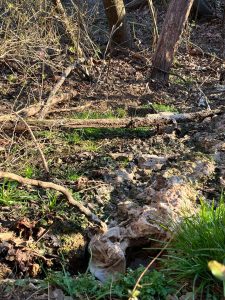
Goins took these photos near the Bank of Dade, showing sewage that came from the deteriorating manhole.
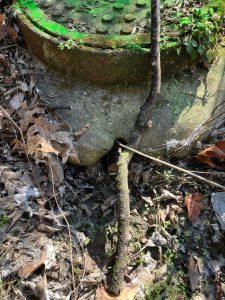
Case and Moore explained that the sewer department inspected each location Goins brought to their attention and made repairs accordingly.
Regarding the line on private property, Case said, “We met with the owner. It’s his responsibility, but Dewayne and the team helped him clean it up. Our job is to inform any property owner if they’re leaking sewage. If they don’t fix it, then we call EPD and they can fine the owner, but we help clean it up.”
They are well aware that the sewer infrastructure and the clay pipes need attention. This is something they’ve been working on for years. Early in Case’s time as mayor, the city hired Ladd Engineering to come up with a plan for improvement.
Ladd Engineering began by studying the entire system. Case said, “We wanted to know what the system could do, where it can grow, how much more the plant can handle, and where the technology of the system is aging.”
The most urgent need was replacing the bar screen (as mentioned in multiple city meetings this last year or so and covered in the Sentinel). This is now complete, and the pumps at each of the ten pump stations have been upgraded with a monitor system.
Next on the list of priorities is improving the handling of solids. Case explained that this phase will include work on the Woolbright pump station and replacing sewer lines. The roadblock, of course, is money. Case estimates that it will cost $15 million to replace all of the city’s main lines.
Currently, the city replaces sections when major issues arise. Case explained, “From manhole to manhole is considered new infrastructure, so Special Purpose Local Option Sales Tax (SPLOST) can cover it.” However, regular repairs cannot be covered by SPLOST. These (such as repairing the manholes Goins discussed) are covered by sewer fees.
Case explained, “Way before I became mayor, there was good money in the sewer. There were times the city could use that money to help keep the millage rate down and pull from it once in a while. Well, it got pulled from way before me, but we never caught back up because expenses kept getting higher and higher, but our rates were too low.” The city increased fees accordingly.
SPLOST and sewer fees are obviously not enough for the $15 million needed, so the city is also pursuing Georgia Environmental Finance Authority (GEFA) infrastructure grants/loans. Case said, “We are working on it, but it’ll take a couple of years to get a GEFA WaterFirst designation which would save a percent on interest.”
In the meantime, the city is working on the Woolbright pump station and continuing to address portions of lines. Moore called it “triaging.”
Through his watershed work with Limestone Valley, Bontekoe also has insight into the topic. He said, “I appreciate Anthony’s care and concern and desire to improve the community.”
He explained that the Lookout Creek Watershed is monitored with set parameters. He explained that the city sewer department follows a watershed protection plan (a reactive plan that watches trends to look for any major deviations i.e. problems that need to be addressed) while Limestone Valley follows a watershed management plan (a voluntary proactive plan focused on overall improvements).
He shared the 66-page “Lookout Creek Watershed Management Plan” which covers potential nonpoint source and point source pollutants and how these are monitored and addressed.
As for the presence of E. coli, Bontekoe noted that animal feces play a part in this. He referenced a report on another stream outside of Dade County that had nothing upstream but a national forest. Because of the high wildlife population, that stream had high levels of E. coli. He added that E. coli measurements are also impacted by time of year.
Bailey Lands (graduate intern for Limestone Valley) put together an eleven-page report on monitoring E. coli in the Lookout Creek Watershed. Interested readers can email admin@limestonevalley.org to request to see the report.
In this report, all but one sample had E. coli MPN/100-ml in the low hundreds or lower. The anomaly was 1,046 MPN/100-ml. Drinking water must have zero MPN/100-ml, which is why water treatment facilities test the outgoing water before it goes to your tap.
The report explained that Dade’s levels are categorized as high risk. It focused on fish populations, saying, “A low index of Biotic Integrity (IBI) score for fish in a stream indicates that the fish community is in poor condition.” Town Creek’s IBI is very poor, but Bontekoe explained that this is caused by a number of factors, among which sewage isn’t a key factor.
Bontekoe is in favor of the city pursuing a WaterFirst designation. He said, “The city is taking a proactive drive at becoming a Water First community which tells me they are taking care of our water.”
Adding that the city has voluntarily partnered with Limestone Valley several times, he said, “I’ve seen good faith gestures from the city to improve water quality.”
He wants all citizens to care about water. “This is taking a civic approach to our water quality rather than a judiciary approach—when citizens see something, they say something and do something.”
Bontekoe concluded, “Do I think people should be concerned? Absolutely! Do I think they should be scared? No.”
What does all of this mean for playing in Town Creek at Jenkins Park? While the city has a sign up to discourage people from playing in the water, the government can’t prevent anyone from taking that risk.
Moore said, “The city doesn’t encourage anyone to get in the creek. Any groundwater anywhere can be contaminated.”
Case said, “But they can do it at their own risk. It’s no different than going to the river or Lookout Creek.”
Bontekoe furthered, “That’s a personal discretion question. Even if somebody posted a sign, it’s a free country.” He noted that someone with a compromised immune system might get sick from playing in a body of water while a hearty person might not.
The city, Bontekoe, and Goins agree that water must be cared for well. As Goins said, “Water is the greatest resource that God gave us, more valuable than gold and diamonds, and we must be good stewards of it.”