Author/Speaker Morris Morrison Speaks To School District Throughout This Year
By LYDIA BERGLAR
News Editor

Photo by Lydia Berglar – Guest speaker Morris Morrison encourages Dade County Schools teachers and staff at last week’s in-service gathering.
“My life was saved by educators,” Morris Morrison said at last Monday’s school district in-service assembly. “It was people who looked just like you who stopped me in middle school and high school and said, ‘Hey boy, you could be president one day, so act like it.’ I had educators like you talking to me about conduct before I even knew what the word conduct really meant.”
When Morrison, his wife (Lisa), and their daughters came to Dade County as visitors last year, they quickly realized that they wanted to spend more time in this community, so they bought a home on Lookout Mountain. With a desire to invest in the local schools, Morrison (a professional speaker and published author) offered his services to Dade County Schools at a heavily discounted price.
Kicking off the county-wide in-service gathering, Morrison spoke to all Dade County Schools employees. With many laughs, some music and dancing, and even some tears, he spurred the educators on to continue in their good work while also touching on hot button social topics like fatherlessness, government overreach, and polarization caused by critical race theory.
Morrison will also be speaking to Dade County High School and Dade Middle School students throughout the year about personal growth through discipline and social and emotional intelligence. He explained to the Sentinel, “Everything I talk about comes back to discipline. My book ‘Disrupt Yourself’ is about how you can become more disciplined and grow.”
He hopes to continue working with and inspiring Dade County students beyond just this year, saying, “My team and my family, we’re going to commit to these schools. I love this county. I am not a believer in public schools, not like we’re seeing it across the country, because it’s gotten so crazy. Then you come to places like this. People here love kids! They’re not teaching to try to get rich.”
As he said at the in-service assembly, “When I’m in Dade County, I feel like I’ve taken a step back in time about 15 or 20 years to a great, healthy place that still has the right values in place. My family’s never felt more welcome.”
Morrison’s personal story involves being raised in the streets of New York City and orphaned, moving to West Virginia with his adopted parents, becoming an orphan a second time as a teenager, and yet finding a path forward in life. He is open about his faith in the Lord, and he shared his story with the educators.
A key of Morrison’s message is that change and disruption are not to be feared; rather, they can be necessary for continued growth.
He recalled when the University of Notre Dame invited him to speak to the football team, but because the school beat his beloved West Virginia Mountaineers in his childhood, Morrison balked at the invitation. However, he agreed, and the experience made an impact on him. “Most teams that I’ve spoken for have a Heisman trophy on display, if they’re lucky. Notre Dame has a Heisman room. I’ve never worked with an institution more committed to excellence, but I almost said no to them.”
He shared other anecdotes, like his humorous journey to becoming a country music fan after snubbing the genre for many years. As fans of 90s rap, he and his Black friends were of the mentality, “We don’t listen to country music.”
Morrison said, “That’s the exact moment that stops an educator or teacher from growing, stops a mother from being a good mother, stops a superintendent from being a good superintendent—it’s the moment when they say, ‘I don’t do that’ or ‘We don’t do that.’”
Another part of Morrison’s message is that we are not victims. Explaining his experience as a Black man in a culture where claiming victimhood is popular, he said, “All my Black family members told me, ‘We don’t talk to White people. They don’t like us; we don’t like them.’ I said ok. The only problem was, as soon as I got to kindergarten, I realized I loved everybody, and they loved me back. This is what we call, in the field of psychology, cognitive dissonance. It’s where you have an experience that’s inconsistent with what your internal beliefs are. Here I am, as a kid, learning that all White people aren’t racist, and of course I learned that all Black people ain’t your friend either.”
Morrison boldly renounced the polarization caused by critical race theory. He and Lisa started a Christian school because at their daughters’ previous school, “They were teaching critical race theory. They were teaching my young Black daughter to not like little White girls in her class because their great-great-great-great-great-great-grandfathers may have owned slaves. I’m proud of being a Black man. I’m proud of being an educator. I’m proud of all of those things, but I am a Christ follower. That is my title, so I don’t stand for anything that divides our world.”
He was delighted to see that Dade County Schools still pray and say the Pledge of Allegiance, telling the teachers and staff, “There are very few schools that I see who pray and who actually pledge allegiance to our flag.”
He urged the Dade County Schools staff, “When you leave today, think about one thing you can do to disrupt yourself. The disruption process is real simple: You’re either uncomfortable or you’re comfortable; you’re either disciplined or you’re undisciplined. What areas in your life do you need to become more disciplined in?…You gotta disrupt yourselves because you’re the safeguarders and the arbitrators of our youth. You’re the ones who our kids are looking to.”
As Morrison returns throughout the year to talk with Dade students, he hopes to set an example for them of physical health, emotional strength, mental discipline, and relational service.
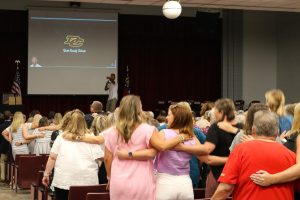
Photo by Lydia Berglar – A big believer in movement and a fan of how music unites people, Morrison had the audience simulate Virginia Tech’s traditional entrance featuring unified jumping along to Metallica “Enter Sandman.”
In a similar vein to last week’s discussion with the principals, Morrison sees two key issues impacting today’s youth: constant technology use and unhealthy eating/lack of movement. He believes these interconnected issues are negatively impacting kids’ emotional and social well-being.
He told the Sentinel, “Kids look like they’re human beings, but they aren’t really doing what humans are designed to do. They’re interacting with a device that, at the limbic system of their brain, is driving their cognition, behaviors, and emotional centers. Their phones have become their whole world, and it’s dangerous.”
Morrison noted that many school districts are enforcing strict measures regarding technology. “Of course, kids are mad about it, but I think that’s what leaders need to do. Just like we know that drugs and alcohol are harmful so we don’t allow them at school, technology is the next thing.”
Another concern for Morrison is kids’ diets. “Kids can eat processed food for a whole month and not even know it and not get anything that has nutritional value. They don’t want to eat broccoli and vegetables and fruits, but we have to get back to that.”
Explaining that he hopes students will find fulfilling lives and careers by using their talents to serve, Morrison said, “One of the reasons today’s youth are so lonely is because they’re living a life that’s totally about them. When a kid is on social media, it’s their timeline, their profile, their likes. The people that I know who end up finding their gifts in life, they find it through either discovering what they’re good at and then serving with it, or some just want to serve and along the way, they find out what they’re good at.”
Overall, Morrison hopes to encourage Dade’s students that they are capable of so much more than what the culture is currently offering them. He said, “I want kids to realize that they are living a processed life, from how their brains are being hijacked—literally, they call it amygdala hijacking—by what they’re seeing on their phones, and even at the cellular level, their mitochondria are working in slow motion. They’re starved of potassium, magnesium, zinc, and vitamin D.”
With all of these intertwined issues, Morrison believes there are simple steps forward. He concluded, “Everyone’s making money talking about mental health, but the answers are really, really simple, and it doesn’t require Dr. Fauci and the top scientists in the world getting together. We know: Go get sunlight every day, move and be active, put your phone down, and eat whole foods.”