Inside The Costume Closet: Randy Forester Binds History With Theatre
By LYDIA BERGLAR
News Editor
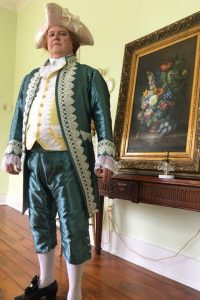
Photo courtesy of Randy Forester – History buff, costume designer, and Dade Countian Randy Forester poses in one of his elaborate period costumes at a Fashion Through History event.
Melding historically accurate fashion with stage-ready functionality is no easy task, but it’s one Randy Forester enjoys. Throw tight budgets, short timeframes, quick changes, and performers’ comfortability into the mix, and Forester has his work cut out for him.
The Dade County native was recently recognized in the June 6 issue of “Chatter Magazine” for his costume work with the Chattanooga Theatre Centre, but Forester has also worked on costumes for the Chattanooga Symphony and Opera, and he sometimes takes the stage himself.
The article also highlighted Scott Dunlap, Chattanooga Theatre Centre’s set designer and long-time collaborator with Forester. It can be read on the Times Free Press website with the title “All the world’s a stage for these two Chattanooga designers.”
Forester’s initial foray into costume design was as a Dade County student at Northwest Georgia High School when he designed and sewed costumes for the dance team. After graduating, he attended Reinhardt University where he performed with the concert choir and an eight-person ensemble called Daybreak. He then attended the University of Georgia and joined the Men’s Glee Club.
Although he did some costume work for Daybreak, it wasn’t until he auditioned for a role with the Little Theatre of Chattanooga (now called Chattanooga Theatre Centre) that his career as a costumer took off. “Kay Jennings, the costume designer, found out I could sew,” he recalled and laughed, “That was a big mistake. The scenic designer, Gary Hoff, also found out I could design and build props, so they fought over me.”
This volunteer work slowly turned into more of a side gig than a hobby, explained Forester. In the mid-1990s, Jennings announced that herself, Dunlap, and Forester would be handling all of the costumes for “Beauty and the Beast.” They split the outfit needs into thirds, and Forester dressed all of the villagers.
After this production, Jennings got Forester a job with Chattanooga’s stagehand union, Local 140, to help with “Doctor Doolittle.” Forester said that Local 140 kept asking him to work, particularly when a Broadway show came to town.
Surprisingly, Forester has never received formal training in design or sewing. He is completely self-taught with the help of books, how-to videos, and decades of experience.
He borrowed a sewing machine for his early jobs, saved up enough to buy his own, and eventually bought a serger sewing machine with the money he earned from working on “Joseph and the Amazing Technicolor Dreamcoat.”
As Forester told “Chatter Magazine,” he is a costume designer—not a fashion designer. He explained to the Sentinel, “Fashion design is geared for what people wear everyday. There’s more artistry and whimsy in costume design. Although there is art in fashion, designers are looking for what’s going to sell.”
Forester is also a history buff, and he particularly enjoys the research involved in costume design. One recent show he worked on—“Something Rotten,” a Shakespeare inspired comedy—was set in Elizabethan England, which Forester has studied quite heavily. He also specializes in the Regency era and Colonial America.
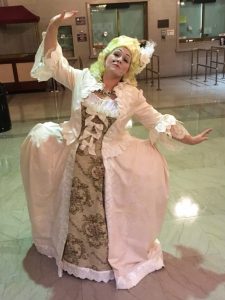
Photo courtesy of Randy Forester – Madame de la Grande Bouche (the motherly wardrobe in “Beauty and the Beast”) poses in the costume Forester created for her.
As a member of the Society for Creative Anachronism, he enjoys participating in historical fashion-related events, often creating outfits for himself and other members.
When it comes to the stage, however, costumers must sometimes sacrifice historical accuracy for practicality. Forester said,“You’ve got to accommodate all kinds of modern conveniences, like tap shoes and microphones.”
In one show, he substituted one type of hoop skirt for another: farthingales proved difficult to find, but Forester was able to find plenty of panniers, which came two centuries later. He said, “One is 16th century, one is 18th century, but who’s going to know?”
While Forester said that seeing the finished product is the best part, he enjoys the problem solving in between. In his words, “You have an idea, and the process it takes you to get from the idea to the finished product involves figuring out little puzzles.”
Then comes the hardest part for Forester: “Letting go. You put your heart and soul into this venture. It becomes a part of you, but the theatre company has paid for those costumes, and they’re not yours. You have to let it go and go on to the next project.”
Before he sits back to enjoy the final performances, Forester attends tech week rehearsals, ready to make any needed repairs and final adjustments. He said that actors must learn how to use the costumes, especially if they involve quick changes or neat tricks, but putting on the costume also completes the actor’s transition into the character. “Once they put on the costume, actors feel like they’re in that character’s body, and the character comes alive.”
Forester called “Something Rotten” from Chattanooga Theatre Centre’s 2023 season “one of the best looking shows I’ve ever done,” and another all-time favorite of his was “Joseph and the Amazing Technicolor Dreamcoat.”
The costumes for both of these shows were completely designed and made by Forester in about six to eight weeks. Joseph in particular required everything to be handmade with a budget of only $500.
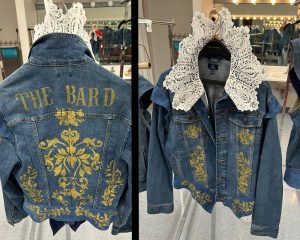
Photo courtesy of Randy Forester – As evident in this photo of Shakespeare’s jacket, Forester merged modern clothing with Elizabethan styles for Chattanooga Theatre Centre’s 2023 production of “Something Rotten.”
Budget constraints, however, sometimes lead to moments of genius. Forester recalled, “In ‘Something Rotten,’ William Shakespeare is supposed to look modern while also fitting within that time period. I couldn’t afford to buy the leather jackets that I wanted to use, but I was in Walmart and found blue jean jackets on sale for $15 a piece, so I bought every one I could get.”
He cut off the sleeves, stenciled on a gold font, made a peplum around the waist, and added lace collars, giving a “West Side Story”-gang-meets-Elizabethan-England look for Shakespeare and his cronies.
Forester sometimes finds just what he needs in the costume closet. A search through the closet brought an old robe of unknown origin back to the limelight when it was reused in “Something Rotten.” The gold embroidery on the maroon robe perfectly matched the other costumes, and the wear and tear on the robe matched the setting and story. Forester mused, “Somebody watching the show would think, ‘He’s really good; he made that thing look old!’ Well, it really was old.”
The eponymous piece from “Joseph and the Amazing Technicolor Dreamcoat” made an appearance in “Something Rotten” as well.
Other times, Forester finds exactly what he needs while shopping. He needed something that hinted at ancient Egyptian styles for a couple of headdresses in Joseph. While shopping at a home decor store, he noticed wire vases with beading. “It’s really a vase that I put on these girls’ heads,” he laughed.
Forester said he can’t pick a favorite costume. “You put so much of yourself in every costume, it’s like your children; you don’t choose favorites.” However, he is particularly proud of a gray hooded overcoat from “Something Rotten.” While once again walking through Walmart, he noticed beautiful gray embroidered drapes on sale for $7.98 and decided he had to buy them. Then, while working on the overcoat design in an Elizabethan style, he knew exactly which fabric to use for it, and the result is stunning. (See “Chatter Magazine” for a photo.)
Designers must take fabric types into consideration. Forester explained, “You want to put your actors on stage in all-natural fibers because of heat and sweat. It’s hot up there on the stage, and polyester keeps the heat in, but many of these costumes can’t be washed.”
He also avoids velvet at all costs because “it crawls like nobody’s business. You’ve got to pin the heck out of it or hand sew it. It’s bulky, it’s hot, ironing melts it or flattens it, and although it can look really beautiful, it’s not worth the trouble.”
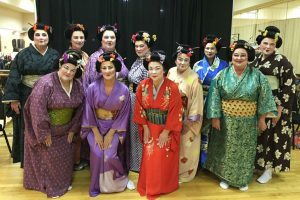
Photo courtesy of Randy Forester –
For the Chattanooga Symphony and Opera, Forester has worked on “Carmen” and “Madama Butterfly” (pictured here).
Sometimes, Forester gets to incorporate theatre magic and quick changes into the costumes. For example, “Something Rotten” featured color-changing skirts, created by a wrap skirt with a ribbon tail over the colorful skirts and brought into action with twirling actresses and their male dance partners at hand to pull the ribbons.
Other times, he must work through pesky problems. In “Pride and Prejudice,” for example, snaps (a historically inaccurate modern convenience used to enable a quick change) kept popping open on one dress until Forester was able to make them work.
While onstage malfunctions are an inescapable reality for the theatre world even after careful dress rehearsals, Forester said, “Remember that it’s just one performance and you’ll have another one.”
Forester often fills comedic roles when he himself is on stage, but his dream role is Willy Loman in “Death of a Salesman” to test out his serious side. However, he said genially, “Even when I try to be serious on stage, people laugh.” As for dream costume work, his dream shows are “Hamilton” and “SIX,” two history-inspired musicals with modern twists.
Part of Forester’s job is to prepare the actors to take the stage mentally and emotionally as well as visually. Forester said, “I like making people feel special. I want them to feel confident about themselves, and if I can do that with my costumes, that’s great.”