
The Link Between Human Violence, Organized Crime, and Animal Crimes
By LYDIA BERGLAR
News Editor
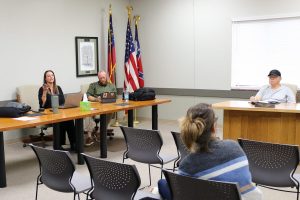
Photo by Lydia Berglar – Jessica Rock speaks to local officials and law enforcement on June 4 about Georgia’s laws about animals as well as the connection between crimes against animals and crimes against humans.
As part of ongoing efforts to improve Dade County’s ability to handle animal-related issues, Monda Wooten (City of Trenton street commissioner/Dade County Pet Project) along with Audray Luck (Luck’s Rescue) organized a training session for local law enforcement and government leaders with an expert. The Sentinel followed up with several of the folks involved after the training.
Tommy Bradford (chief deputy, Dade County Sheriff’s Office) said that misinformation about animal laws and how local law enforcement handles situations spreads easily. He said, “We don’t have a lot of training on this. I told Monda it’d be nice to have someone we could trust to show us what to look for. We want to make sure when we’re getting called out on these animal calls that we’re telling them the right thing.”
Jessica Rock, an animal crimes resource prosecutor with the Prosecuting Attorneys’ Council of Georgia, spent June 4 at Trenton City Hall, leading the session called, “Human Violence, Organized Crime, and Animal Crimes: Understanding the Link.” In Rock’s time as a special victims prosecutor, she witnessed connections between animal cruelty and violence toward humans. She transitioned to focusing on animal crimes, becoming Georgia’s first dedicated animal crimes prosecutor.
Rock was also sworn in as federal prosecutor to handle dog and rooster fighting cases, and Judge Chris Arnt swore her in as a special assistant district attorney for the Lookout Mountain Judicial Circuit.
In the session with our local law enforcement, Rock explained that understanding the laws about crimes against animals allows law enforcement to further investigate crimes against humans. In her words, “Animal crimes are not just about animals. They are a community issue, because when animals are abused/neglected, it also tends to hurt humans. Animal fighting is often connected to drug trafficking, gun trafficking, and gang violence. Animal cruelty is often connected to human abuse. We spent half the class talking about these links. ”
While many academic studies have examined and written about these links, Rock witnessed examples before knowing that they had been studied. She said, “Long before I knew there was a connection, I was personally witnessing it with my own victims in my own cases as a prosecutor.”
Bradford found this part of the training particularly interesting. He said that now when officers are out on calls, particularly domestic violence calls, they are trained to notice animals and ask about their welfare. He noted that sometimes abusive spouses will use a beloved animal to manipulate the other spouse or children.
He said, “We now know more of the questions to ask, and officers will have their eyes open for animal abuse and the human violence component of it.”
The rest of the class focused on the state’s animal cruelty statute, and Rock discussed how to investigate such cases, what evidence to collect and document, and how to put case files together for prosecutors.
Although Wooten was out of town, Luck attended the training and found the explanation of state laws interesting. She explained, “I get a lot of calls about people shooting dogs, and there’s been a lot of misinformation about when it’s okay to shoot a dog. The only time someone is allowed to shoot a dog is when it’s actively attacking you, your pets, or your livestock. If you’re able to get away, you can’t then come back to shoot the dog.”
While Rock covered additional aspects of the law, one relevant part of the state code, O.C.G.A 4-8-5, reads, “a. No person shall perform a cruel act on any dog; nor shall any person harm, maim, or kill any dog, or attempt to do so, except that a person may: 1. Defend his or her person or property, or the person or property of another, from injury or damage being caused by a dog; or 2. Kill any dog causing injury or damage to any livestock, poultry, or pet animal.”
Rock, Luck, and Bradford all expressed appreciation for the cooperation of all involved. Rock said, “It’s not often that I lead a training where the mayor, chief deputy, chief of police, and decision-making folks in government are there. Everybody was paying attention, asking questions, and seemed genuinely interested in working together to impact the community. I witnessed an entire county and the city in the county saying, ‘We are moving forward.’”
Luck agreed, saying, “There was a lot of engagement, and I was super happy with the turnout. I’m looking forward to working as a team with law enforcement to make Dade County a safer place for its citizens and its animals.”
Noting that the state laws hold more weight than local ordinances and Dade citizens are therefore already subject to the law about shooting dogs, Bradford explained that Georgia’s laws about animal welfare are very limited which has created difficulties for the sheriff’s office. However, Dade County could set its own ordinances to further define animal cruelty and reduce ambiguity that the sheriff’s office often faces.
Bradford noted that there are a multitude of opinions about animal welfare. He explained some of the cultural expectations about animals, saying that animals have generally roamed free in this area but newcomers who are used to having leash laws have moved into the county, causing a clash of opinions.
One major difficulty Dade faces is resources. Bradford said, “We don’t have resources here to work a proper case. We’re getting an overabundance of calls. I agree we need the animal shelter, and I agree we need animal control. But to build a building quickly without having other things in place (like ordinances, a vet, who’s going to be the coordinator, how much is it going to cost) is [imprudent].”
For example, if the sheriff’s office or Trenton Police Department take an abused animal away from its owner, they don’t have anywhere to take the animal. Bradford said, “Audray’s one person, Monda’s one person, Ann Brown is one person. I think we need to work with people like Audray who can do a lot of fundraising. There are grants out there that may be available to us to help out with animal control.”
Even with Dade’s lack of resources, Rock was impressed by the community’s work. She said, “I know Dade County doesn’t have as many resources as some other counties, such as animal control officers or a shelter, but Dade is working on those things and I was super impressed to see how far they’ve come. Everybody seemed to understand that animal related issues are community issues. This wasn’t just one training and then going our separate ways; we will continue to work on these issues together.”





Lydia did a super job on covering the training session. We are thrilled to have support from the newspaper about getting the word out about all the work being done to improve animal welfare in our community.
Excellent writeup. These Trenton, Dade County professionals, who see the connections between human violence, organized crime and animal crimes; and who are learning, training and coordinating among themselves are to be highly commended. Their attention to their community’s needs is inspiring. Thank you and God bless.