Historical Society Tour Showcases Victorian-Style House
By LYDIA BERGLAR
News Editor
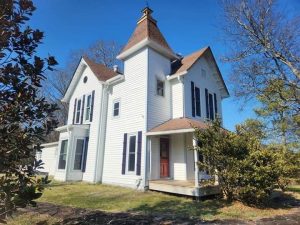
Photo courtesy of Josh Lewis – The Dade County Historical Society is hosting a tour of Josh and Leslie Lewis’ restored New England home on October 21. Located north of Trenton off Highway 11, the house was built in the 1880s.
Dade County Historical Society’s second house tour of the year will be on October 21. (See details at the end of this article). The house is familiar to many who have traveled north on Highway 11 over the years. Sitting above the highway, 15621 North U.S. 11 is a striking sight.
The house is one of the last three remaining Victorian-style homes built during the New England boom. As the Historical Society documented in their recent series in the Sentinel, the New England project of the late 1800s was a well-planned community that never quite came to be. However, remnants from that era remain, such as this house.
In 1976, the Historical Society documented six houses from this building boom, but now, we’re down to three. According to the deed office, this one was built in 1888 and advertised to sell for $1,500.
Society members are particularly excited about this tour because the current owners, the Lewis family, carefully restored the home, keeping it as close as possible to the style of the 1880s.
Josh Lewis said, “My wife and I researched what colors were used in the Victorian era. Every room is a different, historical color from the 1880s. I furnished it as close to the 1880s as possible while not denying my family modern conveniences. My wife designed the modern, brand new kitchen, but most of the house–furniture, art, curtains, the Heart Pine original floors–is historically accurate.”
The Historical Society found that the house changed hands many times, especially in the last 70 years. In the 1970s, the Jones family owned it. Lewis said, “They did a lot of work on the house. I told them that we removed seven layers of paint–yellow, blue, green–from the banister, and they said, ‘We did the same thing about 40 years ago!’”
Another quirk of the house is one particular light fixture. Lewis said, “Structurally, it’s sound; it’s not going to fall over anytime soon, but the house leans. You can’t tell anywhere except for one spot. A hanging light fixture looks like it’s hanging at an angle. I have an identical one several yards away, but it hangs completely straight. It’s because the house is segmented.”
Lewis and his wife, Leslie, purchased the home in 2018. After several years of work, they moved in with their two daughters, Kaelin and Cassidy. Lewis says, “I plan to die in that house. Our daughters love it. After moving from apartment to apartment while I was in the Air Force, it’s like a castle to them.”
Before his career in the Air Force, Lewis was a kid growing up in Birmingham, Ala. and regularly visiting his mother’s hometown of Dade County. His grandfather, Edward Wilkie, moved to the county in the 1950s and became the president of the Bank of Dade. Lewis spent every summer, most Christmases, and many weekends visiting his grandfather.
He fondly recollected, “I loved Trenton and Dade County so much as a child. Life in Birmingham was full of school and work, but when I came to Trenton, everything just kind of slowed down. My grandfather was my hero.”
Long before he began looking for a home in the area, Lewis noticed the Victorian-style home. “Every time we went up Highway 11, I would look out the window at that house. I remember it being boarded up one time, and I thought it was such a shame.”
As his retirement from the Air Force approached, Lewis began looking at houses in the tri-state area. This house was painted brown when it was listed, and at first, Lewis couldn’t believe it was the same one he had admired as a child. He began looking into the condition of the house and negotiating the price.
“The more I got involved in that house, the more I wanted it,” he said. As a history buff, Lewis enjoyed joining the Historical Society and learning more about the history behind the house and New England. “I knew the work that needed to be done, and I saw the potential.” The floors were bowed, the wiring needed to be redone, the roof needed to be replaced, and lead paint had to be removed.
For Leslie, however, the idea took some time to get used to. She grew up in Chicago, and even without a substantial restoration project, Dade County was entirely different from what she was used to. Lewis said, “Like me, she was a firefighter in the military. I told her before we moved here that it’s a small town, and that people feel you out first. Since then, she’s told me more than once that this is the best community with the nicest people. Everybody’s been so kind to her.”
Lewis offered his thoughts on the value of preserving local history. He said, “Yes, it takes money to do this. People have asked me why we’re letting people in. I’m doing it to show others that it can be done and it’s worth doing. I can tell people that the restoration work cost a lot, but decorating it historically didn’t cost that much.”
He also believes that history is tied to the present. “When people see the result of projects like this, it will give them a personal pride in the history of the county. Then, instead of tearing old buildings down, they might try to restore them. It’s about making the history tangible and relevant to today.”
The tours will be on the afternoon of October 21 from 1:30-4:30 p.m. In order to manage traffic flow, groups of ten people will be scheduled for each half hour. Therefore, attendees must sign up ahead of time by calling 706-657-7857 or stopping by the Dade County Public Library.
Because parking is limited at the house, guests will park at New England Baptist Church, and a bus will shuttle them to and from the tour.
Be sure to check out the upcoming Historical Society columns in the Sentinel for more about the history of the house.